
Which house shows marriage astrology is a common question for anyone trying to understand partnership, spouse indications, or marriage timing through a Kundli. In Vedic astrology, the seventh house is the primary starting point.
However, marriage cannot be understood through one house alone. The seventh lord, planetary influences, supporting houses, Navamsa, dashas, and transits must form a connected pattern.
Acharya Satvinder Ji approaches astrology as a guiding science for understanding planetary direction, timing, and patterns present from birth. It supports aware planning and discipline; it does not rewrite fate or replace personal responsibility.
Which house shows marriage astrology in a Kundli?
The short answer is the seventh house, also called Yuvati Bhava. Yet a dependable reading studies its lord, occupants, aspects, strength, and supporting chart factors together.
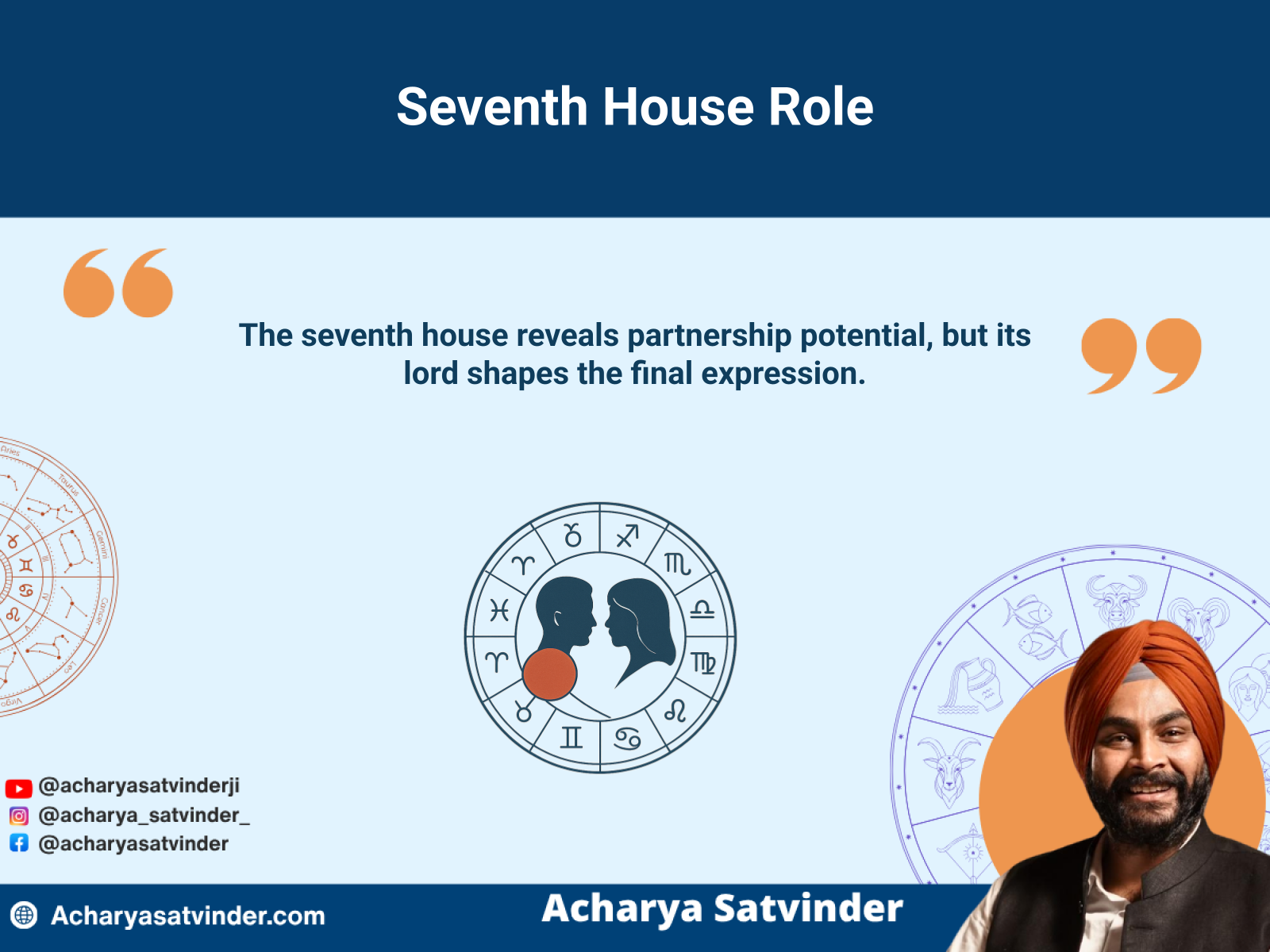
The seventh house stands opposite the ascendant and represents committed partnership, the spouse, mutual agreements, and the way a person relates to an equal. It describes more than the wedding event.
The planet ruling the seventh-house sign is known as the seventh lord. Its placement reveals where relationship responsibilities may develop and what conditions influence the experience of marriage.
- The sign: It shows the basic style through which partnership is approached.
- Planets in the house: They influence expectations, attraction, duties, and relationship behaviour.
- Planetary aspects: Supportive or difficult influences modify the house without independently deciding the outcome.
- The seventh lord: Its dignity, house placement, conjunctions, and aspects show how effectively marriage potential can operate.
An empty seventh house does not mean that marriage is absent. Its ruling planet and the influences reaching the house remain active and must still be examined carefully.
The seventh house opens the marriage enquiry, but the seventh lord carries its promise into the rest of the chart.
Why the Seventh House Is Primary
The seventh house represents the movement from individual identity toward committed partnership. It reveals how cooperation, adjustment, expectations, and shared responsibilities may be experienced within marriage.
Because it is directly opposite the first house, it also reflects the balance between personal needs and the partner’s presence. A strong axis can support mutual recognition without requiring both people to behave identically.
Strength does not simply mean that benefic planets occupy the seventh house. A well-placed lord, constructive aspects, suitable dashas, and agreement between the birth chart and Navamsa can be equally important.
Likewise, a challenging placement is not an automatic denial. It may indicate maturity through relationships, a need for patience, unusual circumstances, or lessons concerning communication and responsibility.
Supporting Houses That Complete Marriage Analysis
Marriage creates a family structure, emotional bond, private life, and shared future. Several houses therefore support the seventh house by describing different parts of the marital experience.
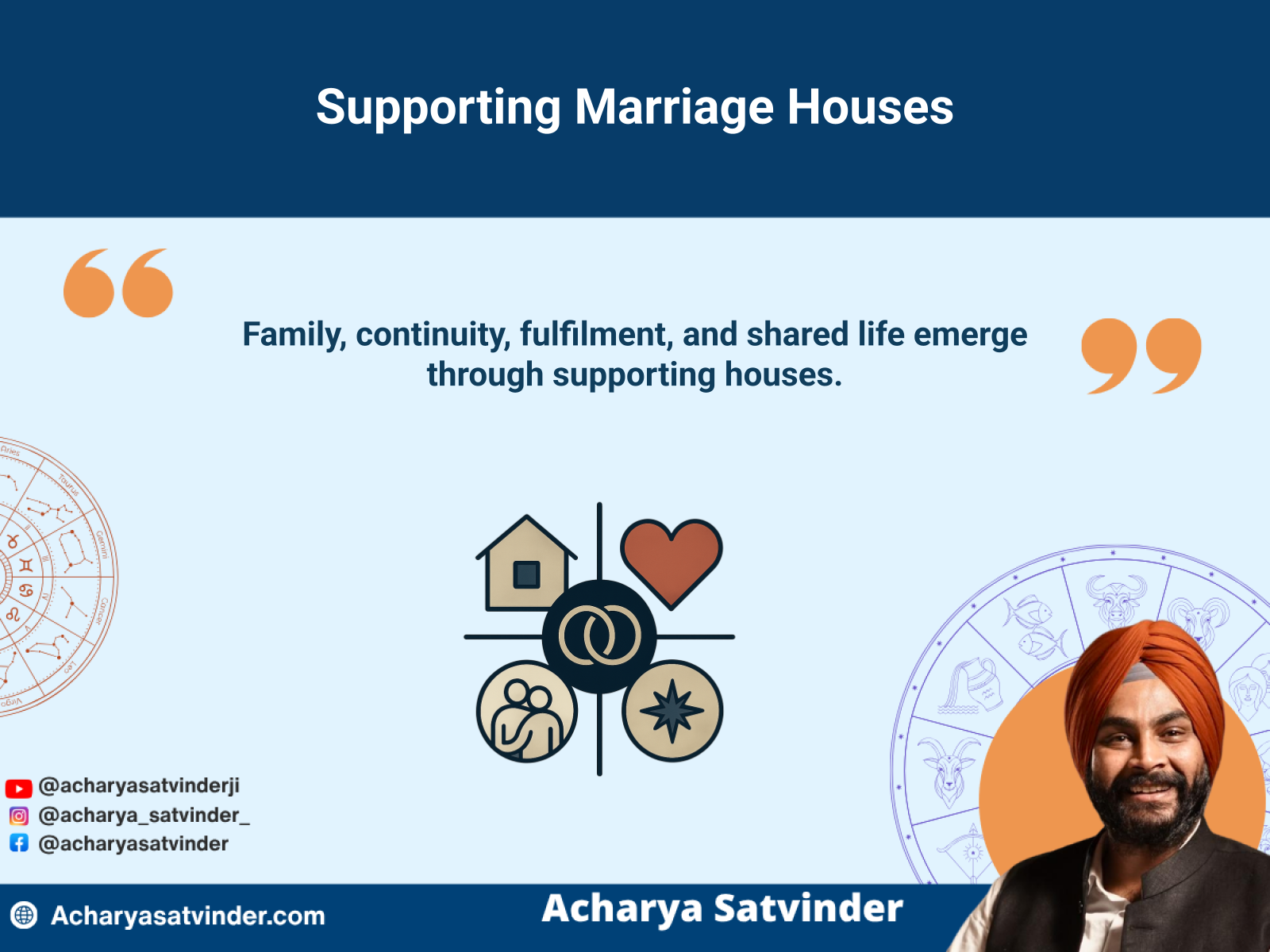
The main supporting houses
- Second house: Family continuity, shared values, speech, accumulated resources, and the household formed after marriage.
- Fifth house: Romance, affection, emotional expression, and the possibility of a relationship developing before formal commitment.
- Eighth house: Intimacy, shared vulnerability, joint responsibilities, transformation, and the deeper adjustments required after marriage.
- Eleventh house: Fulfilment, social support, gains through partnership, and the achievement of the desire for a recognised union.
No supporting house replaces the seventh house. Instead, they clarify whether partnership can grow into family life, emotional closeness, shared responsibility, and sustained fulfilment.
Subsequent unions require a separate and sensitive assessment rather than repeating the first-marriage formula. Read more about second-marriage indications in a Kundli.
Marriage is a seventh-house matter, but sustaining it requires support from the family, intimacy, and fulfilment houses.
Planets That Influence Marriage
Planets shape how the marriage houses express their potential. None should be labelled favourable or unfavourable without considering rulership, dignity, aspects, conjunctions, and the complete horoscope.
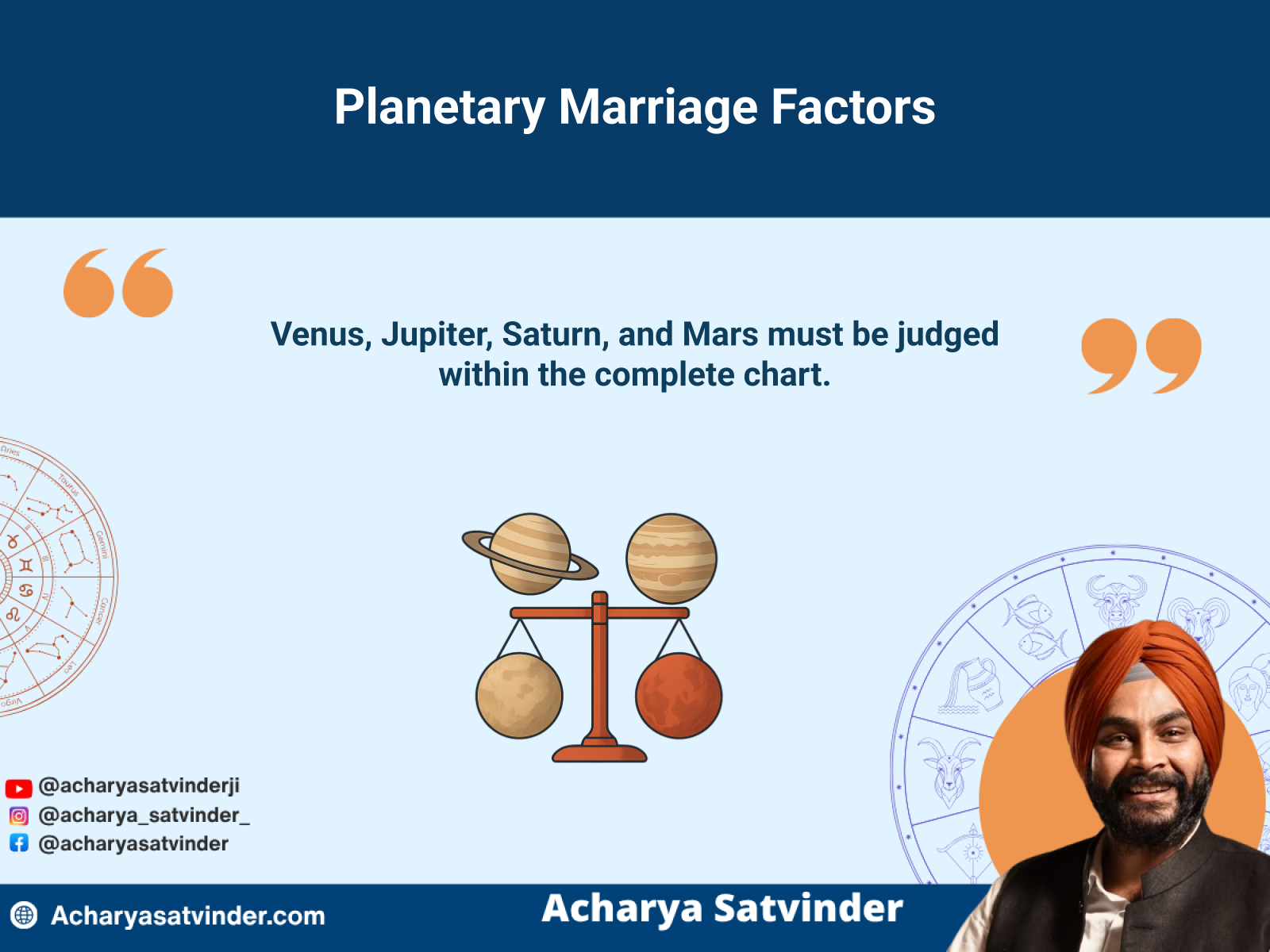
- Venus: The natural significator of attraction, harmony, affection, refinement, and the capacity to enjoy companionship.
- Jupiter: Wisdom, guidance, ethics, growth, and support within commitment; some classical methods also apply it as a spouse indicator in particular contexts.
- Saturn: Patience, duty, maturity, boundaries, and sometimes delay when commitment requires greater preparation.
- Mars: Initiative, physical attraction, courage, impatience, and conflict style when its energy lacks constructive direction.
- Rahu and Ketu: Unconventional circumstances, intense attraction, uncertainty, detachment, or experiences that do not follow familiar expectations.
The condition of the planet matters more than a simple label. Saturn can support loyalty, Mars can protect commitment, and Venus can become complicated when weakened or connected with difficult houses.
A planet does not decide marriage alone; it delivers results through its complete role in the individual chart.
Navamsa, Dashas and Marriage Timing
The birth chart shows the main promise, while the Navamsa refines the strength and development of marriage indications. Dashas and transits help identify when those indications may become active.
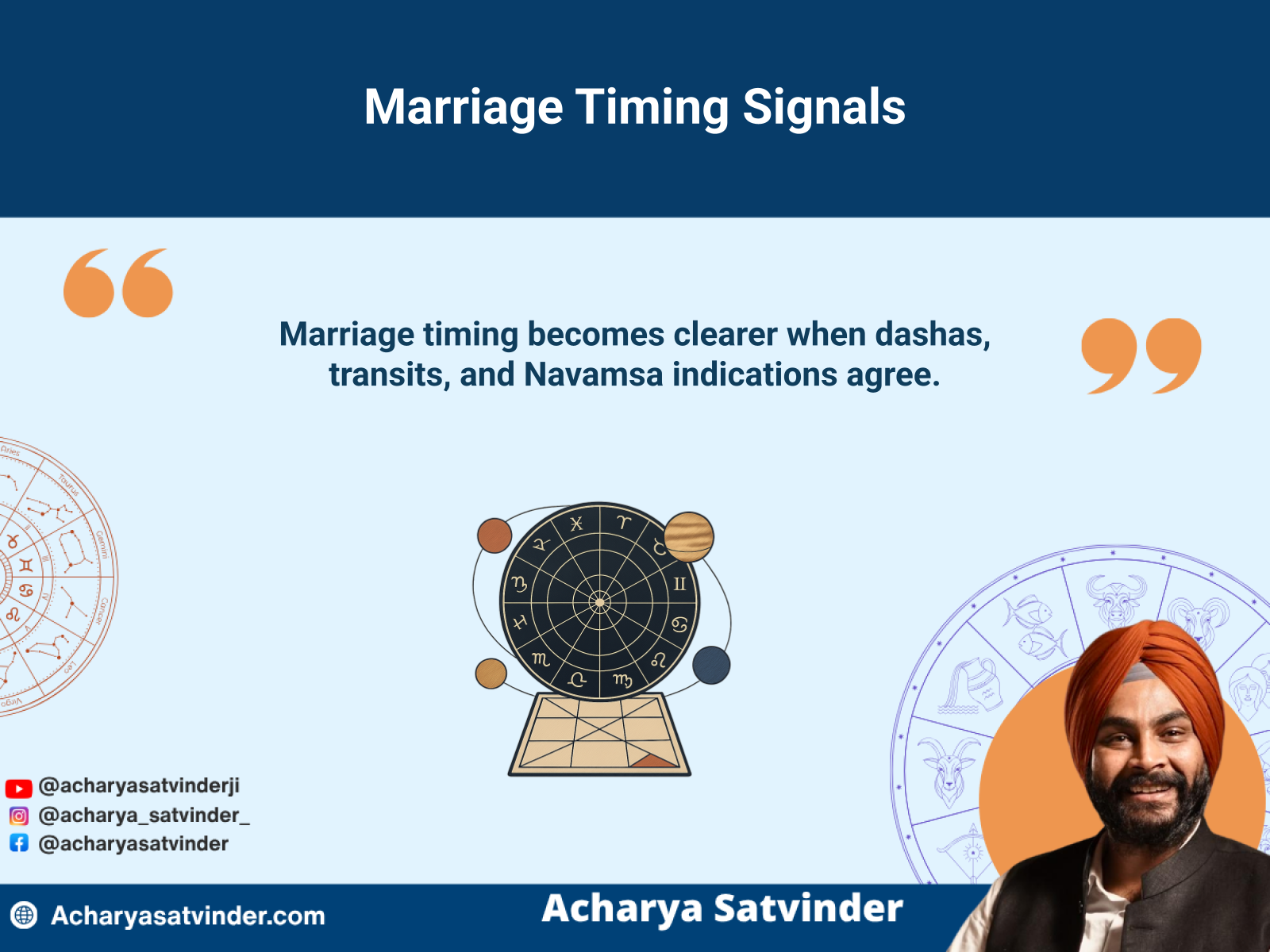
The Navamsa, or D9 chart, should confirm and deepen the birth-chart reading rather than replace it. Its ascendant, seventh house, seventh lord, Venus, and connected planets deserve careful examination.
A complete answer to which house shows marriage astrology must separate marriage potential from marriage timing. A supportive combination may remain quiet until an appropriate planetary period activates it.
- The Mahadasha or Antardasha of the seventh lord may activate partnership matters.
- A planet occupying or strongly influencing the seventh house may become relevant during its period.
- Periods involving Venus or connected second and eleventh lords can support formalisation.
- Jupiter and Saturn transits may act as triggers when the natal promise and dasha already support marriage.
Generic age-based statements cannot replace individual timing analysis. A detailed explanation of how astrology predicts marriage timing shows why several indicators must agree.
Dashas activate the promise, while transits often create the conditions through which it becomes visible.
How an Astrologer Reads Marriage Step by Step
Astrological judgment becomes more dependable when the reader follows a fixed sequence instead of chasing dramatic combinations. A practical answer to which house shows marriage astrology moves from natal promise to confirmation and timing.
- Confirm the birth time, date, and place before calculating the ascendant and divisional chart.
- Assess the ascendant and its lord to understand the person’s temperament and relationship readiness.
- Read the seventh house, its sign, occupants, aspects, and ruling planet.
- Examine the second, fifth, eighth, and eleventh houses for supporting relationship themes.
- Compare the birth-chart indications with the Navamsa instead of reading D9 independently.
- Study relevant dashas and transits only after establishing the underlying marriage potential.
Consider a hypothetical chart where Saturn influences the seventh house, but the seventh lord is strong and supported in Navamsa. This could indicate a later, serious commitment rather than denial.
If a suitable dasha simultaneously connects the second, seventh, and eleventh houses, formal partnership may become more active. Unusual combinations may also produce sudden or unexpected marriage patterns.
Good interpretation begins with the chart’s promise and ends with timing, never the other way around.
Common Mistakes to Avoid
When people ask which house shows marriage astrology, the biggest risk is accepting a one-line prediction. A house becomes meaningful through ownership, dignity, aspects, conjunctions, divisional confirmation, and active planetary periods.
- Predicting marriage or denial from one planet in the seventh house.
- Assuming Saturn always denies marriage or Mars always causes separation.
- Ignoring the seventh lord because the seventh house appears empty.
- Using the Navamsa without first establishing the birth-chart promise.
- Giving an exact date from a general sign, transit, or online chart description.
Astrology should support thoughtful decisions, not replace compatibility, communication, consent, or practical understanding. This distinction is central when considering whether astrology is necessary for marriage.
What If Marriage Appears Delayed?
Delay requires a complete diagnosis because different combinations create different forms of waiting. Some charts show preparation, limited opportunities, family responsibilities, emotional hesitation, or a later period of stronger commitment.
Saturn’s involvement may bring caution and maturity, while a weakened seventh lord can create uncertainty or repeated obstacles. These influences still require confirmation from Navamsa and planetary periods.
Understanding the specific reasons for delay in marriage is more useful than fearing a single placement. Delay and denial are not interchangeable conclusions.
Where spiritually appropriate, Naam Simran, Daan, Seva, respectful communication, and disciplined living may help a person respond consciously. These practices support steadiness and responsibility; they do not change the promised life path.
A delayed period can call for preparation and clarity, not fear or a permanent negative conclusion.
FAQs
Which is the main house for marriage in astrology?
The seventh house is the primary house for marriage, spouse, and committed partnership. Its lord, occupants, aspects, and strength must be judged with the complete chart.
Which other houses support marriage analysis?
The second, fifth, eighth, and eleventh houses describe family formation, romance, intimacy, and fulfilment. They support the seventh house but do not replace it.
Which planet is most important for marriage?
Venus is the natural significator of attraction, harmony, and companionship. The seventh lord and other connected planets remain equally important in an individual Kundli.
Does Saturn in the seventh house always delay marriage?
Saturn can indicate caution, responsibility, maturity, or delay, but it does not automatically deny marriage. Its rulership, strength, aspects, Navamsa position, and dasha must be assessed.
Final Words
The clearest answer to which house shows marriage astrology is the seventh house, but the full judgment belongs to the entire chart. Its lord, supporting houses, planets, Navamsa, dashas, and transits must tell a consistent story.
Acharya Satvinder Ji’s approach uses these indications to understand direction and timing with awareness. Responsible astrology guides planning, patience, and disciplined choices without reducing marriage to one placement or fixed prediction.

Acharya Satvinder is a spiritual guide and life mentor who blends Sikh astrology, philosophy, and coaching to help you find clarity, balance, and purpose. He offers personalized guidance for career, relationships, stress, and spiritual growth — empowering you to unlock your true potential.
With over 20 years of experience, Acharya Satvinder is regarded as one of the most respected and Best astrologers in India for his ethical and disciplined approach. Each year, he guides more than 10,000 individuals through his teachings and consultations, including extensive one-to-one sessions with followers across India, Canada, USA and the global NRI community. His guidance explains discipline, conscious decision-making, seva, and inner clarity as the foundation of meaningful growth.



Pingback: Punjabi astrologer in Amritsar for marriage kundli matching
Pingback: Is astrology important for marriage? Practical Vedic Guide
Pingback: Vedic astrology houses and their lords: Kundli Guide
Pingback: What is karmic marriage astrology? A Vedic Guide
Pingback: Best marriage astrologer online: Clear Kundli Guidance
Pingback: Marriage astrology for boy and girl: Complete Kundli Guide
Pingback: How to know marriage astrology: Complete Kundli Guide