How to know marriage astrology begins with understanding that marriage is never judged from one planet or one house alone. A responsible reading connects several chart factors before reaching any conclusion.
Acharya Satvinder Ji approaches astrology as a guiding science for understanding planetary direction, timing and patterns shown from birth. This awareness helps a person plan with greater discipline rather than expecting astrology to rewrite fate.
A Kundli may indicate relationship tendencies, supportive periods and possible challenges. Character, consent, emotional maturity, family circumstances and honest communication remain essential when making a marriage decision.
How to know marriage astrology through a complete Kundli
A reliable reading starts with the birth chart as a connected system. The seventh house is central, but its lord, strength, aspects and supporting charts decide how that promise develops.
The seventh house represents committed partnerships, the spouse and the way a person handles equality within a relationship. A detailed guide to the house connected with marriage can help clarify this foundation.
The seventh house opens the marriage question; the full chart decides its meaning.
Begin with accurate birth details
The Kundli should be calculated from the correct birth date, exact birth time and birthplace. Even a small time difference can affect the ascendant, houses and divisional charts.
- Birth date establishes the planetary positions.
- Birth time determines the ascendant and house structure.
- Birthplace supports accurate local chart calculation.
If the recorded time is uncertain, marriage timing and spouse-related conclusions should be treated cautiously. Events from the person’s past may sometimes help an experienced astrologer assess whether correction is needed.
This connected reading is the practical answer to “How to know marriage astrology” because it replaces isolated assumptions with a structured assessment of promise, strength and timing.
The main chart factors for marriage
Marriage analysis combines houses, planets, lords and divisional charts. Each factor contributes a different layer, so agreement between several indicators carries more weight than one attractive or difficult placement.
The seventh house and seventh lord
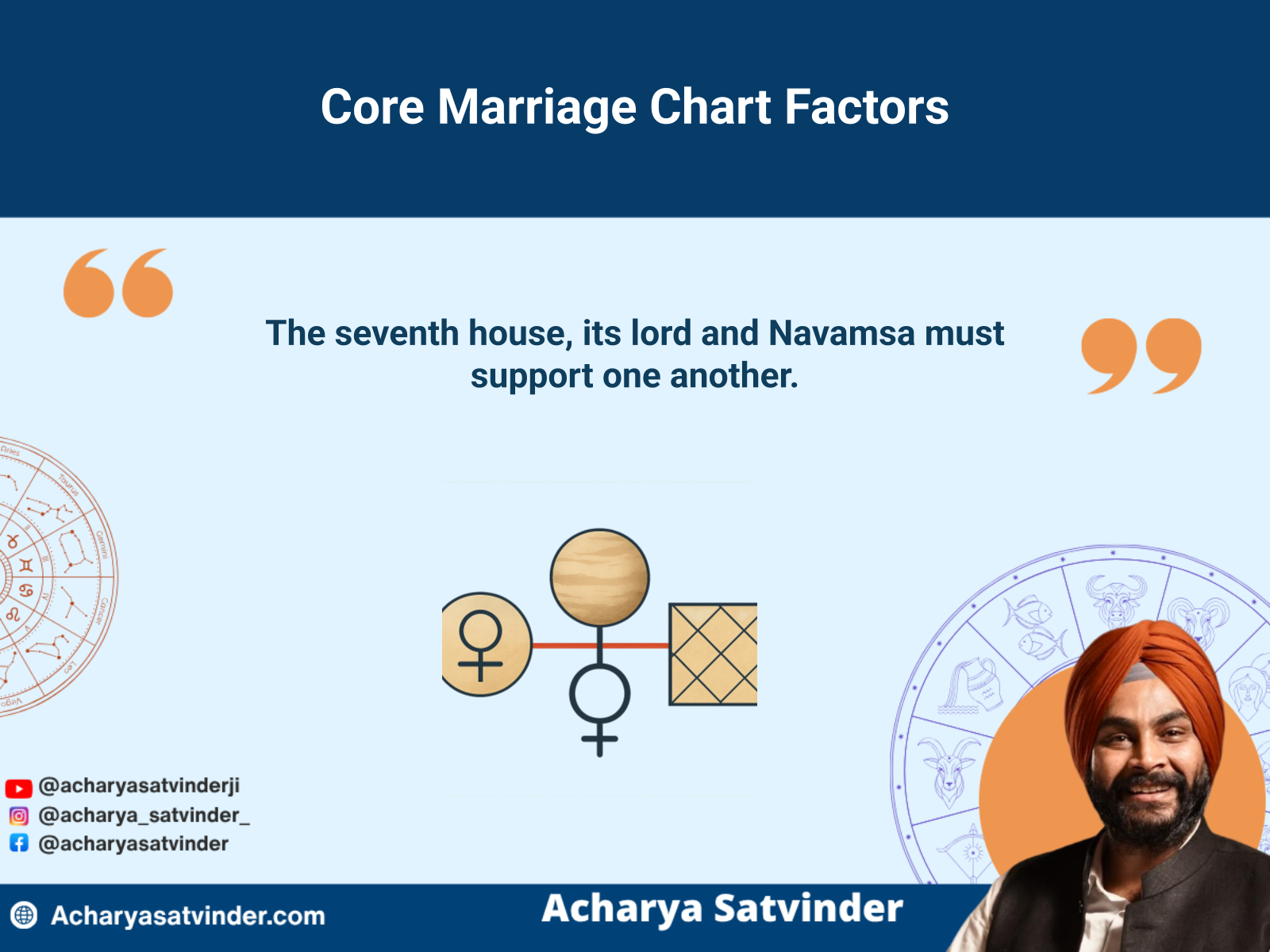
The sign occupying the seventh house shows the general environment of partnership. Its ruling planet, called the seventh lord, reveals where relationship responsibilities develop and how easily the house can express its potential.
- The first house shows the individual entering the relationship.
- The second house relates to family continuity and shared values.
- The fifth house contributes affection, attraction and emotional expression.
- The seventh house governs committed partnership.
- The eighth house concerns intimacy, trust and shared responsibilities.
- The eleventh house relates to fulfilment and long-term hopes.
Venus, Jupiter and the Moon
Venus helps describe affection, attraction and the capacity to create harmony. Jupiter may show wisdom, growth and ethical understanding, while the Moon reveals emotional needs and instinctive responses within close relationships.
These planets must be judged through their signs, houses, dignity, lordships, conjunctions and aspects. The practical importance of astrology before marriage lies in connecting these tendencies with real behaviour and shared values.
The Navamsa chart
The Navamsa, also called the D9 chart, is used to deepen the marriage assessment. It can confirm planetary strength, relationship maturity and the way birth-chart indications may unfold after commitment.
A strong-looking placement can give mixed results when its lord or supporting chart is weak.
The D9 should not replace the main birth chart. A sound interpretation compares the seventh house, seventh lord, relationship significators and relevant patterns in both charts before discussing marriage potential.
How marriage timing is judged
Marriage timing is examined through planetary periods and current transits after the underlying potential is understood. Timing techniques activate a chart promise; they do not create a promise that the Kundli does not support.
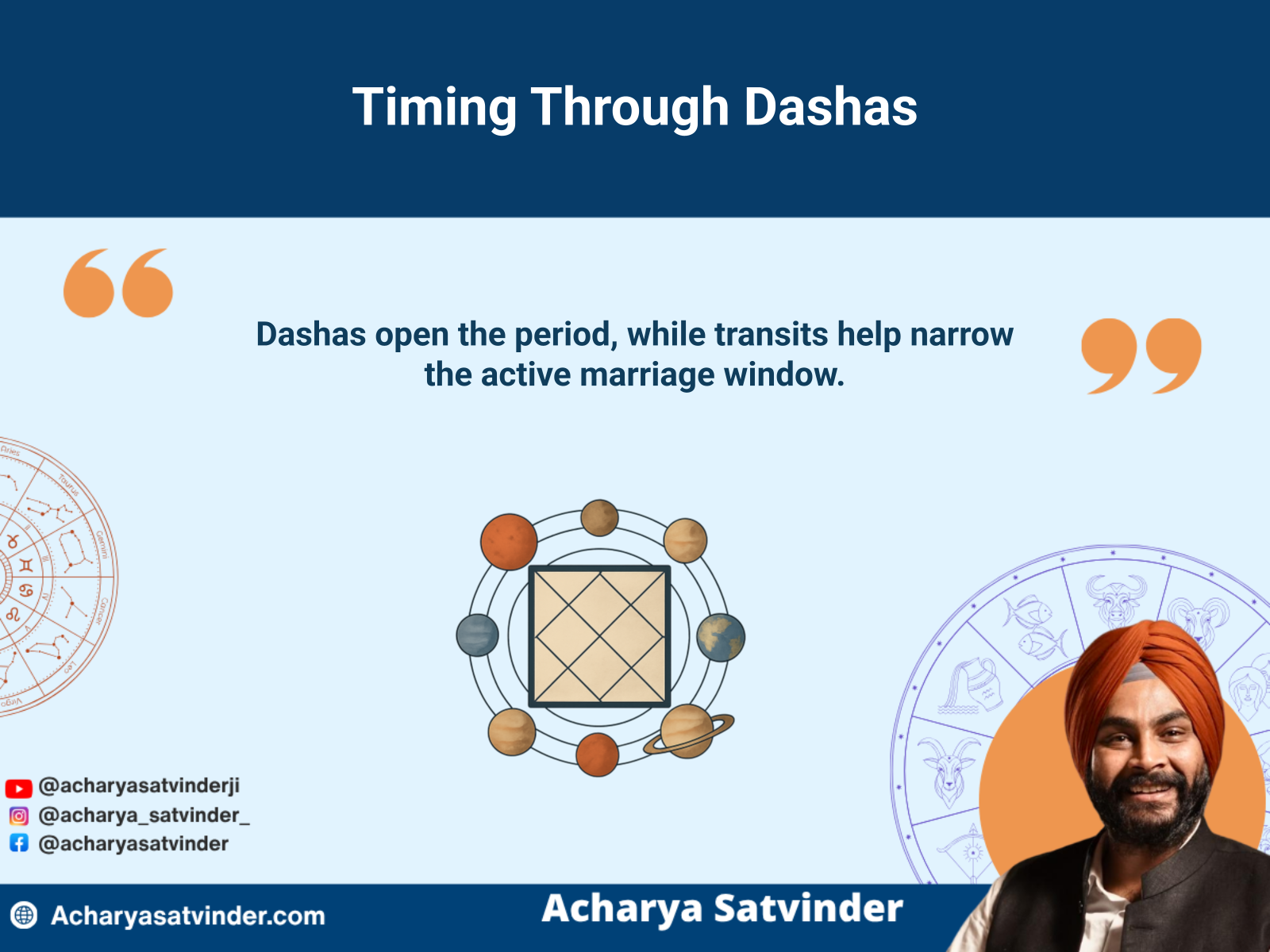
Mahadasha and Antardasha periods connected with the seventh lord, planets occupying or influencing the seventh house, or important relationship significators may bring marriage matters into greater focus.
Jupiter and Saturn transits are then studied alongside the active dasha. Their contact with the ascendant, seventh house, relevant lords or Navamsa factors may help narrow a broader period.
Dashas show when a promise becomes active; transits refine rather than create that promise.
For example, imagine a chart with supportive marriage potential but no active relationship-related period. Proposals may appear, yet commitment could develop later when both the dasha and transits support the same theme.
When people ask “How to know marriage astrology”, they often expect an exact wedding date. A more responsible answer identifies stronger windows while allowing for personal choices, family discussions and changing circumstances.
Marriage potential and compatibility are different
An individual Kundli shows personal marriage patterns, whereas matching compares how two people may function together. Both charts require separate examination before their interaction can be understood responsibly.
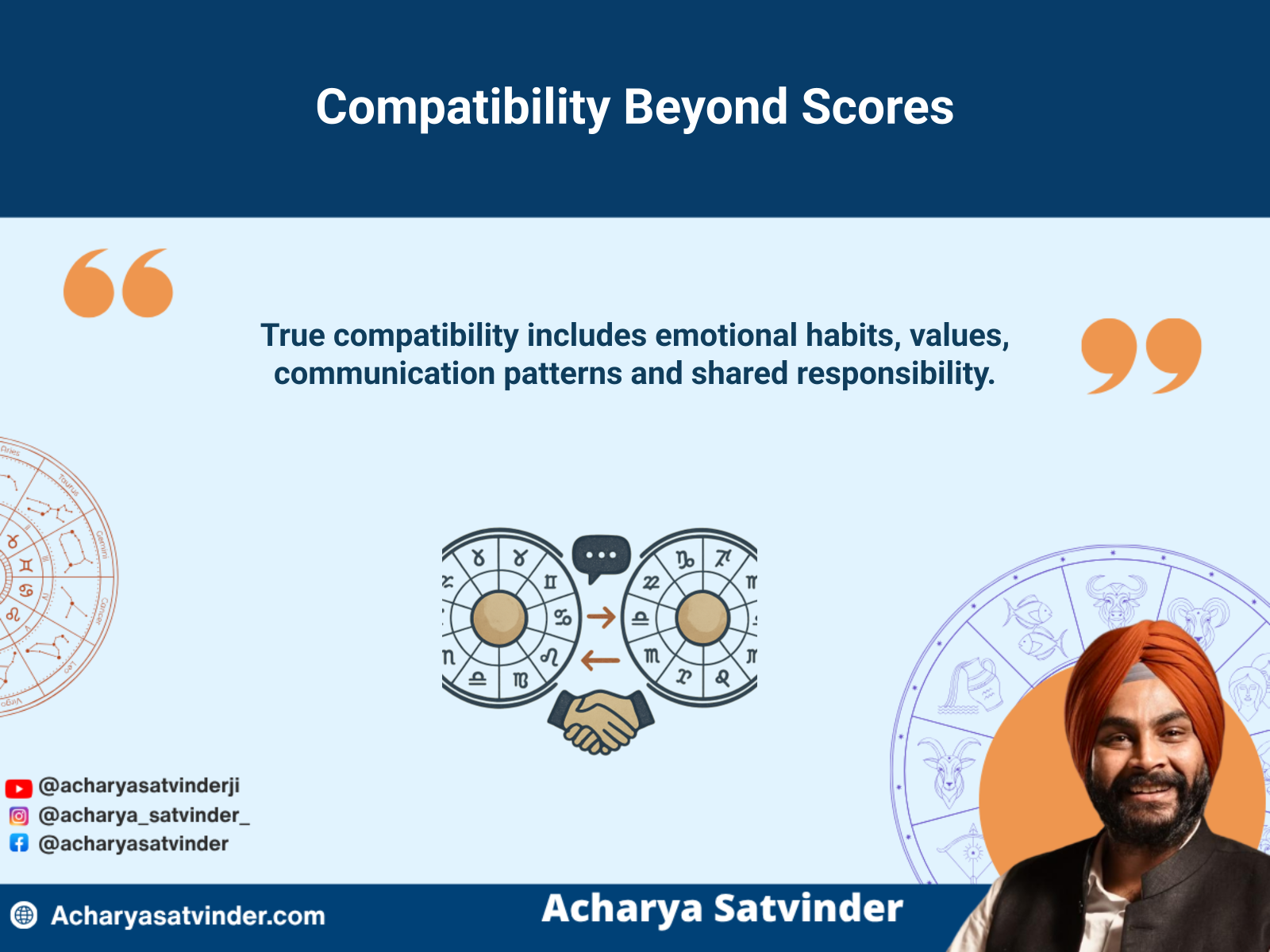
Guna Milan may offer useful information about traditional compatibility factors, but a score cannot represent the complete relationship. Planetary strength, emotional habits, communication and long-term expectations also deserve attention.
A complete marriage astrology assessment for both partners examines the seventh houses, relevant lords, Moon patterns, Venus, Jupiter, Mars-related conditions, Navamsa support and the running planetary periods.
A matching score cannot measure consent, emotional safety or everyday communication.
Compatibility should therefore support a thoughtful conversation rather than deliver a mechanical approval or rejection. Differences may be manageable when both people communicate well, while apparently favourable charts cannot compensate for dishonesty or disrespect.
What astrology may reveal about spouse and married life
The chart may describe broad tendencies connected with a partner and the experience of commitment. These observations indicate patterns rather than providing a fixed portrait of one guaranteed person.
- Likely temperament and communication style.
- Approach to affection, responsibility and personal space.
- Possible family or cultural adjustments.
- Periods of greater relationship activity.
- Areas requiring patience, boundaries or mature discussion.
Some charts contain intense connections that people interpret as spiritually significant. Understanding karmic patterns associated with marriage requires the complete chart and should never be reduced to attraction, hardship or one unusual conjunction.
Astrology can also highlight how the individual responds within marriage. This is often more useful than focusing only on a future spouse, because self-awareness supports better choices and healthier communication.
Common mistakes when reading marriage astrology
Quick interpretations often create unnecessary fear or unrealistic confidence. Most errors arise when a person treats one label, score or planetary placement as the final verdict.
- Judging only the seventh house: Its lord, aspects, strength and supporting houses may substantially change the interpretation.
- Using the Navamsa alone: The D9 confirms and develops themes but must remain connected with the main birth chart.
- Assuming one planet always delays marriage: Saturn, Mars, Rahu or any other planet behaves according to placement, lordship, strength and association.
- Ignoring timing: Supportive potential may remain quiet until an appropriate dasha and transit pattern becomes active.
- Treating matching as a substitute for conversation: Charts cannot verify integrity, consent, emotional safety or practical readiness.
Good astrology reduces confusion; it should not create fear, dependency or rushed decisions.
Automated reports can organise chart data, but they may overlook context and exceptions. A responsible online marriage astrology check should be treated as a starting point rather than a final judgement.
A practical step-by-step method
A step-by-step answer to “How to know marriage astrology” begins with chart accuracy and ends with responsible interpretation. Following a fixed order helps prevent contradictory or fear-based conclusions.
- Verify birth information. Confirm the date, time and birthplace used to calculate the Kundli.
- Read the ascendant. Understand the person’s nature, priorities and approach to partnership.
- Assess the seventh house. Examine its sign, occupants, aspects and overall condition.
- Study the seventh lord. Check its house, sign, strength, conjunctions and relationship with other lords.
- Review supporting factors. Consider Venus, Jupiter, the Moon and the houses linked with family, affection, intimacy and fulfilment.
- Compare the Navamsa. Look for confirmation, maturity and consistency between the D1 and D9 charts.
- Apply dashas and transits. Identify periods when marriage-related planets and houses become active together.
- Add practical context. Consider readiness, values, communication, family realities and personal choice.
No single step should be used independently. The strength of a conclusion depends on repeated indications across the chart and agreement between marriage potential, planetary timing and lived circumstances.
How to use the guidance responsibly
Astrological guidance is most useful when it leads to awareness and disciplined action. It should help people ask better questions without removing personal responsibility from an important life decision.
Discuss values, finances, family boundaries, health expectations, career plans and future responsibilities openly. If serious conflict, coercion or emotional harm is present, practical support matters more than a favourable chart interpretation.
Naam Simran, Daan, Seva and disciplined living may support patience and inner steadiness when approached consciously. They are spiritual responses to life, not methods for replacing the path shown from birth.
FAQs
Can astrology tell the exact date of marriage?
Astrology may identify stronger marriage periods through dashas and transits. An exact date should not be promised without considering personal choices and practical circumstances.
Which house is most important for marriage?
The seventh house is the primary house of committed partnership and the spouse. Its lord, aspects, strength and supporting chart factors must also be examined.
Can an online marriage astrology report be reliable?
An online report can calculate basic chart factors when the birth details are accurate. Its conclusions still require context and careful interpretation by a knowledgeable astrologer.
Does a low Guna score mean the marriage should be rejected?
A low score does not automatically decide the outcome of a relationship. Both complete charts, communication, values, maturity and practical compatibility should also be considered.
Final Words
The real value of How to know marriage astrology lies in understanding the complete pattern rather than searching for a quick prediction. The seventh house is only the beginning of that careful process.
Acharya Satvinder Ji considers house lords, planetary strength, aspects, Navamsa, dashas and transits together. This balanced approach offers direction while preserving the importance of consent, character, communication and informed personal judgement.

Acharya Satvinder is a spiritual guide and life mentor who blends Sikh astrology, philosophy, and coaching to help you find clarity, balance, and purpose. He offers personalized guidance for career, relationships, stress, and spiritual growth — empowering you to unlock your true potential.
With over 20 years of experience, Acharya Satvinder is regarded as one of the most respected and Best astrologers in India for his ethical and disciplined approach. Each year, he guides more than 10,000 individuals through his teachings and consultations, including extensive one-to-one sessions with followers across India, Canada, USA and the global NRI community. His guidance explains discipline, conscious decision-making, seva, and inner clarity as the foundation of meaningful growth.