Marriage astrology for boy and girl compares two birth charts to understand compatibility, commitment patterns, marriage timing and areas that may require mature adjustment. It is most useful when it creates clarity rather than fear.
A proper Vedic assessment does not approve or reject a relationship from one score. It studies both individual kundlis, the shared pattern between them and the real-life readiness of the prospective couple.
Acharya Satvinder Ji approaches astrology as a guiding science for understanding planetary direction, timing and patterns shown from birth. Readers asking how important astrology is for marriage should also consider character, consent and practical judgment.
Marriage astrology for boy and girl: What a complete reading examines
A dependable reading starts with the marriage promise in each individual chart. It then compares compatibility, supporting houses, planetary strength, Navamsa and active timing before drawing a balanced conclusion.
The birth chart and seventh house
The seventh house is the primary area of committed partnership, but its sign alone is not enough. Its lord, occupants, aspects and connections reveal how relationship responsibilities may operate.
An empty seventh house does not mean marriage is absent, while a difficult placement does not independently deny it. The guide to the house that shows marriage explains this complete-chart approach.
Factors assessed together
The wider kundli provides the context needed to understand whether different indications support, balance or challenge one another. A responsible assessment may include:
- The ascendant and its lord for temperament and personal direction
- The seventh house and seventh lord for partnership patterns
- The second house for family continuity, speech and shared values
- The fifth house for affection, romance and emotional expression
- The eighth house for trust, intimacy and shared responsibilities
- The eleventh house for fulfilment and formalisation of commitment
- The Moon, Venus, Jupiter, Mars, Saturn, Rahu and Ketu in context
- The Navamsa for deeper confirmation of marital development
No single factor receives all the credit or blame. House ownership, planetary dignity, conjunctions, aspects and repeated indications across chart layers must support the final interpretation.
The seventh house begins the marriage enquiry, but the complete kundli reveals how partnership may actually function.
How kundli matching compares two charts
Kundli matching examines how two individual relationship patterns interact after commitment. Traditional calculations provide useful structure, while full-chart comparison reveals the strengths and pressures hidden behind the total.
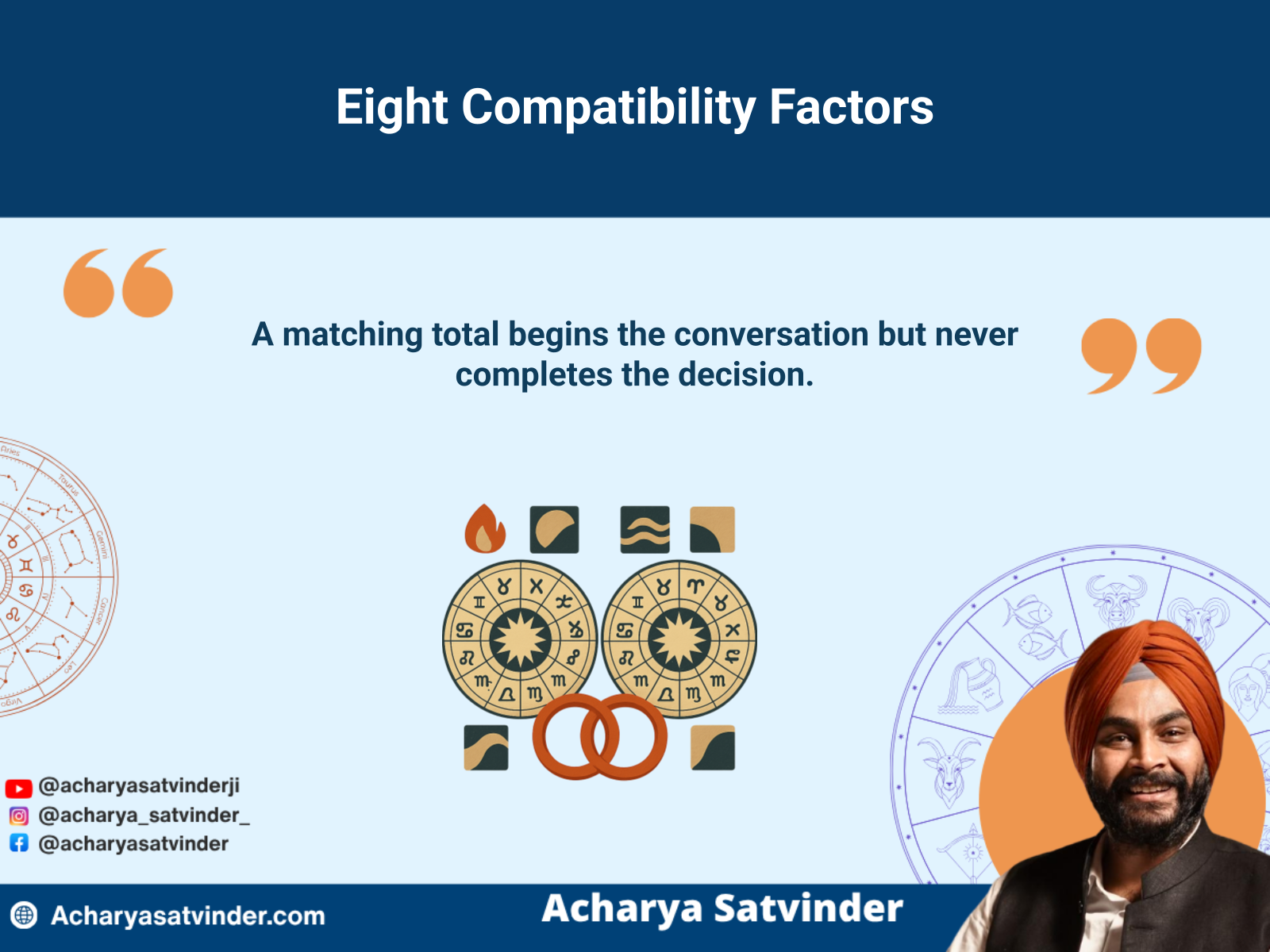
Ashtakoota matching uses the Moon signs and birth nakshatras of both people to compare eight compatibility areas. These factors create a traditional total of thirty-six points.
- Varna: approach to values and duties
- Vashya: mutual influence and adjustment
- Tara: traditional wellbeing and supportive flow
- Yoni: instinctive and physical compatibility
- Graha Maitri: mental rapport through Moon-sign lords
- Gana: temperament and behavioural style
- Bhakoot: emotional and family-development patterns
- Nadi: traditional constitutional compatibility
The total can highlight areas that deserve closer attention, but it cannot describe every emotional habit or future circumstance. Even an apparently favourable result needs interpretation within both complete charts.
A responsible online marriage astrology check beyond scores should clarify individual factors, possible balancing conditions and the limitations created by uncertain birth information.
A matching score is a doorway into analysis, not a final judgment about two lives.
Why the matching score is not enough
A high total may appear reassuring, while a low total may create immediate anxiety. Neither reaction is complete until the astrologer studies where the points were gained or lost.
The wider comparison must distinguish a traditional calculation from the deeper relationship promise. Important considerations include:
- Nadi and Bhakoot results, including applicable balancing conditions
- Manglik status and the complete role of Mars in both charts
- Individual seventh houses and their ruling planets
- Emotional patterns shown through the Moon and connected influences
- Navamsa support for commitment and marital development
- Current dashas affecting readiness, pressure or formalisation
A responsible marriage astrology for boy and girl assessment also examines communication, family adjustment, attraction, financial attitudes and conflict responses. These realities cannot be compressed into one numerical result.
Imagine a hypothetical couple with a strong total but opposite expectations about relocation and family boundaries. Their score cannot resolve those issues; the charts and direct conversations must show whether adjustment is realistic.
Intense attraction should not automatically be treated as lasting suitability. Understanding karmic marriage patterns and responsibilities may add context, but emotional intensity never replaces respect, safety or mature judgment.
A favourable score cannot create maturity, and a lower score does not independently reject a relationship.
Marriage timing, readiness and life patterns
Compatibility and timing answer different questions, although they influence the same marriage journey. One describes how two people may function together, while the other identifies periods when commitment becomes more active.
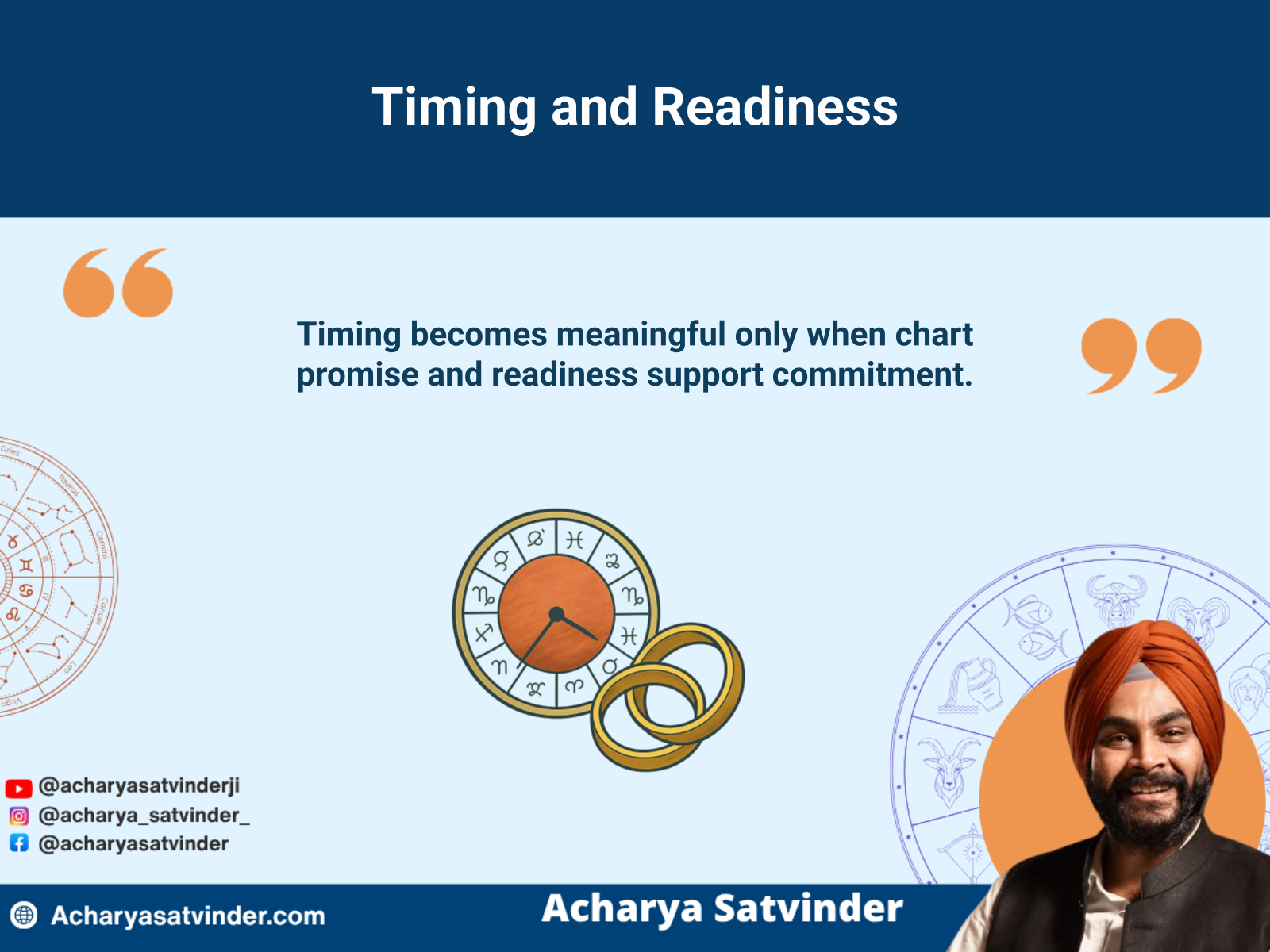
The birth chart first establishes whether marriage-related possibilities are supported. Dashas and transits are then studied to understand when proposals, decisions, delays or adjustments may become more prominent.
- Periods connected with the seventh house or seventh lord
- Periods involving planets placed in or aspecting marriage houses
- Navamsa confirmation of the natal relationship promise
- Major transits that activate already-supported chart factors
A transit cannot produce a result that has no foundation in the natal pattern. Similarly, a supportive period does not mean someone should accept the first proposal without observation and discussion.
Timing opens a window of possibility; readiness determines how consciously that window is used.
Saturn, Mars, Rahu or another planet should never be blamed automatically for delay. Their house ownership, strength, aspects, Navamsa position and active period must tell a connected story.
Practical questions couples should discuss
Astrology becomes more useful when it leads to honest and specific conversations. Both individuals should compare practical expectations before engagement rather than waiting for disagreements to reveal them later.
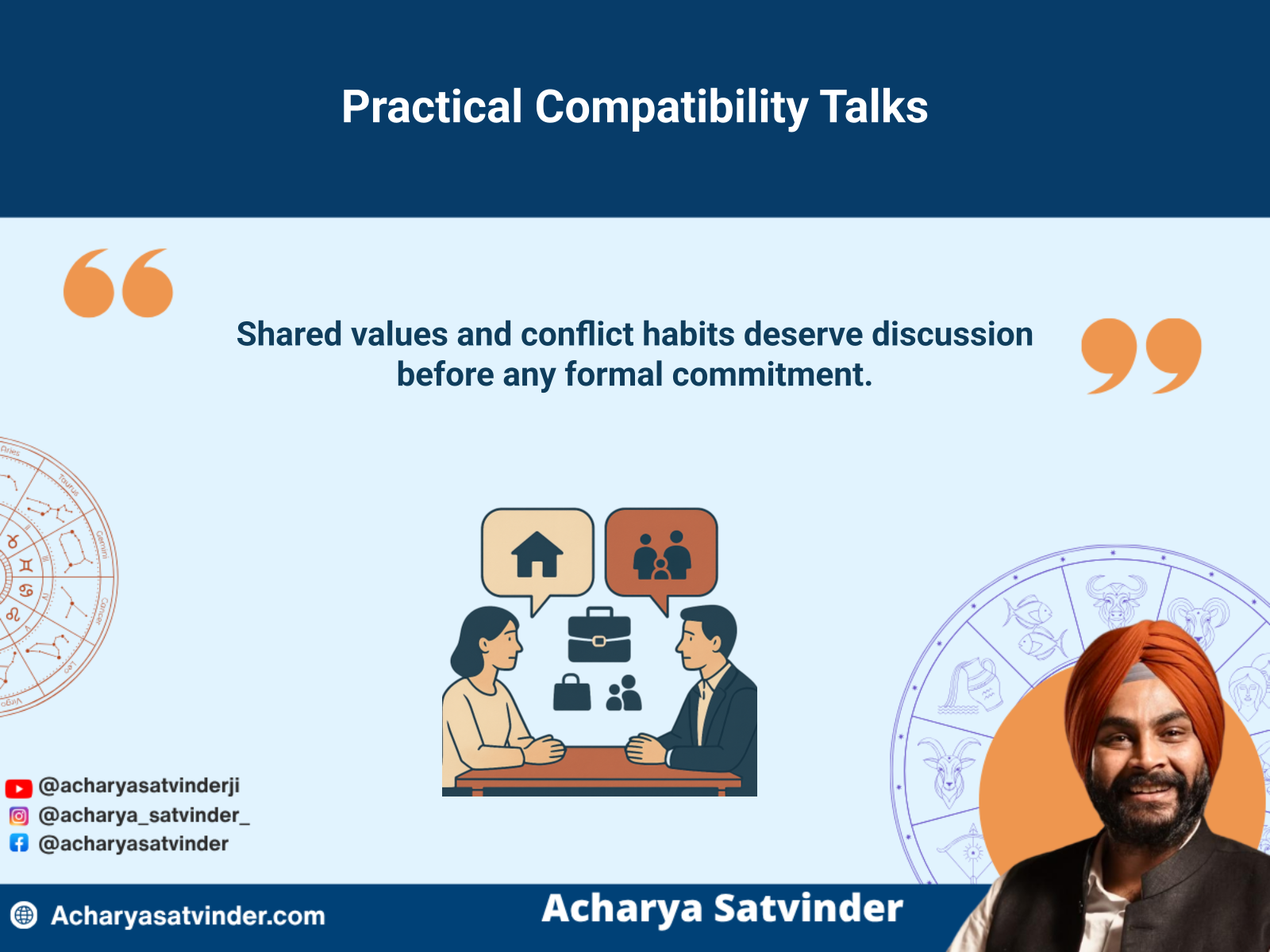
- Where will the couple live, and is relocation expected?
- How will careers, study and household responsibilities be balanced?
- What are their expectations regarding money, saving and debt?
- How involved will extended family be in major decisions?
- Do both people want children, and how do they view caregiving?
- How does each person communicate during conflict or uncertainty?
- Are faith, personal space and social expectations compatible?
These questions are not separate from a meaningful compatibility assessment. They show how planetary tendencies may appear through daily choices, boundaries and shared responsibilities.
The strongest match combines chart awareness with honest conversation, observation and freely given consent.
Repeated dishonesty, coercion, humiliation or unsafe behaviour should never be excused through astrology. Practical support, personal boundaries and safety remain more important than any favourable calculation.
Birth details and a responsible consultation
Accurate input improves the reliability of chart calculation and interpretation. Both individuals should provide recorded information honestly and disclose any uncertainty before the reading begins.
- Date of birth establishes planetary positions for the day.
- Exact birth time determines the ascendant, houses and divisional charts.
- Birthplace provides the geographical reference required for calculation.
If a birth time is unknown, an astrologer should explain which observations remain usable and which require caution. Entering an assumed time can create misleading house, Navamsa and timing conclusions.
When arranging marriage astrology for boy and girl, prepare a short list of genuine concerns rather than seeking simple approval. A guide to choosing a responsible online marriage astrologer can help families evaluate the reading method.
Acharya Satvinder Ji studies complete charts, planetary strength, house lords, aspects, dashas and timing without claiming to rewrite fate. Naam Simran, Daan, Seva and disciplined living may support conscious conduct, not alter the promised path.
FAQs
What birth details are needed for marriage astrology?
Both people should provide their dates, exact birth times and birthplaces. Any uncertainty about the recorded time should be disclosed before interpretation.
Is a thirty-six-point matching score enough to approve a marriage?
No, the total represents only one traditional compatibility layer. Both complete charts, Navamsa, planetary strength, timing and practical expectations also require assessment.
Can kundli matching be done without an exact birth time?
Limited Moon-based matching may still be possible when the birth time is unavailable. House positions, Navamsa and detailed timing conclusions require much greater caution.
Does Manglik status automatically make a match unsuitable?
No, Mars must be studied through both complete charts and relevant balancing conditions. One isolated label should never decide the relationship outcome.
Can the same analysis be used for a love marriage?
Yes, the same chart factors can clarify compatibility, timing and family adjustment. Existing affection should still be supported by respect, communication and shared responsibility.
Final Words
Used responsibly, marriage astrology for boy and girl offers a structured way to understand compatibility, timing and areas requiring patience. It should inform the decision without taking responsibility away from the people entering marriage.
A complete reading joins kundli comparison with honest conversations about behaviour, values and long-term expectations. That balanced approach turns planetary guidance into practical awareness rather than fear or blind dependence.

Acharya Satvinder is a spiritual guide and life mentor who blends Sikh astrology, philosophy, and coaching to help you find clarity, balance, and purpose. He offers personalized guidance for career, relationships, stress, and spiritual growth — empowering you to unlock your true potential.
With over 20 years of experience, Acharya Satvinder is regarded as one of the most respected and Best astrologers in India for his ethical and disciplined approach. Each year, he guides more than 10,000 individuals through his teachings and consultations, including extensive one-to-one sessions with followers across India, Canada, USA and the global NRI community. His guidance explains discipline, conscious decision-making, seva, and inner clarity as the foundation of meaningful growth.