
Vedic astrology houses and their lords form the basic framework through which a Kundli connects planetary positions with specific areas of life. Each house represents a field such as identity, family, education, marriage, career, gains or inner growth. Its lord shows where that field receives direction within the chart.
Acharya Satvinder Ji views astrology as a guiding science for understanding birth patterns and timing. It supports thoughtful planning and disciplined action, not fear or promises to rewrite fate.
How Vedic astrology houses and their lords work together
A house identifies the area of life being studied, while its ruling planet carries that house’s concerns elsewhere in the Kundli. Both must be considered before drawing a conclusion.
The twelve houses, traditionally called bhavas, are counted from the Ascendant or Lagna. The rising sign becomes the first house, and the remaining signs follow in sequence.
The zodiac sign occupying a house determines its lord. If Taurus occupies the second house, Venus becomes the second lord because Venus rules Taurus in the classical Vedic framework.
A planet placed inside a house influences that life area, but the house lord reveals where its underlying matters travel. Its sign, house position, strength and associations shape how those matters may unfold.
A house shows where an experience belongs. Its lord shows how that experience connects with the rest of life.
This is why two people with Jupiter in the tenth house may experience different career patterns. Their Ascendants, house ownerships, aspects, conjunctions and active dashas may be entirely different.
House-by-house guide to the twelve bhavas
Every house has several traditional significations, so no brief list can replace a complete analysis. These core meanings provide a reliable starting point for understanding a birth chart.
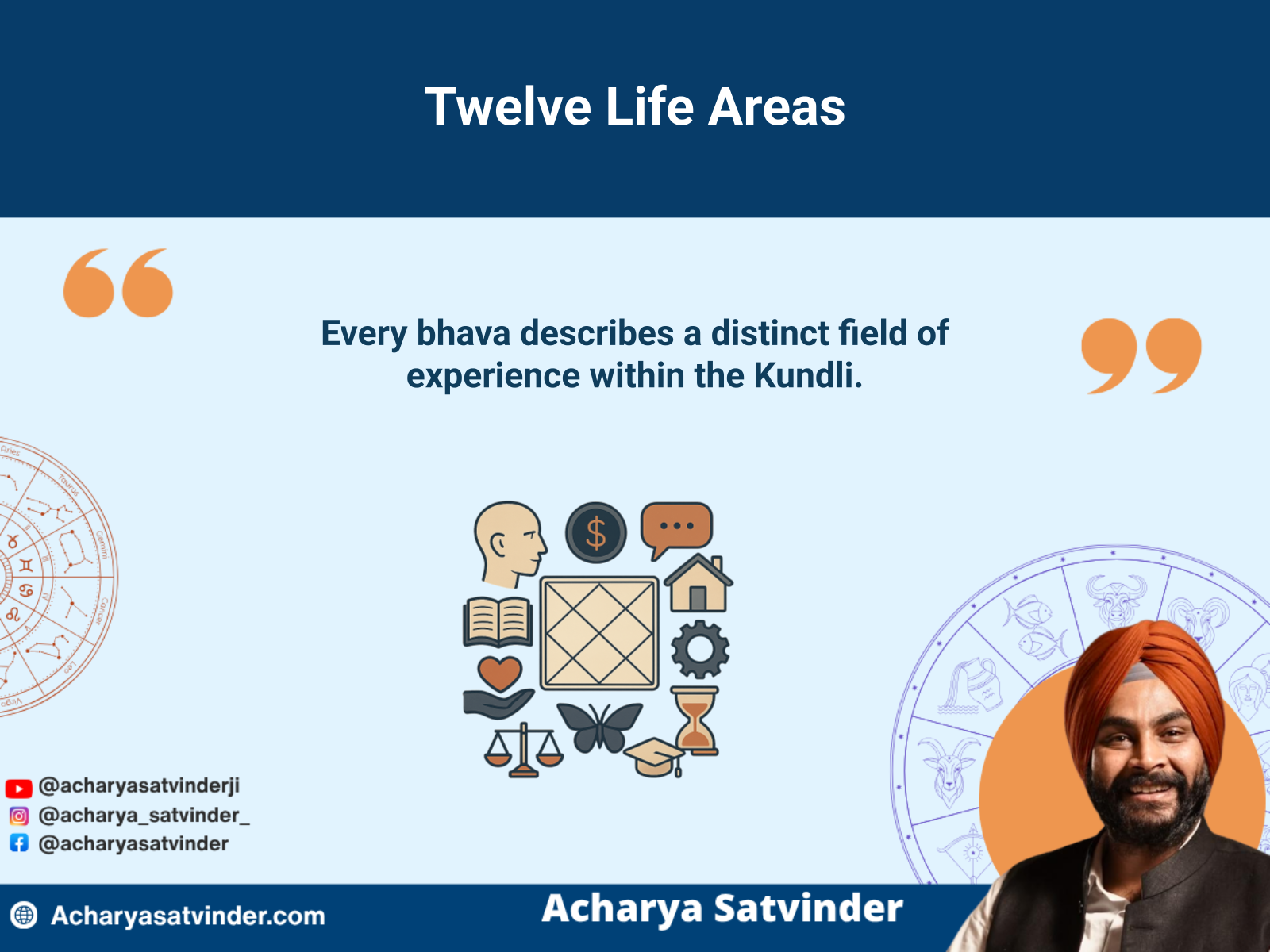
- First house: Body, identity, vitality, temperament, appearance and the general direction of life.
- Second house: Family values, speech, accumulated wealth, food habits, savings and early upbringing.
- Third house: Courage, communication, personal effort, skills, younger siblings and short journeys.
- Fourth house: Mother, home, emotional security, vehicles, education and property matters.
- Fifth house: Intelligence, creativity, children, learning, counsel, romance and past merits.
- Sixth house: Daily work, service, health challenges, competition, debts, disputes and problem-solving ability.
- Seventh house: Marriage, agreements, business partnerships and public interaction. Read more about the house connected with marriage.
- Eighth house: Longevity, sudden developments, shared resources, research, vulnerability, transformation and inheritance patterns.
- Ninth house: Dharma, teachers, higher knowledge, father, faith, fortune and long-distance journeys.
- Tenth house: Profession, duties, authority, reputation, job movement and possible business direction.
- Eleventh house: Gains, income, networks, elder siblings, recognition, ambitions and fulfilment of objectives.
- Twelfth house: Expenditure, rest, seclusion, foreign environments, surrender, contemplation and release.
A house can carry comfortable and demanding expressions at the same time. The sixth house, for example, may indicate conflict but also the discipline required to handle competition and daily responsibilities.
Similarly, the eighth and twelfth houses should not be read only through fear. They may describe necessary transitions, private work, research, detachment or deeper spiritual reflection.
No house is completely positive or negative. Its expression depends on the entire planetary structure and the maturity with which life is handled.
How to identify each house lord
Begin with the Ascendant and note the zodiac sign occupying every numbered house. Match each sign with its classical ruling planet to identify the corresponding house lord.
| Signs | Classical lord |
|---|---|
| Aries and Scorpio | Mars |
| Taurus and Libra | Venus |
| Gemini and Virgo | Mercury |
| Cancer | Moon |
| Leo | Sun |
| Sagittarius and Pisces | Jupiter |
| Capricorn and Aquarius | Saturn |
Suppose Aries rises in a hypothetical chart. Mars then rules the first and eighth houses, Venus rules the second and seventh, while Saturn rules the tenth and eleventh.
With Taurus rising, the entire lordship pattern changes. Venus rules the first and sixth houses, Mercury rules the second and fifth, and Saturn rules the ninth and tenth.
The sign identifies the house lord, not the house number alone. Changing the Ascendant changes the complete ownership pattern.
Rahu and Ketu can strongly influence houses through placement, conjunction and association. In the standard classical rulership scheme used here, however, they are not assigned independent ownership of zodiac signs.
How house lords connect life areas
Where a lord is placed shows which two life departments become connected. This connection offers a theme for investigation, but it should never be treated as an automatic prediction.
- Lagna lord in the tenth: Personal identity may become closely connected with profession, responsibility or public contribution.
- Second lord in the eleventh: Savings, family resources or speech-related skills may connect with income and wider networks.
- Fourth lord in the twelfth: Home matters may involve distance, private living, expenses or time away from the birthplace.
- Seventh lord in the sixth: Partnerships may require careful handling of duties, disagreements, routines or unequal expectations.
The relationship between Vedic astrology houses and their lords becomes clearer when these placements are read as connections rather than fixed promises. A lord carries its house subjects into the house it occupies.
Its ability to support those subjects depends on dignity, combustion, retrogression where applicable, conjunctions, planetary aspects and functional role. Support from other planets can substantially modify the expression.
A lord carries one house’s concerns into another. Strength and planetary company influence whether that connection feels supportive, demanding or mixed.
The natural significator, known as the karaka, also matters. Marriage analysis, for instance, requires the seventh house, its lord, relevant planets, Navamsa indications and timing rather than one placement alone.
A practical method for reading any house
A disciplined sequence prevents isolated interpretations and unnecessary fear. Use the same process whether the question concerns career, relationships, finance, education, property or personal development.
- Confirm the birth details: Accurate time, date and place are needed to establish the Ascendant and house structure.
- Select the relevant house: Begin with the life area being examined instead of scanning randomly for difficult placements.
- Identify its sign and lord: Note the ruling planet and the house where that planet is placed.
- Judge planetary condition: Examine sign dignity, conjunctions, aspects, degrees and support or pressure from other planets.
- Review occupants and karakas: Planets inside the house and natural significators add important layers of meaning.
- Study timing: Relevant dashas, sub-periods and transits show when a natal possibility may receive greater activation.
Divisional charts can add confirmation for specialised questions, but they should not replace the main birth chart. The Navamsa supports relationship and planetary-strength analysis, while other divisions serve different focused purposes.
Acharya Satvinder Ji advises combining planetary guidance with education, preparation and responsible conduct. Naam Simran, Daan, Seva and disciplined living are conscious responses, not methods for escaping one’s life path.
Timing activates possibilities already shown in the chart. Awareness helps a person meet those periods with preparation and steadiness.
Important house groups in Kundli
Traditional house groups help an astrologer understand the broader function of a placement. A house may belong to more than one group, so these categories should be read together.
- Kendra houses: First, fourth, seventh and tenth; associated with life’s central foundations and visible responsibilities.
- Trikona houses: First, fifth and ninth; connected with purpose, intelligence, learning, values and dharma.
- Upachaya houses: Third, sixth, tenth and eleventh; areas where effort, experience and maturity can improve management.
- Dusthana houses: Sixth, eighth and twelfth; associated with challenge, adjustment, vulnerability, transition and inner work.
The first house belongs to both Kendra and Trikona groups, while the tenth is both Kendra and Upachaya. Such overlap adds depth and prevents one-dimensional labels.
House groups describe tendencies, not final outcomes. The ruling planet’s condition, yogas, aspects and active timing remain essential to interpretation.
Common mistakes to avoid
Beginners often notice one striking placement and assume it decides an entire life area. A sound reading of Vedic astrology houses and their lords avoids these shortcuts.
- Assigning permanent lords to house numbers: Actual ownership changes with the Ascendant and the signs occupying the houses.
- Ignoring an empty house: Its sign, lord, aspects, karaka and timing still provide meaningful information.
- Calling one placement good or bad: Planetary strength and the complete chart can alter its expression.
- Predicting without dashas: Natal combinations show potential, while planetary periods help assess likely timing.
- Reading from fear: Difficult houses often describe responsibilities, transitions and areas requiring greater awareness.
A Kundli is an interconnected map rather than a collection of isolated verdicts. Responsible guidance studies repeating patterns before offering practical direction.
FAQs
How are house lords decided in a Kundli?
The zodiac sign occupying a house determines its ruling planet. Because the Ascendant changes the sign sequence, house lordships differ from one Kundli to another.
Does every house have a permanent ruling planet?
No, numbered houses do not keep the same lords in every birth chart. Their lords depend on the signs placed there from the Ascendant.
What does an empty house mean?
An empty house does not mean that its life area is absent or inactive. Its sign, ruling lord, aspects, karaka and planetary timing still require analysis.
Which house is the most important in Vedic astrology?
The first house and its lord provide the foundation for identity, vitality and the overall chart structure. However, no house should be interpreted without considering its relationships with the others.
Can one house lord predict marriage or career?
One house lord can reveal an important connection, but it cannot provide a complete prediction alone. Relevant houses, planets, aspects, divisional charts and dashas must support the interpretation.
Final Words
Understanding Vedic astrology houses and their lords gives you a structured way to read how different areas of life interact. It replaces isolated assumptions with a more complete method.
Begin with the Ascendant, identify each lord and then examine placement, strength, aspects, dashas and supporting charts. Used calmly, this knowledge can encourage better preparation, self-awareness and disciplined choices.

Acharya Satvinder is a spiritual guide and life mentor who blends Sikh astrology, philosophy, and coaching to help you find clarity, balance, and purpose. He offers personalized guidance for career, relationships, stress, and spiritual growth — empowering you to unlock your true potential.
With over 20 years of experience, Acharya Satvinder is regarded as one of the most respected and Best astrologers in India for his ethical and disciplined approach. Each year, he guides more than 10,000 individuals through his teachings and consultations, including extensive one-to-one sessions with followers across India, Canada, USA and the global NRI community. His guidance explains discipline, conscious decision-making, seva, and inner clarity as the foundation of meaningful growth.



Pingback: Corporate astrology meaning: A Practical Vedic Guide
Pingback: Can i learn astrology online? A Practical Vedic Guide
Pingback: Vedic astrology vs western astrology: Key Differences