Vedic astrology or tarot which is better? The answer depends less on rivalry and more on whether you need a structured life map, timing analysis or immediate symbolic reflection.
Vedic astrology studies planetary positions connected with birth, while tarot interprets cards drawn for a particular concern. Both may encourage reflection, but their foundations and practical strengths are different.
Acharya Satvinder Ji presents astrology as a guiding science for understanding planetary direction, timing and life patterns shown from birth. Its purpose is conscious planning and disciplined action, not a promise to rewrite fate.
Vedic astrology or tarot which is better for your question?
Both methods can offer perspective, but they answer different types of questions. The deciding factor is the depth, time scale and structure required for your situation.
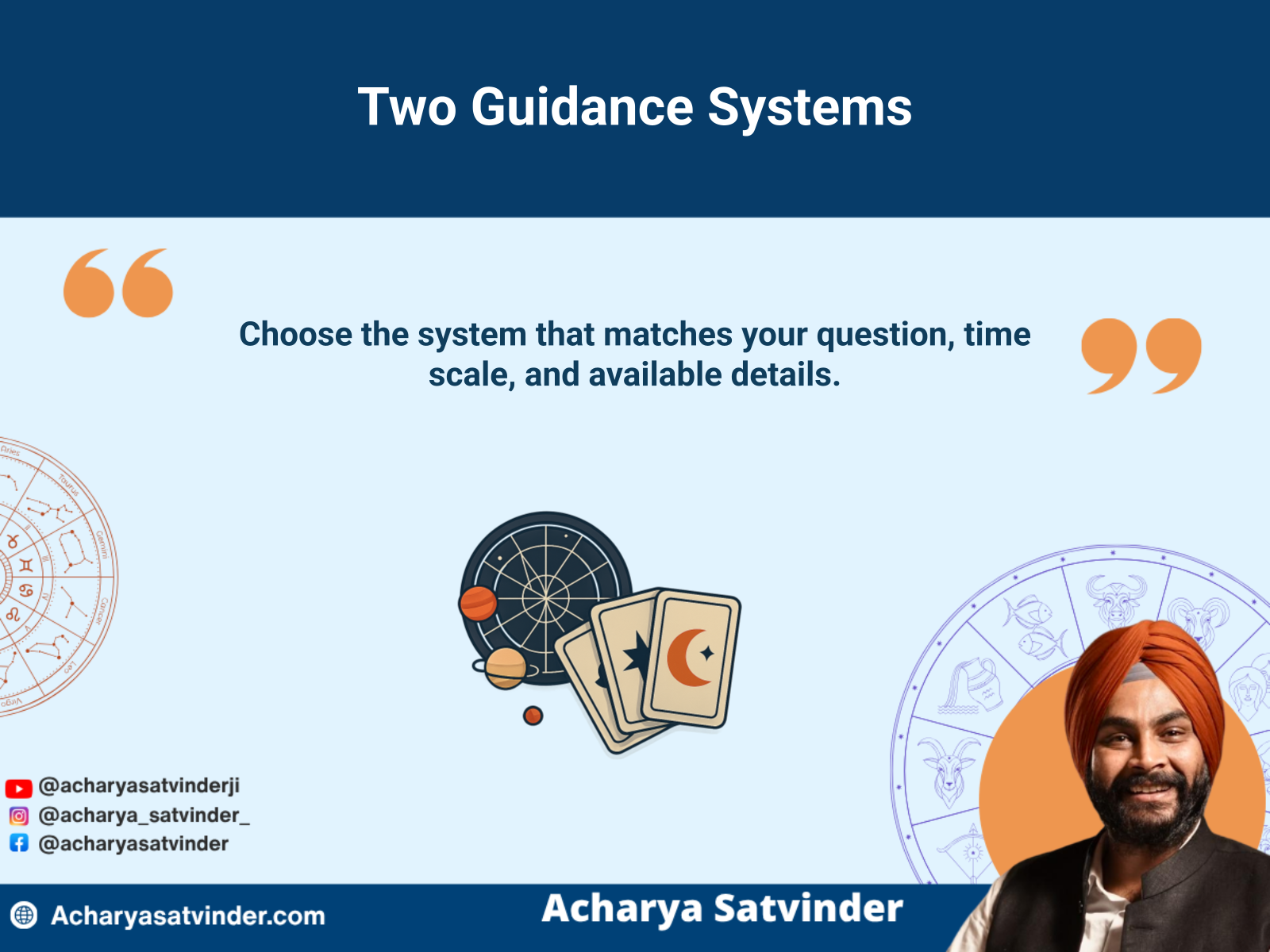
Vedic astrology is generally stronger for understanding long-term patterns, planetary periods and the relationship between multiple life areas. Tarot is often chosen for quick reflection on a present situation, feeling or decision.
| Point | Vedic astrology | Tarot |
|---|---|---|
| Foundation | Calculated birth chart | Drawn symbolic cards |
| Information needed | Birth date, time and place | A question or area of concern |
| Time scale | Life patterns and planetary periods | Present circumstances |
| Main strength | Structure and timing | Immediate reflection |
| Repeatability | The natal chart remains fixed | Each spread can differ |
In simple terms, Vedic astrology or tarot which is better depends on your available information and intended use. A serious timing question requires a different method from a moment of emotional uncertainty.
The better method is the one suited to the question, not the one making the strongest promise.
This comparison also differs from comparing Vedic and Western astrology, because those are two astrological frameworks. Tarot is a separate symbolic card practice rather than another birth-chart calculation system.
How Vedic astrology builds guidance
Vedic astrology begins with a Kundli calculated from the recorded birth details. It connects the complete chart with active planetary periods and the person’s practical circumstances.
The wider Jyotisha tradition considers the Ascendant, Moon, planets, houses, house lords, nakshatras, aspects and planetary strength. Dashas and transits help place those natal indications within time.
Complete-chart analysis matters
A responsible interpretation does not declare an outcome from one planet, sign or house. It looks for connected evidence across the main chart, relevant supporting charts and current timing.
- The Ascendant and condition of its lord
- The houses related to the question
- House lords, occupants, conjunctions and aspects
- Planetary dignity, strength and functional role
- Dashas, sub-periods and relevant transits
Suppose someone is considering a career change. The tenth house matters, but income, service, ability, opportunity, active dashas and actual employment conditions must also be considered.
A birth chart provides a framework; careful synthesis turns that framework into responsible guidance.
Readers who want to understand the foundations behind these methods may review classical Vedic astrology books and their proper study order. Traditional principles become useful only when applied consistently and in context.
How tarot creates a reading
Tarot uses a shuffled deck and a selected spread to examine a question through symbolic images. Interpretation depends on the cards, their positions, the question and the practitioner’s judgment.
Unlike a Kundli, a tarot spread is created at the time of the reading. It does not calculate the planetary pattern present at birth or provide a fixed sequence of planetary periods.
- It can be used without an exact birth time.
- It is flexible for a clearly defined present concern.
- It may help identify feelings, assumptions or possible approaches.
- A repeated question can produce a different spread.
The history of tarot also shows that the cards were used for games before becoming associated with divination. Modern spiritual interpretations developed later around their visual symbols.
Tarot can open reflection, but the cards do not calculate a person’s planetary timeline.
The practical differences at a glance
The systems differ most clearly in their source of information and treatment of time. Understanding these boundaries prevents one method from being expected to perform the other’s role.
| Need | More suitable starting point |
|---|---|
| Long-term life themes | Vedic astrology |
| Dasha and transit timing | Vedic astrology |
| Quick symbolic reflection | Tarot |
| No reliable birth time | Tarot may be easier to access |
| Connected analysis of life areas | Vedic astrology |
Tarot can reflect the emotional atmosphere around a choice, while Vedic astrology can examine whether the broader period supports movement, patience or preparation. Neither should replace facts, skill or qualified professional advice.
Which method suits common life questions?
The nature of the question often reveals which method is more appropriate. Broad, time-sensitive decisions usually need more structure than immediate questions about feelings or perspective.
Career and education
Vedic analysis can connect aptitude, work patterns, income houses, professional direction and active dashas. Tarot may help someone reflect on hesitation, confidence or the emotional tone surrounding an available option.
Marriage and relationships
A complete chart can study relationship houses, their lords, planetary connections and timing without declaring a result from one placement. Tarot is more suited to exploring current communication, expectations or unresolved feelings.
Business decisions
For expansion or leadership concerns, Vedic astrology can place timing within the birth chart and practical business conditions. The principles behind corporate astrology and organisational guidance also require commercial facts and sound judgment.
Immediate personal reflection
Tarot may suit a focused question such as what attitude needs attention before a conversation. It should encourage honest reflection rather than dependence on repeated card draws.
For high-impact decisions, reflection is helpful only when paired with evidence and responsibility.
For major decisions, Vedic astrology or tarot which is better usually leans toward a complete Vedic reading because it offers a broader timing structure. The final choice must still respect practical reality.
Which approach is more accurate?
Accuracy cannot be judged only by how personal or reassuring a reading sounds. It depends on reliable inputs, a suitable method, skilled interpretation and an honest review of limitations.
People asking whether Vedic astrology is more accurate should first define the expected result. Personality insight, event timing, decision support and emotional reflection are different standards.
A Vedic reading can also fail when birth details are incorrect or chart factors are interpreted in isolation. Understanding why Vedic astrology can be wrong encourages realistic expectations and better questions.
- Check whether the method matches the question.
- Look for explanations rather than dramatic conclusions.
- Notice whether uncertainty is acknowledged.
- Avoid guarantees, pressure and fear-based language.
- Compare guidance with real conditions and responsibilities.
Confidence is not proof; trustworthy guidance explains its reasoning and respects uncertainty.
Can Vedic astrology and tarot be used together?
They may be used together when their roles remain clear. Vedic astrology can provide the larger timing framework, while tarot may support reflection on a current response.
For example, a Kundli might indicate a period requiring patience and skill development. A tarot spread could then help someone examine the fears or habits affecting that preparation.
The two readings should not be blended to manufacture certainty. If they appear to disagree, return to facts, clarify the question and avoid repeating readings until a preferred answer appears.
Use each tool within its proper limits, and keep practical judgment at the centre.
How to choose guidance responsibly
A useful session should improve awareness rather than create fear or dependence. Prepare a focused question and decide whether you need long-term timing, immediate reflection or both.
- Verify birth details before requesting a Kundli analysis.
- Ask how several chart factors support the conclusion.
- Choose tarot for reflection, not repeated reassurance.
- Retain medical, legal and financial expertise where required.
- Turn insight into realistic planning and disciplined action.
Acharya Satvinder Ji teaches that Naam Simran, Daan, Seva and disciplined living can support steadiness and conscious conduct. They are spiritual responses to the life path, not methods for controlling it.
FAQs
Is Vedic astrology better than tarot for future timing?
Vedic astrology is generally more structured for timing because it examines dashas, transits and natal chart factors. Its guidance still depends on accurate birth details and complete interpretation.
Does tarot require an exact birth time?
No, tarot usually begins with a question and cards drawn for that reading. An accurate birth time is important for detailed Vedic chart calculation instead.
Can tarot and Vedic astrology give different answers?
Yes, because they use different information and interpretive methods. Treat disagreement as a reason to review the question and practical facts rather than force certainty.
Which should I choose for career or marriage questions?
Vedic astrology is usually more suitable when you need connected life-area analysis and planetary timing. Tarot may support reflection on current emotions, communication or hesitation.
Can I use both methods without becoming dependent?
Yes, if each method has a clear purpose and readings are not repeated for reassurance. Keep practical evidence, personal responsibility and professional advice central to important decisions.
Final Words
The most useful answer to Vedic astrology or tarot which is better comes from matching the method with the question. Choose Vedic astrology for structured chart analysis and timing, or tarot for focused symbolic reflection in the present.

Acharya Satvinder is a spiritual guide and life mentor who blends Sikh astrology, philosophy, and coaching to help you find clarity, balance, and purpose. He offers personalized guidance for career, relationships, stress, and spiritual growth — empowering you to unlock your true potential.
With over 20 years of experience, Acharya Satvinder is regarded as one of the most respected and Best astrologers in India for his ethical and disciplined approach. Each year, he guides more than 10,000 individuals through his teachings and consultations, including extensive one-to-one sessions with followers across India, Canada, USA and the global NRI community. His guidance explains discipline, conscious decision-making, seva, and inner clarity as the foundation of meaningful growth.