
How to read chart in astrology begins with recognising that a birth chart is a connected map, not a collection of independent planetary labels.
A reliable reading moves from birth details and the Ascendant to houses, house lords, planetary strength, aspects and timing. Each layer modifies the meaning of the others.
Acharya Satvinder Ji presents astrology as a guiding science for understanding planetary direction, timing and patterns shown from birth. Its purpose is informed planning, awareness and disciplined conduct.
How to read chart in astrology step by step
A beginner needs a consistent sequence that prevents one striking placement from controlling the interpretation. Start with the foundation and add complexity only after the basic structure is clear.
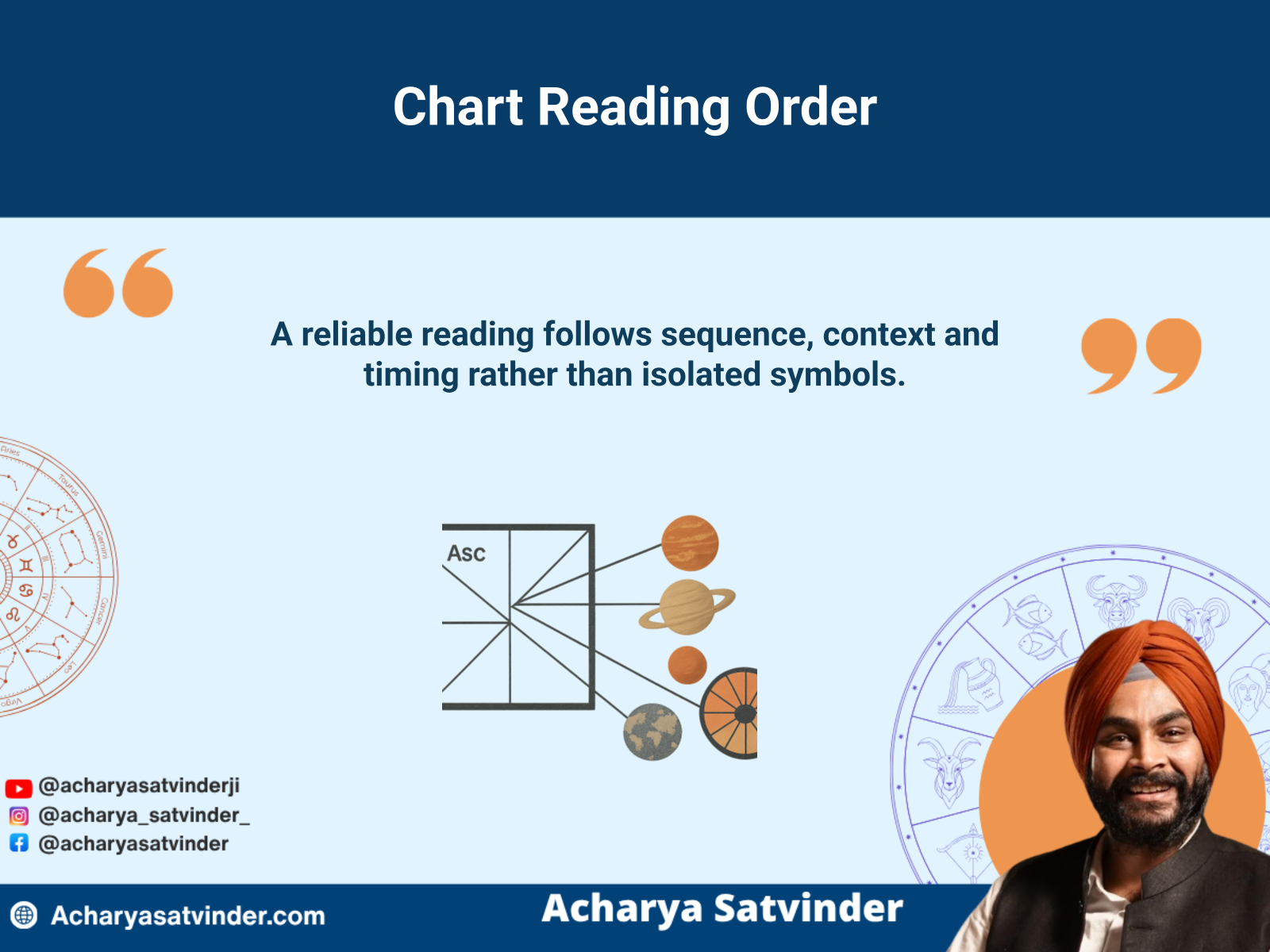
Use the D1 Lagna or Rashi chart for your first overall reading. Confirm that it was calculated from the correct birth date, exact time and birthplace.
- Identify the chart system: Confirm that you are reading a Vedic chart with consistent calculation settings.
- Locate the Ascendant: This establishes the first house and the order of every remaining house.
- Find the Ascendant lord: Note its sign, house, strength, conjunctions and aspects.
- Read the Moon: Observe its sign, house, nakshatra and surrounding planetary influence.
- Map the houses: Connect each house with its life areas, occupants and ruling planet.
- Judge planetary condition: Consider dignity, lordship, degree, relationships and relevant strengths.
- Look for repeated indications: Give more weight to themes supported by several chart factors.
- Add timing: Examine dashas and transits after understanding what the natal chart can support.
North Indian charts keep the houses fixed, while South Indian charts keep the zodiac signs fixed. The underlying planetary information remains the same despite the different visual arrangement.
If your chart appears different from an online example, review the practical differences between Vedic and Western astrology before deciding that the calculation is incorrect.
A chart is a structured relationship among symbols. The reading becomes dependable only when those relationships are interpreted together.
Understand planets, signs and houses
Every placement combines three basic questions: what force is acting, how it expresses itself and where it becomes visible. Planets, signs and houses answer these questions together.

A planet represents an active principle, a sign describes its style, and a house identifies the life area involved. House ownership then connects that placement with additional areas of the chart.
- Sun: Vitality, authority, identity and responsibility.
- Moon: Mind, emotional responses, habits and receptivity.
- Mars: Initiative, courage, competition and decisive action.
- Mercury: Communication, learning, analysis and practical skills.
- Jupiter: Wisdom, growth, guidance, principles and judgement.
- Venus: Relationships, harmony, comfort, creativity and values.
- Saturn: Duty, patience, limitation, endurance and disciplined effort.
- Rahu: Amplification, ambition, unfamiliar experience and strong material focus.
- Ketu: Detachment, separation, inward analysis and past familiarity.
These are starting meanings rather than final results. The same planet can operate differently according to the Ascendant, house ownership, dignity, aspects, conjunctions and active dasha.
The twelve houses cover the self, resources, effort, home, learning, service, partnerships, transformation, principles, profession, gains and withdrawal. Their meanings should be adapted to the question being asked.
The planet supplies the force, the sign shapes its expression, and the house provides the field of experience.
Read the Ascendant and key houses
The Ascendant, or Lagna, provides the chart’s starting point and establishes house ownership. Its lord is central, but it must still be judged within the wider planetary pattern.
Begin by noting the Ascendant sign and the natural qualities associated with it. Then locate its ruling planet and examine whether it has support, pressure, dignity or significant connections.
Next, identify the houses directly related to your question. Avoid reading every house with equal detail when the purpose is to understand one particular life area.
- Career: Study the second, sixth, tenth and eleventh houses with their lords and relevant significators.
- Relationships: Study the first, fifth, seventh and eleventh houses, supported by the complete relationship pattern.
- Education: Consider the second, fourth, fifth and ninth houses along with learning-related planets.
- Property: Examine the fourth house, its lord, connected planets and suitable supporting division.
An empty house is not inactive or irrelevant. Its sign, ruling planet, aspects and connections continue to describe how that part of life may operate.
The house begins the question, but its lord often shows where the answer must be followed.
Judge house lords, strength and aspects
House lordship connects separate parts of the chart and turns static meanings into a coherent pattern. Planetary condition then shows how confidently, steadily or unevenly that connection may operate.
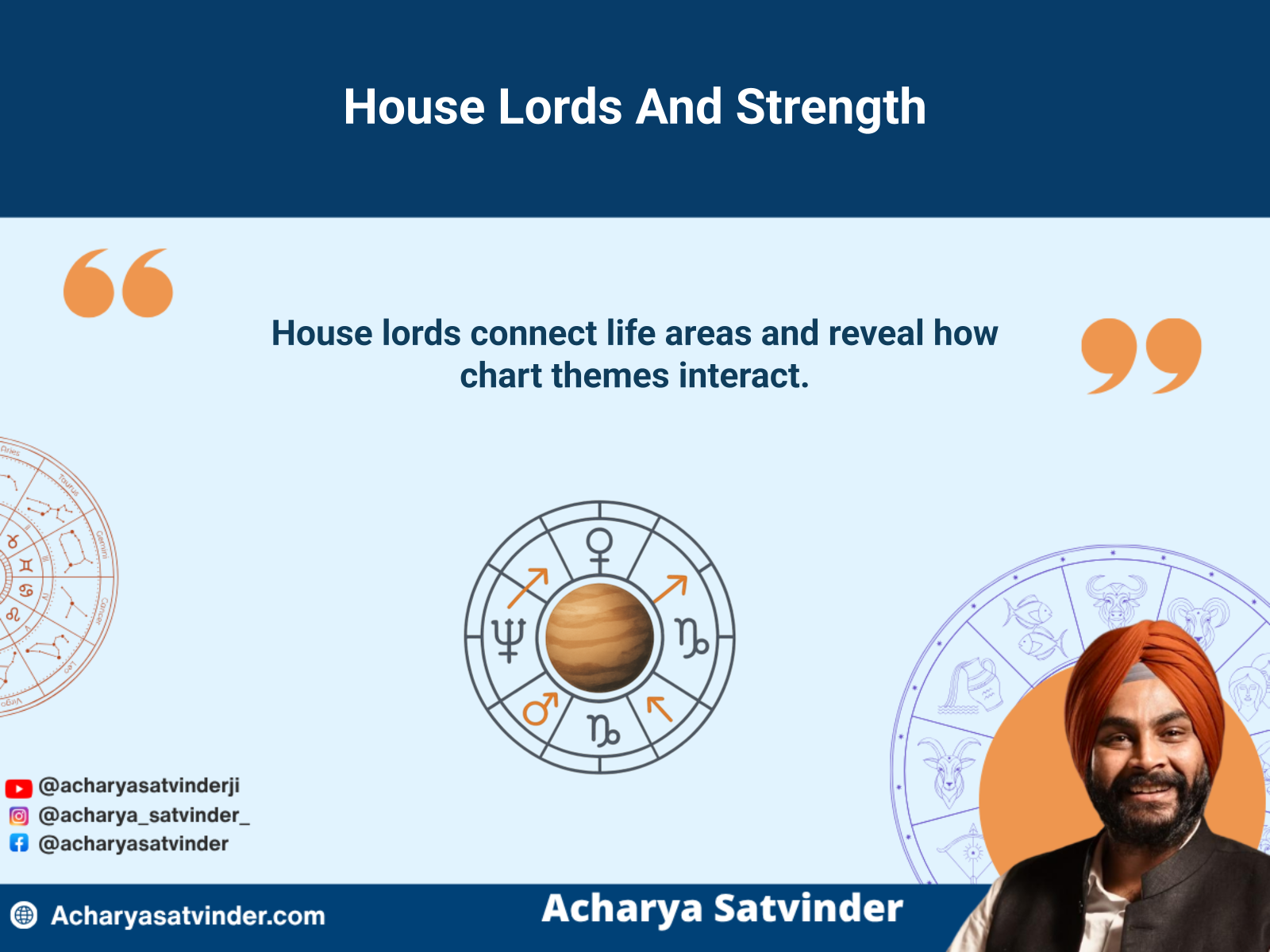
Find the planet ruling each relevant house and note where it is placed. A house lord carries the concerns of its own house into the sign and house it occupies.
Do not label a planet strong or weak from one factor alone. A careful judgement can include sign dignity, degree, combustion, retrogression where relevant, conjunctions, aspects and support from connected planets.
- Check which houses the planet rules for the specific Ascendant.
- Identify the sign and house where the lord is placed.
- Observe planets joining or aspecting it.
- Examine whether related houses repeat the same theme.
- Confirm whether the active timing supports that theme.
Consider a hypothetical career chart where the tenth lord occupies the fifth house. This may connect profession with knowledge, teaching, advising, creativity or strategic thinking, but it is not a complete career conclusion.
The tenth house, relevant planets, education, dasha, supporting chart and practical abilities must also agree. Several expressions may remain possible until these factors are compared.
Repeated chart evidence deserves more weight than one dramatic combination or isolated planetary label.
Add dashas and supporting charts
The birth chart describes underlying patterns, while dashas help examine when particular planetary themes may receive greater attention. Transits provide additional context around that active period.
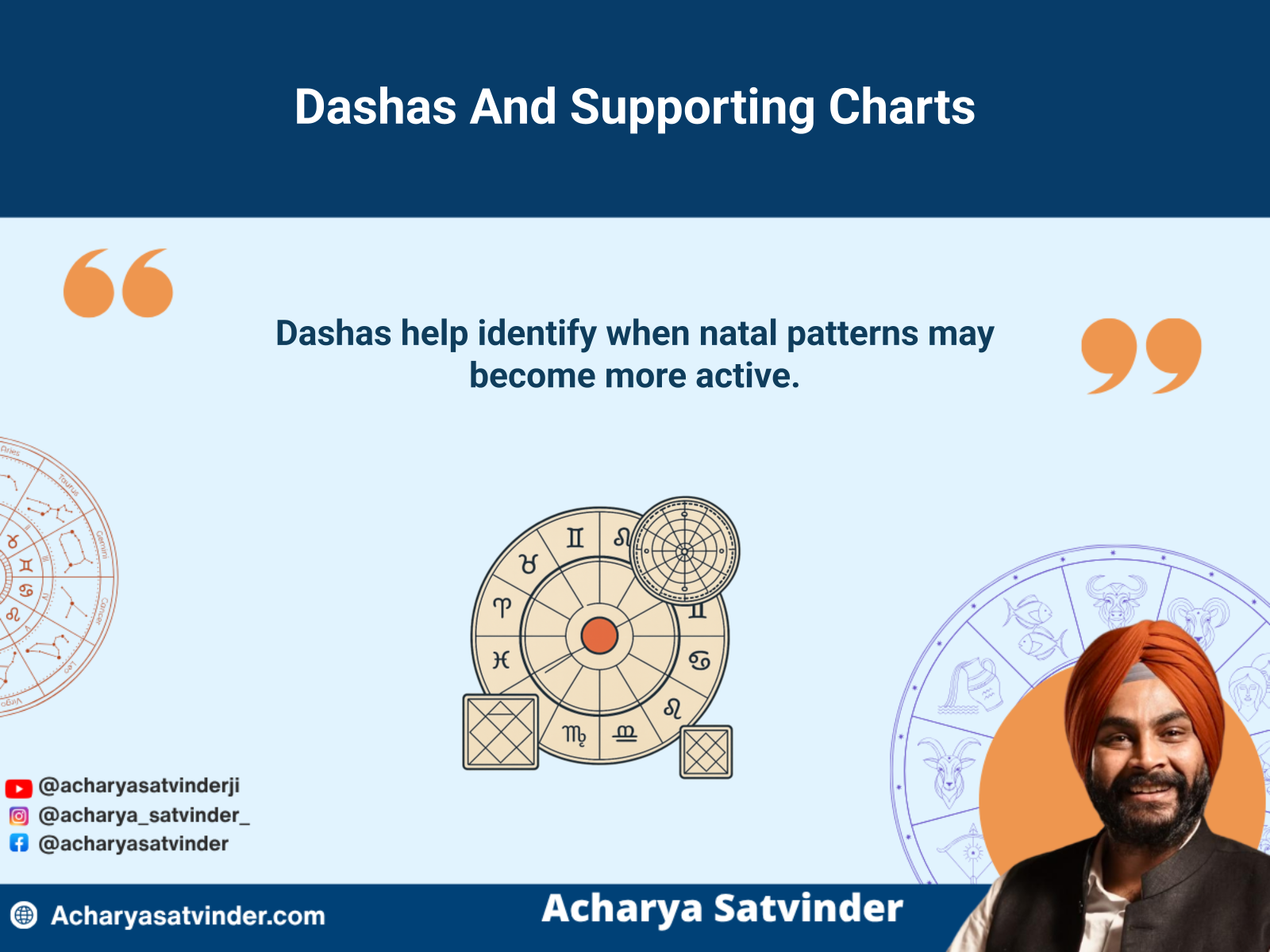
Start with the Mahadasha and Antardasha lords. Judge what they rule, where they sit, their strength and how they connect with the life area being studied.
A dasha does not create a completely unrelated result. It generally activates themes that have a meaningful foundation within the natal chart and its connected factors.
- D1 Lagna chart: The foundation for overall direction and major life areas.
- D9 Navamsa: Supporting insight into planetary depth, maturity, dharma and relationships.
- Subject-specific division: Added detail for career, property, children or another focused concern.
- Transits: Current movement that can support the timing indicated by natal factors and dashas.
Read D1 first and use divisional charts to add resolution. Sensitive divisions require dependable birth data and should never be treated as separate stories that overrule the main chart.
The natal chart establishes the pattern, while timing systems show when that pattern may demand attention.
Build a complete interpretation
A useful interpretation should connect the chart factors in plain language rather than reciting technical labels. It should also distinguish strong evidence from possibilities that require further confirmation.
How to read chart in astrology becomes practical when you record your reasoning in a repeatable order. Use the following framework for every life-area question.
- Write the question in one clear sentence.
- Select the relevant houses and supporting houses.
- Examine their lords, occupants and significators.
- Note strength, aspects, conjunctions and repeated themes.
- Check D1 before opening any supporting division.
- Apply Mahadasha, Antardasha and major transits.
- Summarise the direction, timing and responsible practical response.
For structured study beyond individual articles, learning astrology online through an organised path can help you practise chart synthesis instead of memorising disconnected meanings.
Once the foundation is stable, the method can be adapted to specialised subjects. Even corporate astrology meaning and its practical application require complete-chart reasoning rather than dependence on one placement.
Common beginner mistakes
Most early errors come from rushing into prediction before understanding chart structure. A slower method produces clearer reasoning and reduces unnecessary fear or certainty.
How to read chart in astrology is not learned by collecting dramatic one-line meanings. Watch for these habits when studying your chart or evaluating an interpretation.
- Treating one planet as permanently favourable or difficult.
- Confusing signs with houses in an unfamiliar chart layout.
- Ignoring house ownership for the specific Ascendant.
- Opening advanced divisions before understanding D1.
- Using transits without checking the natal foundation and dasha.
- Making absolute predictions from approximate birth details.
Questions about whether Vedic astrology is more accurate should be separated from the quality of calculation, birth data and interpretation. No method benefits from careless application.
Responsible chart reading communicates patterns and timing calmly while acknowledging uncertainty and personal responsibility.
Professional guidance can help when several factors appear contradictory or an important decision needs context. Before booking, review what influences astrology reading cost and look for complete-chart analysis rather than absolute claims.
FAQs
Which astrology chart should a beginner read first?
Begin with the D1 Lagna or Rashi chart because it establishes the Ascendant, houses and planetary structure. Add supporting divisions only after understanding this foundation.
What do the numbers in a Vedic astrology chart mean?
The numbers commonly represent zodiac signs rather than house numbers. Their placement depends on the chart format and the Ascendant.
Does an empty house have no effect?
An empty house remains active through its sign, ruling planet, aspects and connections. It should never be ignored simply because no planet occupies it.
Should I read planets or houses first?
Identify the Ascendant and houses first, then examine the planets occupying and ruling them. This order gives each planetary placement the correct context.
Can I read my own birth chart accurately?
You can learn its basic structure and identify recurring themes through disciplined study. Complex timing and conflicting indications may still require experienced guidance.
Final Words
How to read chart in astrology well requires sequence, patience and whole-chart judgement. Begin with accurate birth details, the Ascendant and D1 before adding advanced timing or divisional techniques.
Astrology becomes constructive when understanding leads to thoughtful planning, steadier choices and disciplined action. The chart offers direction and timing, while your conduct determines how consciously you respond.

Acharya Satvinder is a spiritual guide and life mentor who blends Sikh astrology, philosophy, and coaching to help you find clarity, balance, and purpose. He offers personalized guidance for career, relationships, stress, and spiritual growth — empowering you to unlock your true potential.
With over 20 years of experience, Acharya Satvinder is regarded as one of the most respected and Best astrologers in India for his ethical and disciplined approach. Each year, he guides more than 10,000 individuals through his teachings and consultations, including extensive one-to-one sessions with followers across India, Canada, USA and the global NRI community. His guidance explains discipline, conscious decision-making, seva, and inner clarity as the foundation of meaningful growth.