What is business astrology, and how can it offer useful direction without replacing practical judgement? It is a focused application of Vedic chart analysis to entrepreneurship, commerce, partnerships, money management, and business timing.
It studies the birth chart as a connected pattern rather than judging success from one planet, sign, or house. The aim is awareness: understanding strengths, pressures, decision habits, and periods requiring preparation.
Acharya Satvinder Ji describes astrology as a guiding science for recognizing planetary direction, timing, and life patterns shown from birth. That guidance becomes useful when combined with discipline, evidence, and responsible action.
What is business astrology in Vedic practice?
Business astrology examines how a person approaches enterprise, responsibility, risk, clients, negotiation, resources, and growth. It also considers when particular commercial abilities or challenges may become more active.

Within Vedic astrology, the Kundli connects houses, house lords, planets, aspects, combinations, strength, and timing. No factor should be separated from that wider relationship.
A business-focused interpretation may help distinguish between independent enterprise, consultancy, partnership, family business, trade, or structured management. It does not automatically declare one path perfect or another impossible.
A business chart offers direction, not an exemption from planning, effort, accountability, or changing market conditions.
Anyone considering a new venture can also study astrology for starting a business to understand how personal suitability and launch preparation work together.
What a business-focused Kundli examines
A responsible reading begins with the person and the actual business question. It then connects commercial possibilities with temperament, resources, operating responsibilities, relationships, and the relevant planetary periods.
Accurate birth details are important because the ascendant and house structure depend on birth time and place. Even a small timing difference may affect the framework used for interpretation.
The analysis can cover business ownership, partnership preferences, financial discipline, leadership style, communication, competition, customer relations, and resilience. A deeper guide to business in an astrology chart explains how these factors connect.
What is business astrology without whole-chart analysis? It becomes an oversimplification that may misread both strengths and pressures.
Houses connected with commerce
Several houses contribute to business interpretation, and each answers a different commercial question. Their lords, occupants, aspects, combinations, and active periods determine how their themes may operate.
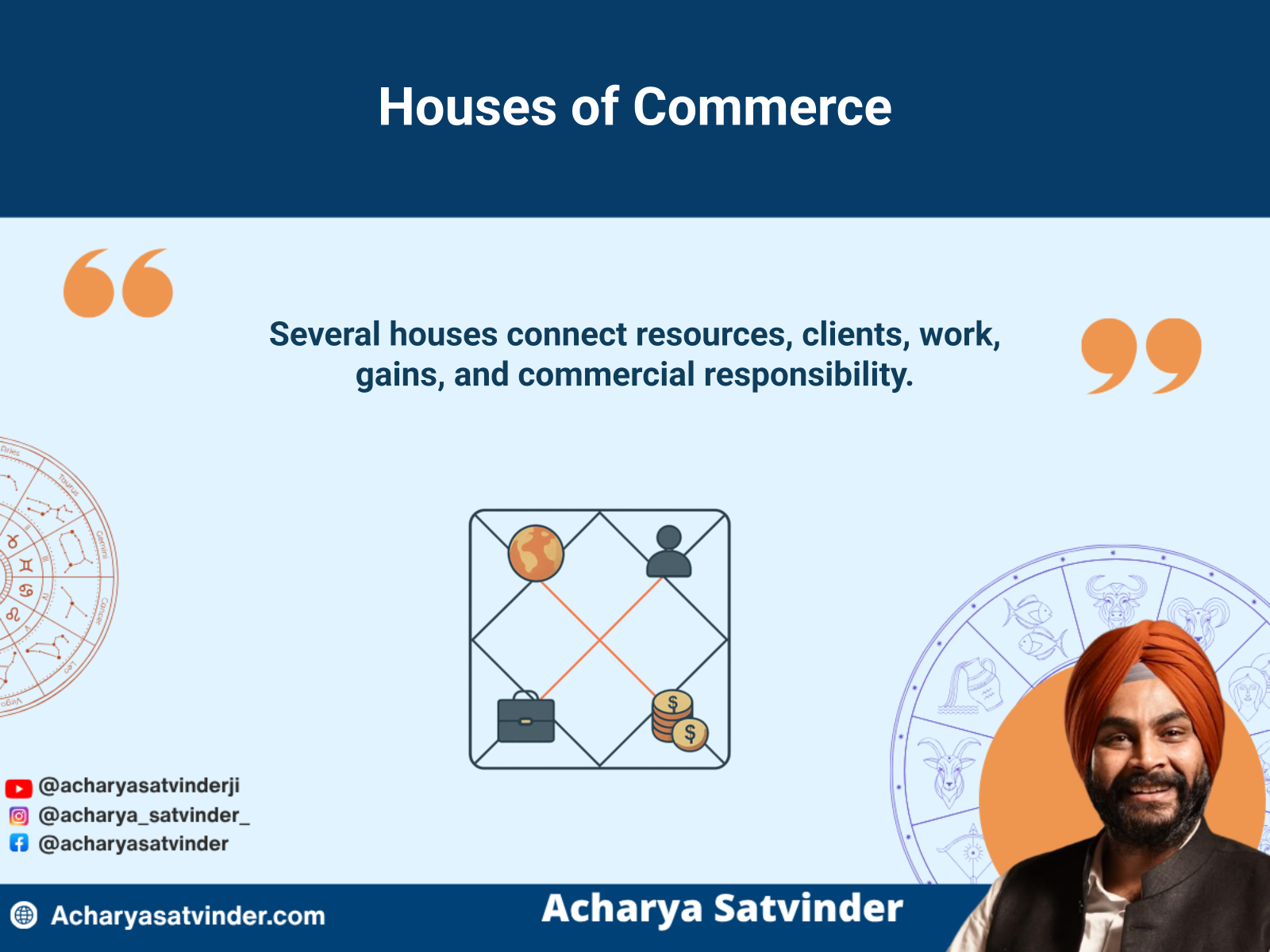
- First house: Initiative, temperament, confidence, health, and the ability to carry responsibility.
- Second house: Accumulated resources, speech, financial habits, values, and family-supported assets.
- Third house: Enterprise, communication, sales effort, courage, skills, and self-directed action.
- Sixth house: Daily operations, service, competition, obligations, disputes, and workforce concerns.
- Seventh house: Trade, clients, contracts, public dealings, negotiation, and business partnerships.
- Tenth house: Work, authority, professional responsibility, reputation, and visible contribution.
- Eleventh house: Gains, networks, fulfilment of objectives, recurring income, and commercial reach.
The second, seventh, tenth, and eleventh houses often receive close attention, but they cannot provide a reliable conclusion alone. The ascendant and supporting or conflicting chart factors remain essential.
A strong commercial indication becomes meaningful only when the chart supports its expression and timing.
Planets and commercial abilities
Planets describe different abilities, motives, and responsibilities that may appear in business life. Their results depend on lordship, placement, dignity, aspects, combinations, and the houses they influence.

- Mercury: Trade, accounting, analysis, communication, marketing, negotiation, and adaptability.
- Mars: Initiative, competition, technical work, decisive action, construction, and operational drive.
- Jupiter: Judgement, counsel, learning, expansion, ethics, finance, and long-range thinking.
- Venus: Design, presentation, relationships, hospitality, comfort, value, and customer experience.
- Saturn: Systems, labour, structure, endurance, manufacturing, compliance, and sustained responsibility.
- Sun: Leadership, authority, administration, visibility, confidence, and dealings with institutions.
- Moon: Public response, changing demand, care, adaptability, habits, and emotional decision patterns.
Rahu and Ketu may add themes involving ambition, unconventional methods, specialized work, technology, detachment, or unfamiliar environments. Their meaning must be derived from the complete chart rather than a fixed label.
No planet is universally good or bad for every business. The same planet can support one function while creating pressure in another, depending on its complete condition.
Timing through dashas and transits
Potential and timing answer different questions, so both require attention. A suitable business idea may still need patience when the active period calls for learning, restructuring, or careful preparation.
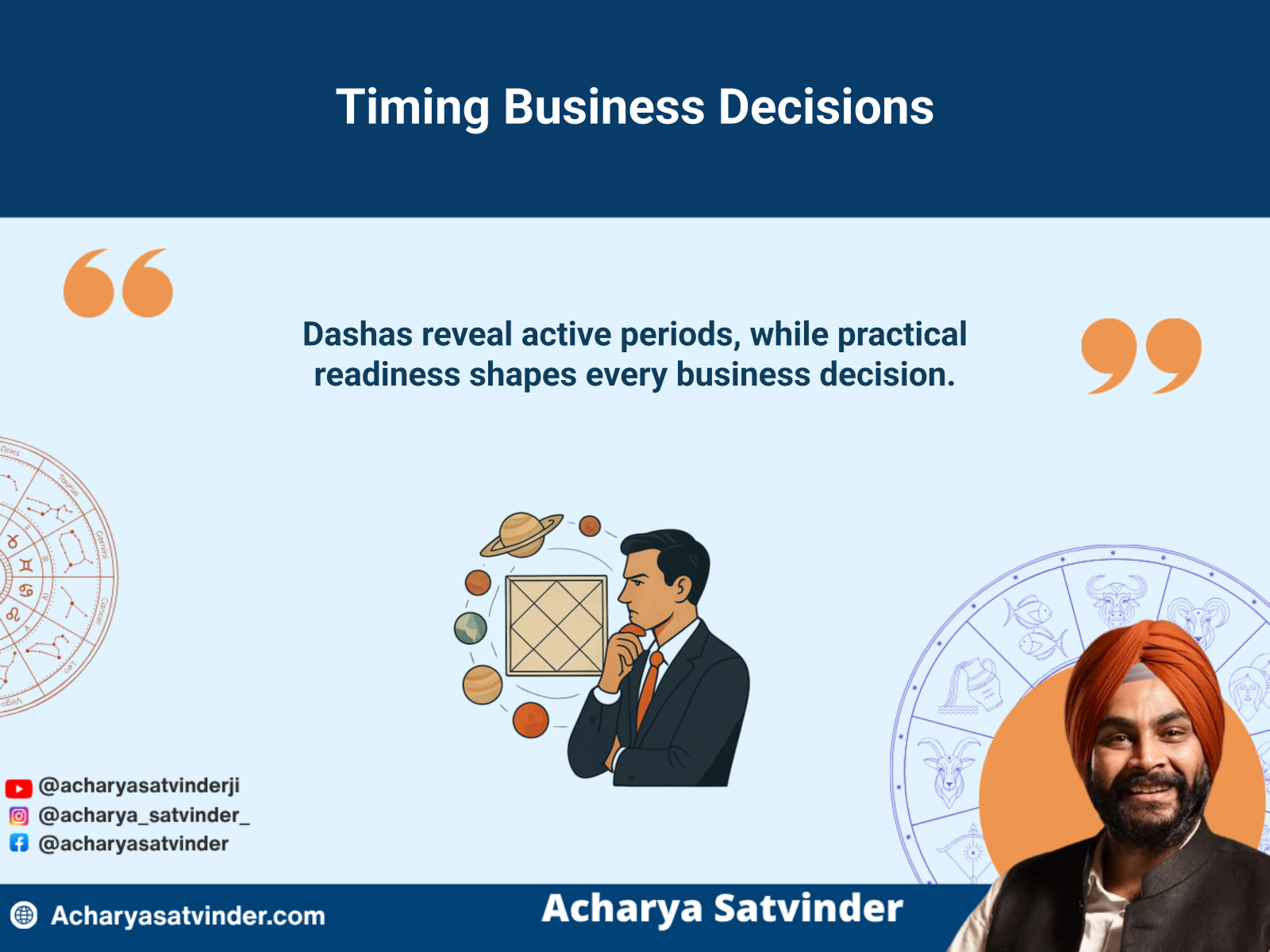
Planetary periods, commonly called dashas, indicate which parts of the birth chart are more active. Sub-periods refine the picture and may reveal shifts in responsibility, opportunity, expenditure, or pressure.
Transits provide another layer by showing current planetary movement in relation to the natal chart. They should be considered with dashas and the chart’s original promise, not treated as isolated signals.
Electional timing may help choose a suitable moment for registration, opening, signing, or launch. It cannot compensate for missing capital, weak demand, unresolved legal concerns, or an untested business model.
Good timing supports a prepared decision; it does not make an unprepared decision responsible.
Questions business astrology can clarify
A focused consultation should address real decisions instead of offering broad statements about success. Clear questions help connect the chart with the person’s business stage, responsibilities, and available choices.
What is business astrology useful for before a major commitment? It can organize reflection around questions such as:
- Does independent work suit my temperament and responsibilities?
- Should I operate alone or consider a business partner?
- Which commercial functions align with my stronger abilities?
- Is the period better for preparation, launch, consolidation, or expansion?
- Where may communication, cash discipline, or partnership boundaries require attention?
- How should I approach a proposed contract, location, or new market?
Partnership decisions
Partnership analysis considers both individual charts, shared objectives, communication, authority, financial expectations, and conflict patterns. Compatibility does not remove the need for written agreements, due diligence, or transparent accounting.
Names and business identity
Naming may be examined only after the business model, audience, and practical identity are understood. Readers comparing approaches can review a guide to choosing a business name through astrology and related astrological naming considerations for businesses.
What business astrology cannot replace
Astrological direction has clear limits and should remain within them. Business decisions still require market evidence, financial understanding, professional advice, lawful conduct, and consistent execution.
What is business astrology unable to do? It cannot guarantee profit, remove commercial risk, replace customer research, or make every attractive opportunity suitable.
- Validate demand through customer and competitor research.
- Prepare realistic budgets, cash-flow estimates, and contingency plans.
- Seek qualified legal, tax, accounting, or investment guidance when needed.
- Define roles, ownership, decision rights, and exit terms in writing.
- Review results regularly and adapt when evidence changes.
Astrology adds perspective to a decision; facts, ethics, and accountability must still shape the action.
Preparing for a business astrology reading
Good preparation makes the consultation more specific and useful. Bring accurate birth details, a concise description of the situation, and the decisions that genuinely require clarity.
- Record your birth date, exact birth time, and birth location.
- Describe the business idea, industry, ownership structure, and current stage.
- List your available resources, obligations, concerns, and practical deadlines.
- Prepare three to five focused questions rather than requesting a general prediction.
- Separate decisions already supported by evidence from those still requiring research.
A business astrology reading for decisions and timing should explain the reasoning behind its guidance. It should also distinguish chart interpretation from practical, legal, and financial responsibilities.
Naam Simran, Daan, Seva, and disciplined living may be suggested as conscious spiritual responses when appropriate. They support humility, steadiness, and responsible conduct rather than rewriting the life path.
FAQs
Can business astrology tell me which business to start?
It can identify commercial abilities, preferences, and chart patterns connected with particular kinds of work. The final choice should also reflect your skills, experience, capital, demand, and responsibilities.
Which house is most important for business?
The seventh, tenth, and eleventh houses are commonly studied, while the second, third, and sixth may add essential context. A reliable interpretation must include the ascendant, house lords, planets, aspects, strength, and timing.
Can astrology guarantee business success?
No chart reading can guarantee profit or remove commercial uncertainty. Astrology can offer perspective, but results also depend on planning, decisions, market conditions, ethics, and sustained effort.
Is an exact birth time necessary for business astrology?
An accurate birth time is important because it determines the ascendant and house structure. If the recorded time is uncertain, that limitation should be discussed before interpreting business questions.
Can business astrology help with partnership decisions?
It can examine communication, authority, financial expectations, shared direction, and potential areas of friction. Written agreements, background checks, transparent accounts, and professional advice remain necessary.
Final Words
Business astrology is most useful when it brings structured awareness to entrepreneurial direction, relationships, resources, and timing. It should encourage preparation and disciplined choices rather than dependence or fear.
What is business astrology at its most responsible? It is planetary guidance read through the complete Kundli and applied alongside evidence, professional advice, ethical conduct, and sustained effort.

Acharya Satvinder is a spiritual guide and life mentor who blends Sikh astrology, philosophy, and coaching to help you find clarity, balance, and purpose. He offers personalized guidance for career, relationships, stress, and spiritual growth — empowering you to unlock your true potential.
With over 20 years of experience, Acharya Satvinder is regarded as one of the most respected and Best astrologers in India for his ethical and disciplined approach. Each year, he guides more than 10,000 individuals through his teachings and consultations, including extensive one-to-one sessions with followers across India, Canada, USA and the global NRI community. His guidance explains discipline, conscious decision-making, seva, and inner clarity as the foundation of meaningful growth.