
Are indian astrologers accurate? Some practitioners can offer detailed, thoughtful guidance, but accuracy is never assured by nationality, tradition, confidence, or reputation alone.
A Vedic reading depends on correct birth data, careful calculations, complete chart interpretation, clear questions, and honest communication about uncertainty. Weakness in any one of these areas can reduce its usefulness.
Acharya Satvinder Ji presents astrology as a guiding science for understanding planetary direction, timing, and life patterns shown from birth. Its purpose is awareness and disciplined planning, not rewriting fate.
Are indian astrologers accurate in practice?
Some astrologers are skilled, cautious, and systematic, while others rely on generic language or excessive certainty. The useful question is whether a particular reader uses sound inputs, connected reasoning, and ethical limits.
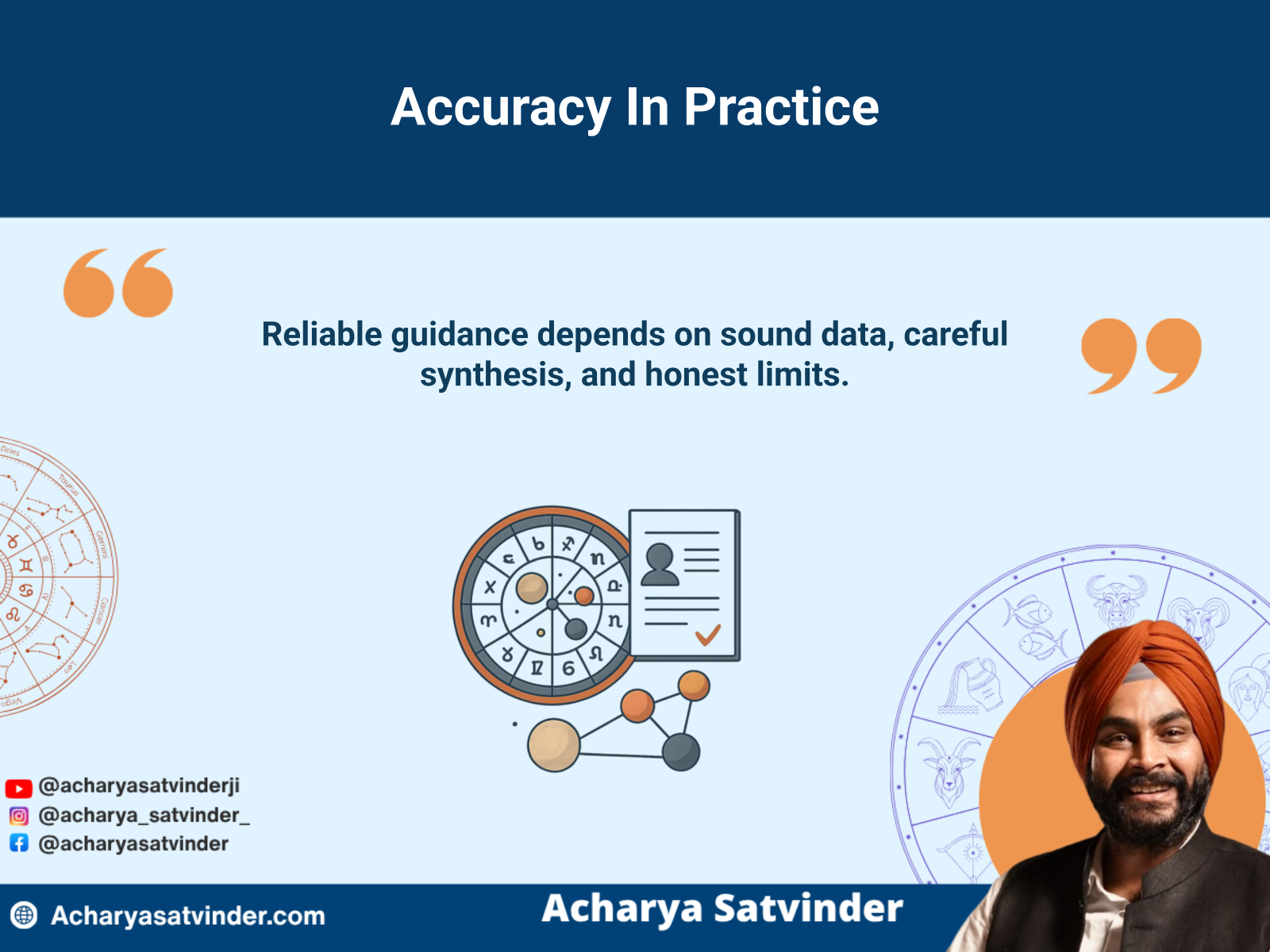
Indian astrology offers a structured tradition involving the ascendant, houses, house lords, nakshatras, planetary relationships, dashas, and transits. A structure, however, is only as dependable as its application.
Modern controlled research has not established astrological prediction as a consistently reliable scientific method. Traditional or personal value should therefore be distinguished from laboratory validation.
Accuracy is not a national trait or a confident tone. It grows from careful method, suitable data, and honest limits.
A fuller discussion of whether Indian astrology really works can help separate calculation, interpretation, personal usefulness, and scientific evidence rather than treating them as one question.
Judge a reading by the clarity of its reasoning and the relevance of its guidance. Dramatic claims, unexplained certainty, or statements broad enough to fit everyone are poor measures of reliability.
What accuracy should mean in astrology
People use accuracy to describe several different qualities, although these qualities are not interchangeable. Separating them makes it easier to evaluate a consultation fairly and avoid unrealistic expectations.
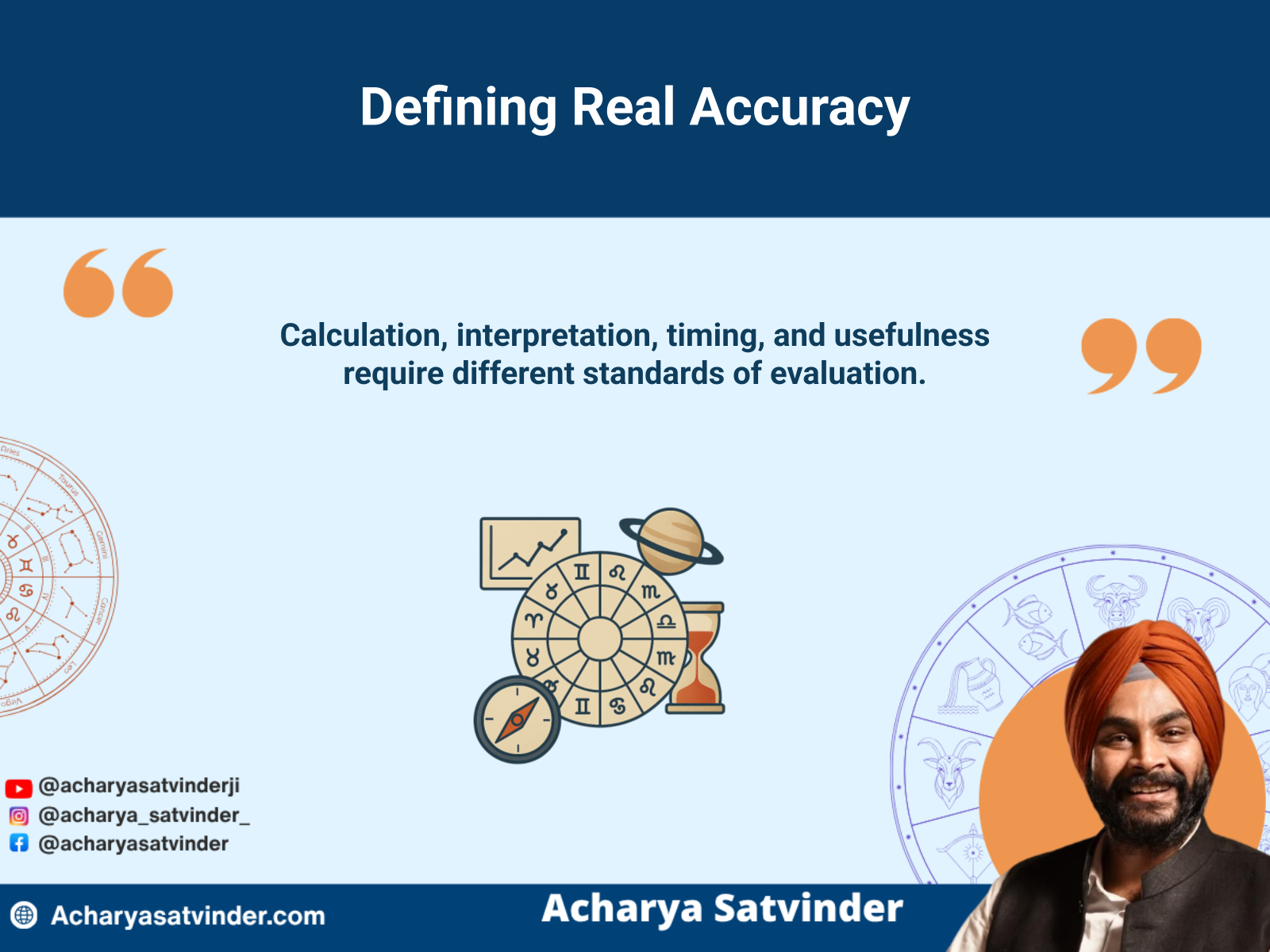
A chart can be calculated correctly while its interpretation remains weak. Likewise, a reading may feel personally meaningful without proving that every forecast will occur exactly as described.
- Calculation accuracy: Were the birth date, exact time, birthplace, and time zone entered correctly?
- Interpretive coherence: Does the conclusion connect several chart factors rather than depend on one placement?
- Timing usefulness: Are dashas and supporting transits used to describe a reasonable period instead of an absolute date?
- Practical relevance: Does the guidance address the person’s real circumstances without ignoring effort, opportunity, and responsibility?
The question “are indian astrologers accurate” becomes more useful when accuracy is defined in advance. Personality insight, broad timing, decision support, and exact event prediction require different standards.
A useful reading explains why a conclusion was reached. It does not ask confidence alone to serve as proof.
Specific questions usually produce clearer guidance than broad demands about the entire future. Asking about the pressures and opportunities within a defined career decision is more workable than asking whether life will always be successful.
How a careful Vedic reading is built
Vedic interpretation becomes more disciplined when repeated themes are checked across the complete chart. No single planet, sign, house, or yoga should be treated as a complete verdict.
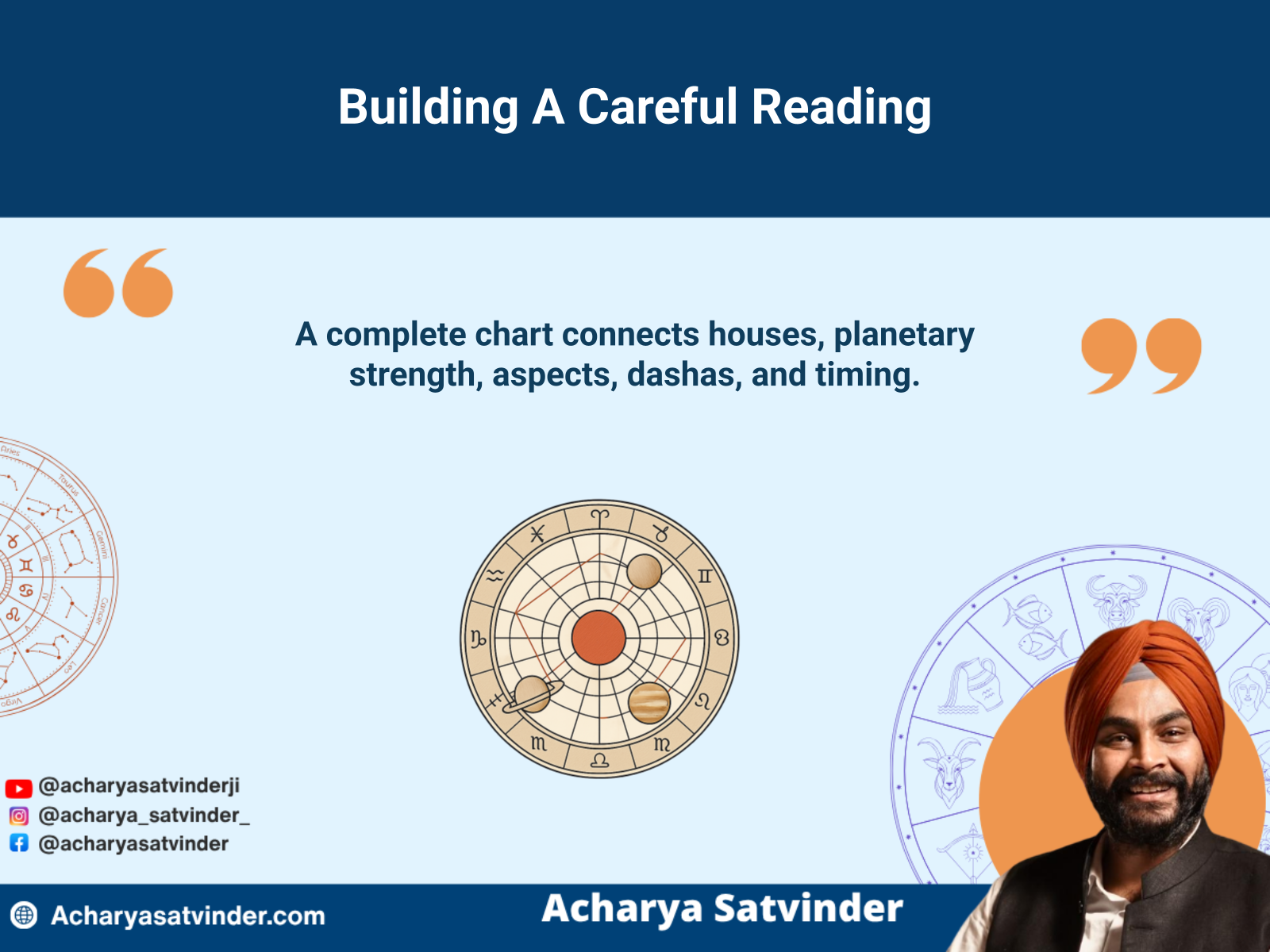
Reliable work begins with the birth date, recorded time, and birthplace. If the birth time is uncertain, the astrologer should acknowledge which calculations and timing conclusions may also be uncertain.
The ascendant and relevant houses provide a starting framework, but the analysis continues through house lords, planetary strength, aspects, conjunctions, dashas, divisional charts, and current timing. Supporting and contradictory factors both deserve attention.
- The birth chart shows the wider pattern and available possibilities.
- House lords connect the relevant areas of life.
- Planetary strength affects how clearly an influence may operate.
- Dashas identify periods traditionally associated with particular planetary themes.
- Transits may support timing but should not replace the natal foundation.
Suppose someone hypothetically asks about changing careers. A careful astrologer would consider professional houses, their lords, active planetary periods, practical qualifications, financial duties, and whether the proposed opportunity already exists.
The conclusion might describe a supportive period for preparation or transition without promising a particular job. Such guidance can help the person plan while leaving the final decision with them.
A complete chart provides context. An isolated placement provides only one part of that context.
Readers comparing different traditions may find a balanced explanation of whether Vedic astrology is more accurate useful, especially when separating methodological detail from universal proof.
Why two astrologers may disagree
Two astrologers can study the same person and reach different conclusions because interpretation involves judgement. Differences do not automatically prove dishonesty, but they should be explained rather than hidden.
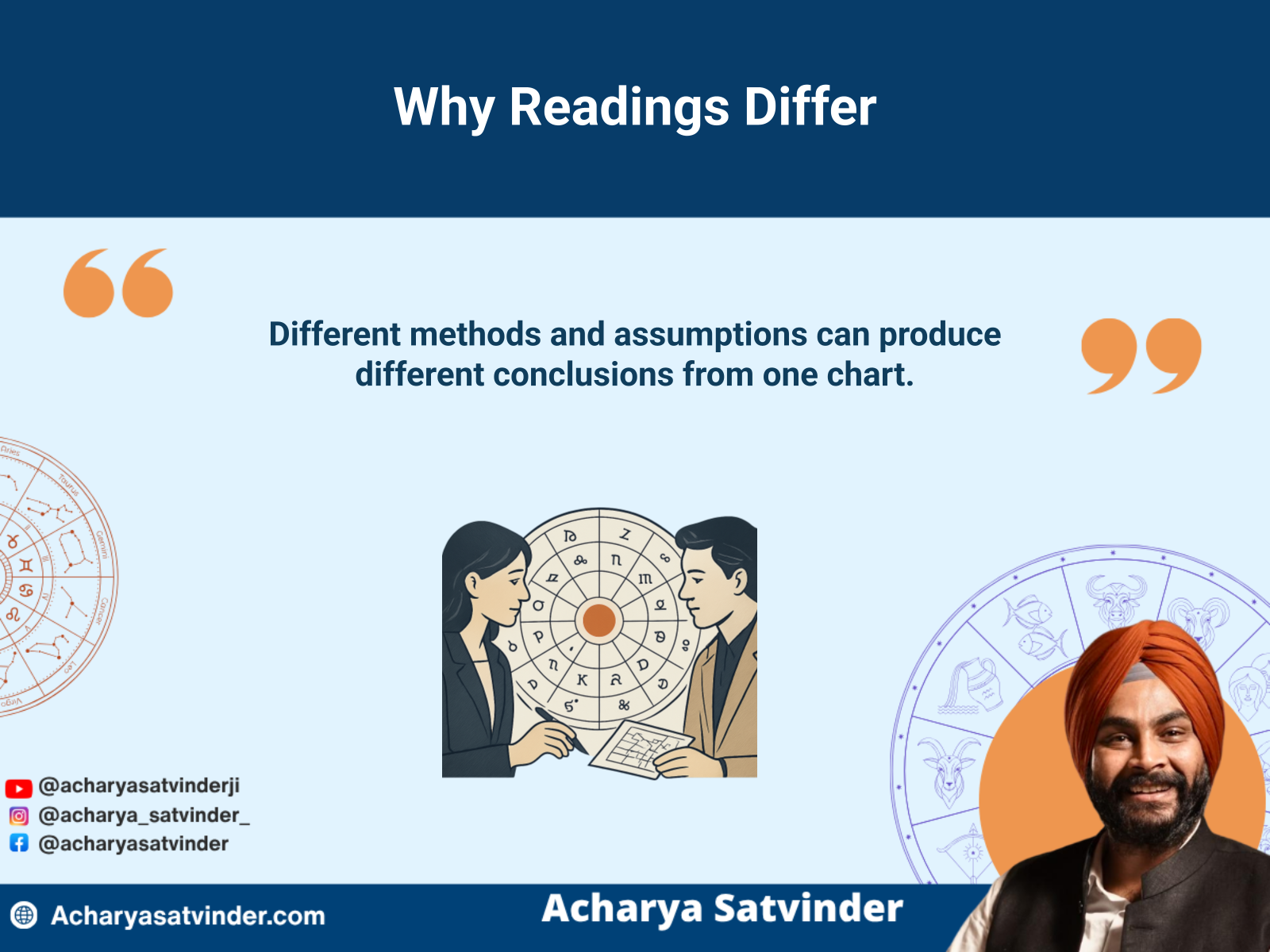
One reader may prioritize the natal chart, while another gives more weight to divisional confirmation or current timing. They may also frame probability, intensity, and suitable action differently.
- The recorded birth time may be rounded, estimated, or incorrect.
- Calculation settings and interpretive schools may differ.
- One astrologer may consider more supporting and contradictory factors.
- The original question may be vague or change during the consultation.
- Personal context may be missing, misunderstood, or given too much weight.
Different conclusions deserve clear reasoning. Certainty without explanation is not a reliable way to resolve disagreement.
Searches for “are indian astrologers accurate” often assume that all practitioners use one uniform method. In reality, training, discipline, experience, communication, and ethical standards vary considerably between individuals.
It is equally useful to understand how Vedic astrology can be wrong, because errors may arise from inaccurate inputs, incomplete synthesis, rigid language, or expectations that no responsible reading should create.
Signs of a trustworthy astrologer
A trustworthy astrologer does not need to create fear or pretend that uncertainty has disappeared. Look for a calm process that respects both the chart and your ability to make decisions.
- Requests the correct birth date, time, and birthplace before detailed analysis.
- Asks what you want to understand instead of delivering unrelated claims.
- Explains which chart factors support an interpretation.
- Distinguishes a tendency or timing window from a certain event.
- Considers the complete chart rather than blaming one planet.
- Avoids pressure, frightening language, and promises of impossible results.
- Encourages practical preparation, responsibility, and appropriate professional advice.
Trust grows when the method is transparent and the language remains proportionate to the available evidence.
When evaluating “are indian astrologers accurate,” notice whether the astrologer welcomes sensible questions. A careful reader should be able to explain uncertainty without becoming defensive or changing the claim after the outcome.
Exploring whether astrology can be learned online also reveals why structured study, supervised practice, and repeated chart analysis matter more than memorizing isolated planetary meanings.
In Acharya Satvinder Ji’s approach, the aim is to understand direction and timing so that a person can plan with awareness. The astrologer guides, but the individual remains responsible for action and discipline.
How to prepare for a useful consultation
Preparation helps an astrologer address your real concern without wasting time on broad generalities. It also gives you a clearer standard for evaluating the usefulness of the reading afterward.
- Verify your birth details. Check written records where possible instead of relying only on memory.
- Choose focused questions. Identify the decision, difficulty, or pattern you want to understand.
- Provide relevant context. Mention practical constraints without supplying a story designed to lead the answer.
- Ask about reasoning. Request a simple explanation of the chart factors and timing behind the guidance.
- Take notes. Record conditions and time ranges so you can review the reading accurately later.
Instead of asking, “Will I become successful?” you might ask which responsibilities and opportunities deserve attention during a planned professional transition. The second question supports a specific and practical discussion.
For business-related decisions, understanding how astrology is applied in corporate settings can help define suitable questions while keeping financial analysis, market evidence, and professional judgement central.
Use guidance without giving up judgement
Astrological guidance is most responsible when it supports reflection rather than dependence. It should help you notice patterns, prepare for demanding periods, and choose disciplined responses within real circumstances.
It should never replace medical care, legal counsel, financial due diligence, mental health support, or direct communication in relationships. High-impact decisions deserve evidence and advice from appropriately qualified professionals.
When spiritually appropriate, Naam Simran, Daan, Seva, and disciplined living may be followed as conscious responses that build steadiness. They should not be presented as methods for changing the life path.
Useful guidance strengthens judgement and preparation. It does not remove responsibility for the choices that follow.
After a consultation, consider whether you received clear reasoning, practical direction, reasonable limits, and room to think independently. A reading that creates panic, dependency, or pressure should be treated with caution.
FAQs
Can Indian astrologers predict exact events?
They may identify themes and timing windows, but exact outcomes should not be presented as certain. A responsible reading explains both the supporting factors and the limits.
Why is an exact birth time important?
Birth time helps calculate the ascendant, houses, divisional charts, and sensitive timing factors. If it is uncertain, the astrologer should reduce precision or discuss birth-time rectification.
Why can two astrologers read the same chart differently?
They may use different calculation settings, interpretive schools, or weighting of chart factors. Disagreement can also arise from vague questions or incomplete information.
How can I test an astrologer’s accuracy?
Begin with one focused question and ask how the conclusion was formed. Later, compare the guidance with its stated conditions and time range rather than remembering only broad statements.
Is astrology scientifically proven?
Modern controlled research has not established astrology as a consistently reliable predictive method. People may still use it as a traditional framework for reflection, timing, and personal guidance.
Final Words
The most balanced answer to “are indian astrologers accurate” is that some practitioners offer thoughtful, well-reasoned guidance, but no nationality or title ensures reliability. Choose clarity over certainty, use the reading as direction rather than command, and keep responsibility for decisions in your own hands.

Acharya Satvinder is a spiritual guide and life mentor who blends Sikh astrology, philosophy, and coaching to help you find clarity, balance, and purpose. He offers personalized guidance for career, relationships, stress, and spiritual growth — empowering you to unlock your true potential.
With over 20 years of experience, Acharya Satvinder is regarded as one of the most respected and Best astrologers in India for his ethical and disciplined approach. Each year, he guides more than 10,000 individuals through his teachings and consultations, including extensive one-to-one sessions with followers across India, Canada, USA and the global NRI community. His guidance explains discipline, conscious decision-making, seva, and inner clarity as the foundation of meaningful growth.