
What does the astrology houses mean? This common beginner question arises when a Kundli appears as twelve unfamiliar sections filled with signs, planets and symbols.
Each house, traditionally called a bhava, represents a particular department of life. Houses show where experiences belong, while signs and planets describe how those experiences may be expressed.
Acharya Satvinder Ji approaches astrology as a guiding science for understanding planetary direction, timing and patterns shown from birth. This awareness supports disciplined planning without claiming to rewrite fate.
What does the astrology houses mean in a Kundli?
A house is a defined life area within the birth chart. It does not act alone because its sign, ruling planet, occupants and connections shape its expression.

The Ascendant, or Lagna, establishes the first house, and the remaining houses follow from it. Accurate birth time and birthplace are therefore important when calculating the house arrangement.
Within Vedic astrology, houses are known as bhavas. The first house concerns the self, while the sequence continues through family, effort, home, learning, service, relationships, change, purpose, career, gains and release.
A house shows where a life theme operates. The planets and house lord describe its condition, connections and timing.
When someone asks, What does the astrology houses mean, the useful answer is not a list alone. Meaning comes from the complete relationship between the house and the wider Kundli.
For a deeper explanation of ownership, see how Vedic astrology houses and their lords connect. A house identifies the subject, while its lord carries that subject into another part of the chart.
Meaning of the Twelve Houses
The twelve houses create a practical map of life’s major departments. Their core meanings provide a starting point, although every house has several related significations.
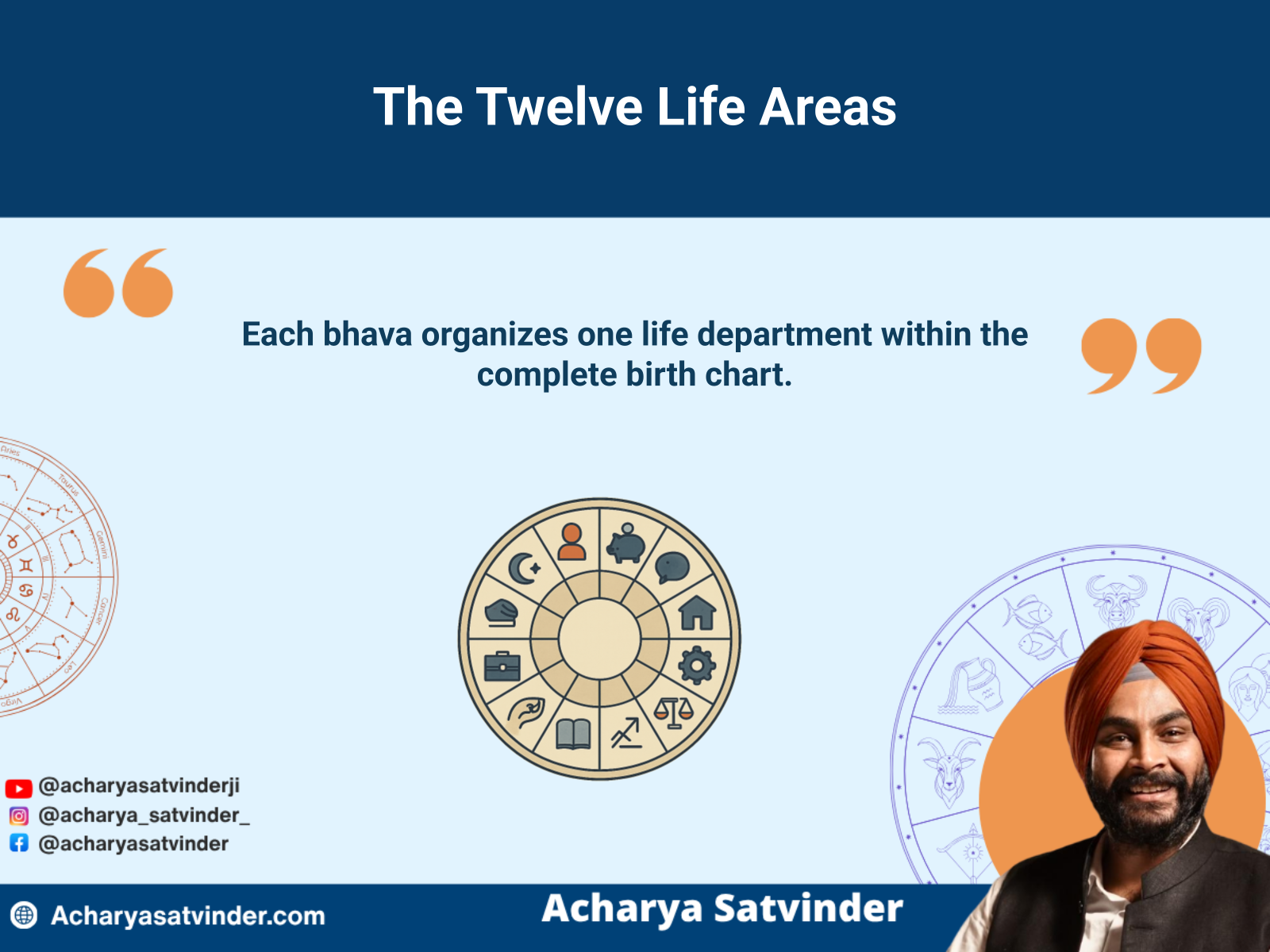
- First house: Identity, physical constitution, appearance, temperament, vitality and the general direction of personal life.
- Second house: Family values, speech, food habits, accumulated resources, savings and early upbringing.
- Third house: Courage, communication, practical skills, personal effort, younger siblings and short journeys.
- Fourth house: Mother, home, property, education, vehicles, emotional security and private contentment.
- Fifth house: Intelligence, creativity, learning, children, counsel, romance and the ability to make thoughtful judgments.
- Sixth house: Daily work, service, competition, debts, disputes, routines, health challenges and problem-solving capacity.
- Seventh house: Marriage, committed partnerships, agreements, business associations and interaction with the wider public.
- Eighth house: Longevity, shared resources, inheritance, research, vulnerability, sudden developments and significant transitions.
- Ninth house: Dharma, teachers, higher knowledge, father, faith, fortune, ethics and long-distance journeys.
- Tenth house: Profession, duties, authority, reputation, public contribution and the responsibilities a person carries.
- Eleventh house: Income, gains, networks, elder siblings, recognition, ambitions and fulfilment of practical objectives.
- Twelfth house: Expenditure, sleep, seclusion, foreign environments, contemplation, release and activities performed away from public view.
A house list answers What does the astrology houses mean only at a basic level. The same house can produce supportive, demanding or mixed experiences depending on the entire chart.
No house is entirely positive or negative. Each one describes necessary experiences that require awareness, maturity and appropriate action.
For example, the sixth house can indicate conflict or debt, yet it also concerns service, discipline and competition. The eighth can show vulnerability while supporting research, endurance and deeper understanding.
How Houses Work Together
A Kundli becomes meaningful when its houses are read as one connected system. House lords, planetary placements and aspects link different life departments together.
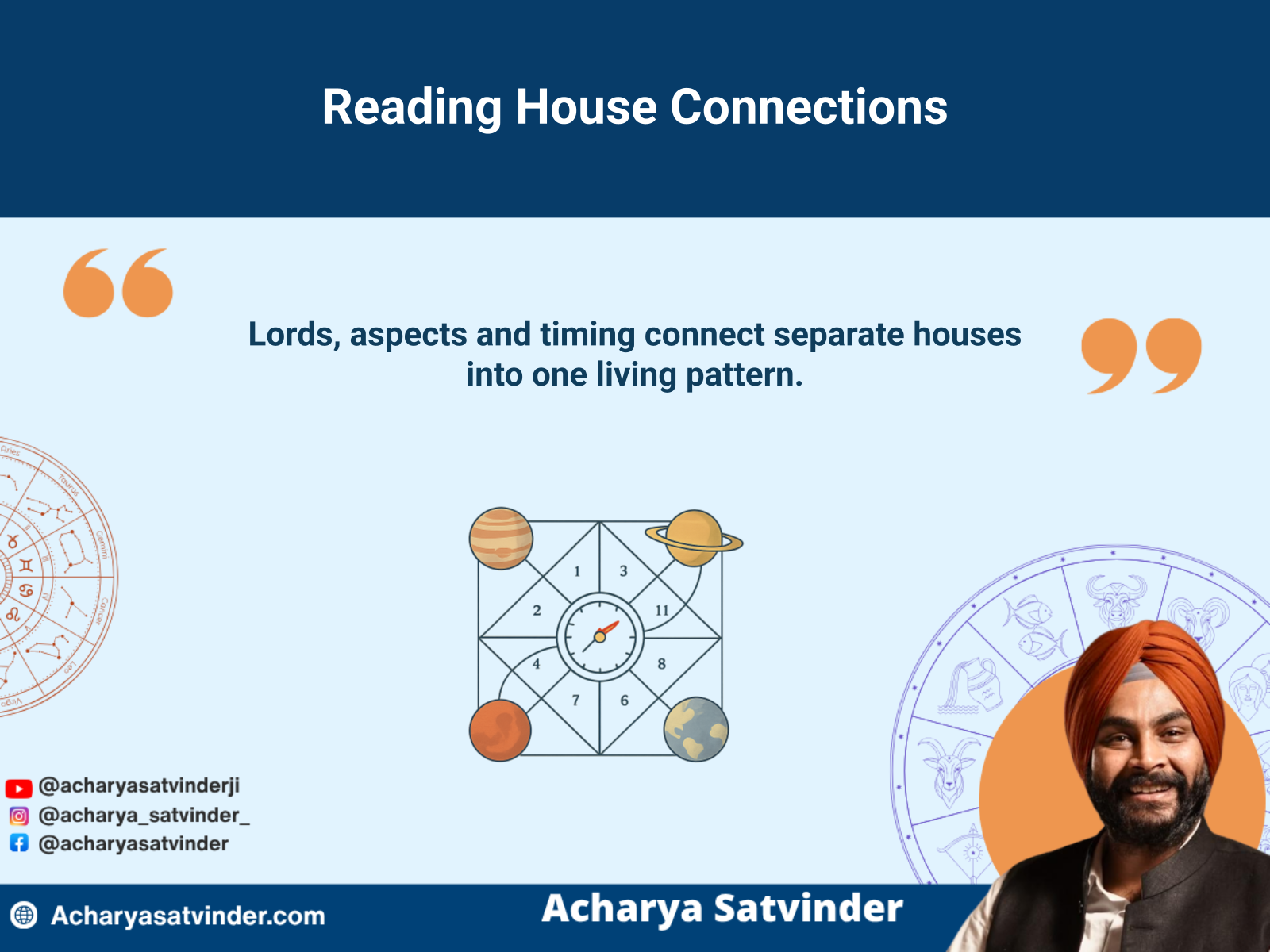
Suppose the tenth lord occupies the fourth house in a hypothetical chart. Profession may become connected with home, education, property, private responsibilities or the need for emotional stability.
This observation is only a theme for investigation. The astrologer must examine the planet’s dignity, strength, conjunctions, aspects, functional role, divisional support and active dasha before interpreting possible results.
Wealth analysis may involve the second, fifth, ninth and eleventh houses, but no single connection promises prosperity. Understanding Dhana Yoga in astrology shows why combinations and timing must support one another.
What does an empty house mean?
An empty house does not mean that its life area is missing. Its sign, ruling lord, planetary aspects, natural significator and dasha activation remain relevant even when no planet occupies it.
An empty house is not an inactive house. Its ruling planet continues carrying its concerns through the Kundli.
Can one planet decide a house result?
A planet placed in a house can strongly influence that area, but it cannot decide the result alone. Its ownership, strength, planetary company and timing may substantially modify the expression.
The natural significator, called the karaka, adds another layer. Marriage, for example, requires the seventh house, its lord, relevant planets, divisional indications and timing rather than one isolated placement.
Important House Groups in Kundli
Traditional house groups help organize the chart according to function and development. These categories overlap, so a house may carry more than one type of significance.
- Kendra houses: The first, fourth, seventh and tenth form the central foundations of identity, home, partnership and worldly responsibility.
- Trikona houses: The first, fifth and ninth relate to purpose, intelligence, values, learning and dharma.
- Upachaya houses: The third, sixth, tenth and eleventh concern areas where effort, practice and maturity can improve management.
- Dusthana houses: The sixth, eighth and twelfth may describe pressure, adjustment, vulnerability, expenditure or release, depending on the complete chart.
These classifications prevent a flat reading in which every house is treated identically. They help the astrologer consider whether a life area develops through stability, purpose, sustained effort or necessary adjustment.
House groups organize the chart, but they do not replace complete interpretation. Strength, lordship and timing remain essential.
How to Read Houses Responsibly
Responsible interpretation follows a consistent process rather than selecting one dramatic placement. The goal is to understand patterns, connections and timing without turning possibilities into fixed verdicts.
- Confirm birth details: Check the recorded birth time, date and place before calculating the Kundli.
- Identify the Lagna: Establish the first house and the sign sequence that follows from it.
- Choose the relevant houses: Focus on the houses connected with the person’s actual question.
- Study the lords: Examine where each relevant house lord is placed and how strong it is.
- Check supporting factors: Review occupants, aspects, conjunctions, karakas and appropriate divisional charts.
- Assess timing: Use dashas and relevant transits to understand when existing chart themes may become more active.
When a question involves physical symbolism, traditional connections between astrology houses and body parts can add context. Such correspondences support awareness and must never replace medical diagnosis or treatment.
If the complete pattern feels difficult to organize, a structured astrology consultation can connect chart observations with the person’s circumstances. Guidance should strengthen judgment rather than create dependence.
Timing activates possibilities already present in the chart. Awareness helps a person prepare, respond calmly and act with discipline.
Common Mistakes When Reading Houses
Beginners often reach conclusions before checking how the chart is constructed. Correcting a few common mistakes makes house interpretation clearer and more balanced.
- Confusing signs with houses: Signs describe qualities, while houses identify life departments.
- Reading one placement alone: A planet requires context from lordship, aspects, strength and timing.
- Fearing empty houses: Every house remains active through its lord and connected chart factors.
- Labelling houses as good or bad: Every bhava can carry constructive and demanding expressions.
- Ignoring chart format: In a standard North Indian chart, fixed sections represent houses while the displayed numbers usually identify zodiac signs.
- Using uncertain birth details: An inaccurate time can change the Ascendant and the entire house framework.
A Kundli should guide thoughtful questions rather than provide reasons for fear. Acharya Satvinder Ji advises combining planetary awareness with practical responsibility, patience and disciplined living.
FAQs
Which house is most important in a Kundli?
The first house and its lord establish the foundation of identity, vitality and the complete chart structure. However, every house becomes important when it relates directly to the question being examined.
Does an empty astrology house mean nothing will happen there?
No, an empty house does not mean that its life area is absent or inactive. Its sign, ruling lord, aspects, karaka and planetary timing still require analysis.
Why is birth time important for astrology houses?
The Ascendant establishes the first house and determines the complete house arrangement. Even a modest birth-time difference can sometimes change the Lagna or important house calculations.
Can one house predict marriage or career?
No single house can provide a complete marriage or career prediction. Relevant houses, lords, planets, aspects, divisional indications and dashas must support the interpretation together.
Are the sixth, eighth and twelfth houses always negative?
No, these houses can describe pressure, adjustment, research, service, expenditure, rest or spiritual reflection. Their expression depends on the complete chart and how responsibly each life period is handled.
Final Words
The clearest answer to What does the astrology houses mean is that houses organize the main departments of life within a Kundli. Their value appears when the complete planetary pattern and timing are read together.
Use house meanings as a framework for awareness, not as isolated verdicts. Thoughtful interpretation can support better planning, steadier choices and disciplined action through changing life periods.

Acharya Satvinder is a spiritual guide and life mentor who blends Sikh astrology, philosophy, and coaching to help you find clarity, balance, and purpose. He offers personalized guidance for career, relationships, stress, and spiritual growth — empowering you to unlock your true potential.
With over 20 years of experience, Acharya Satvinder is regarded as one of the most respected and Best astrologers in India for his ethical and disciplined approach. Each year, he guides more than 10,000 individuals through his teachings and consultations, including extensive one-to-one sessions with followers across India, Canada, USA and the global NRI community. His guidance explains discipline, conscious decision-making, seva, and inner clarity as the foundation of meaningful growth.