
Financial stability astrology studies how your birth chart reflects earning capacity, savings, expenses, obligations and the timing of important financial phases. It is not limited to finding a single wealth-giving placement.
Acharya Satvinder Ji explains astrology as a guiding science that reveals planetary direction and life patterns present from birth. It supports thoughtful planning, but it does not rewrite fate or replace responsible action.
A useful reading therefore considers the complete chart alongside practical realities such as cash flow, debt, family responsibilities and professional decisions.
Financial stability astrology: What it actually examines
A stable financial life is not judged through one fortunate planet or one impressive combination. Earning, retaining, managing and timing resources must support one another.
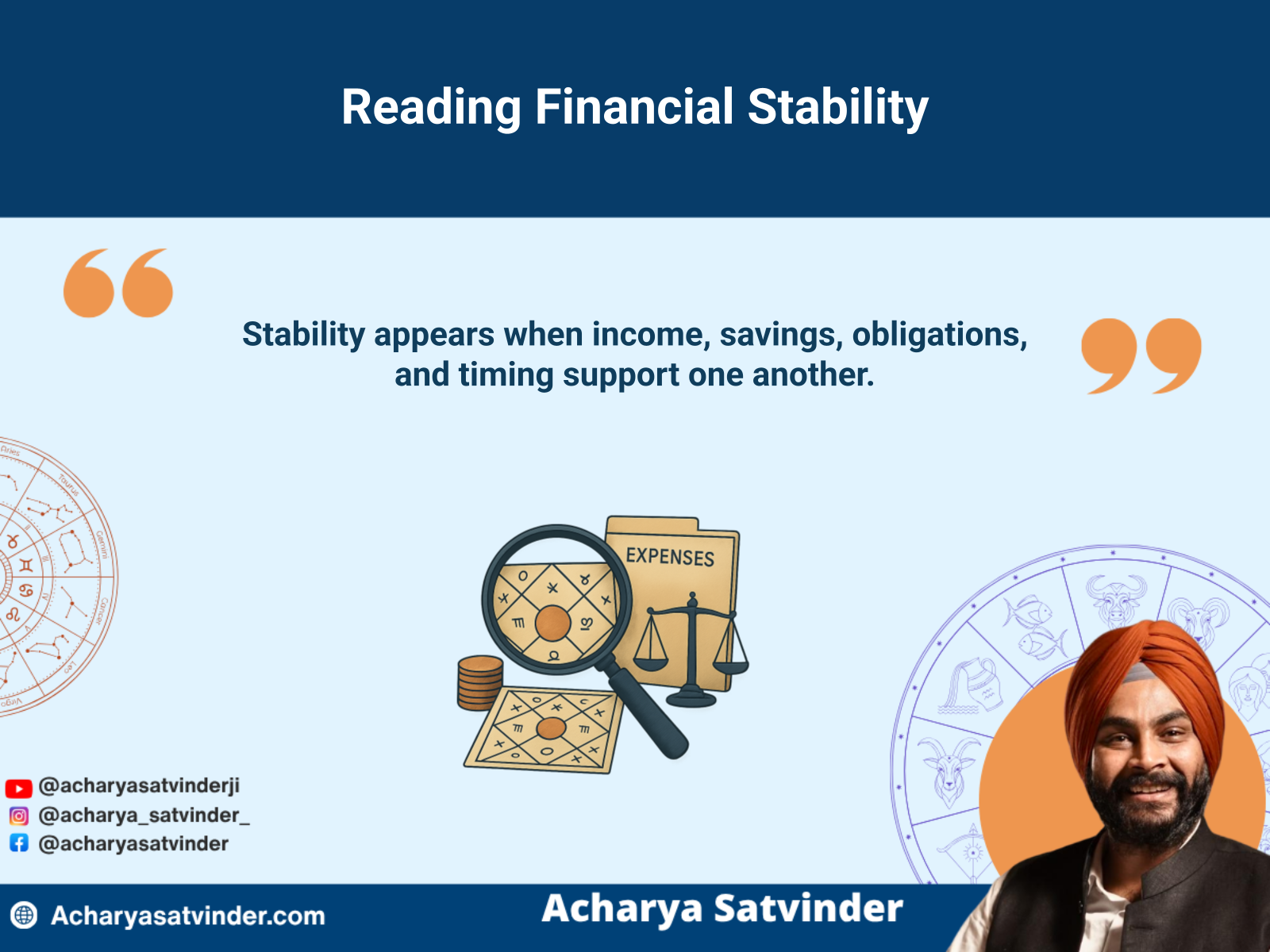
A responsible financial stability astrology reading begins with the ascendant and its lord. Their condition shows the person’s overall strength, judgement and ability to respond constructively during changing circumstances.
The astrologer then studies relevant houses, their lords, planetary dignity, conjunctions and aspects. Dashas and transits reveal when the chart’s financial patterns may become more active.
Stability is different from temporary abundance. A person may earn well during one phase yet struggle to retain money because expenses, debt or irregular decisions remain dominant.
A sound financial reading examines both opportunity and retention. Income alone does not create security.
Houses that shape financial stability
Several houses contribute to a person’s financial condition, and each answers a different question. Their relationships matter more than any house viewed separately.
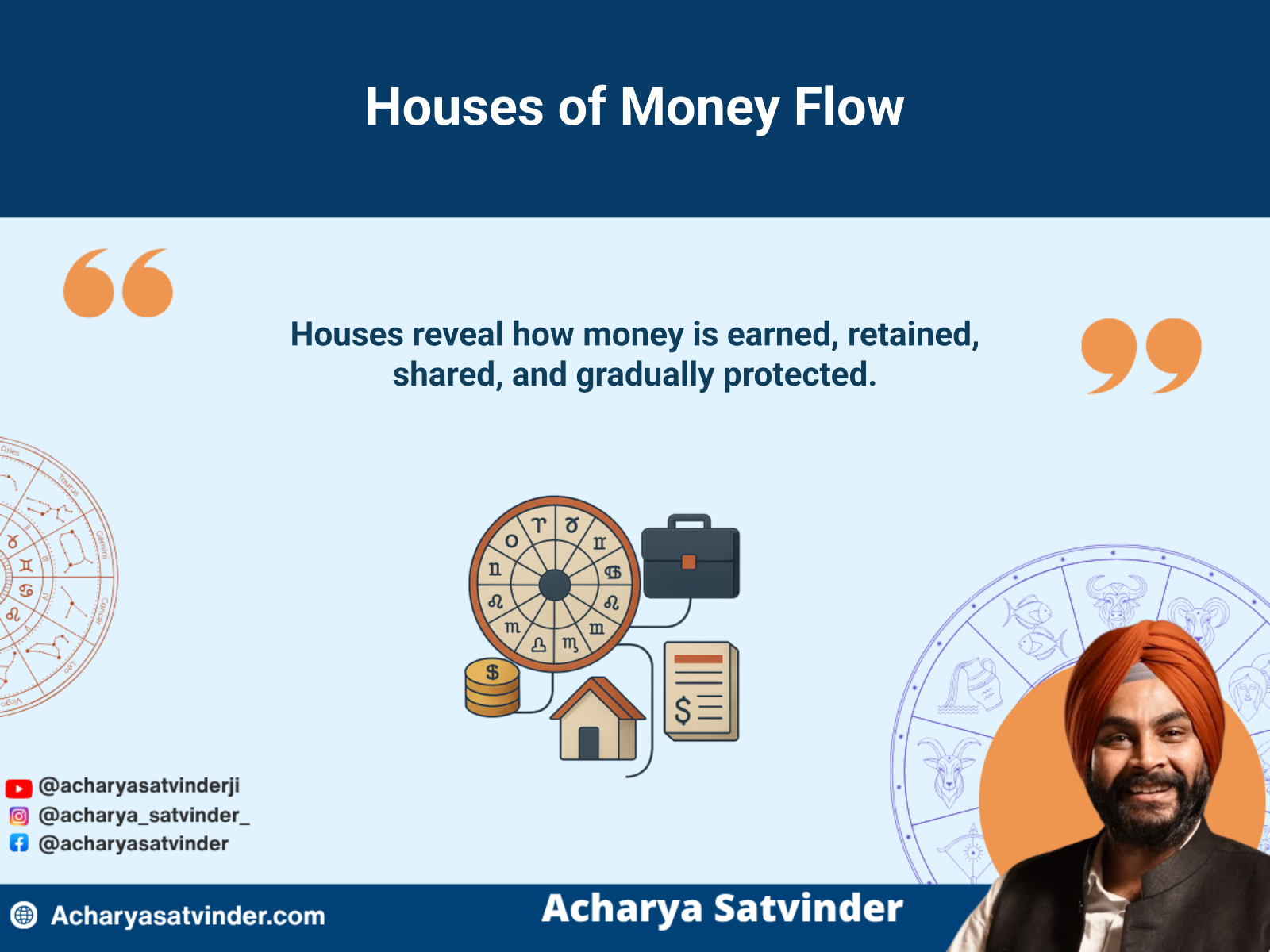
Second and eleventh houses
The second house represents accumulated resources, family values, possessions and saving habits. The eleventh house reflects gains, income, professional rewards and the fulfilment of material objectives.
A connection between their lords can support the movement of income into savings when both are suitably placed. For a deeper foundation, read how money-related houses operate in a birth chart.
Tenth and sixth houses
The tenth house describes profession, responsibility and public contribution. The sixth concerns employment, competition, service, loans and obligations that require regular management.
A strong earning pattern can still feel unstable when repayment demands consume most available income. The sixth house must therefore be assessed without automatically labelling it favourable or unfavourable.
Twelfth, eighth and fourth houses
The twelfth house helps evaluate expenditure and financial outflow, while the eighth can indicate shared assets, inheritance, uncertainty and sudden responsibilities. The fourth may contribute information about property, security and fixed assets.
Money houses show capacity, while expense and obligation houses reveal how much financial pressure that capacity must carry.
Planets and their financial roles
Planets describe different financial tendencies, skills and responsibilities according to their house rulership and condition. None can promise wealth or instability independently.
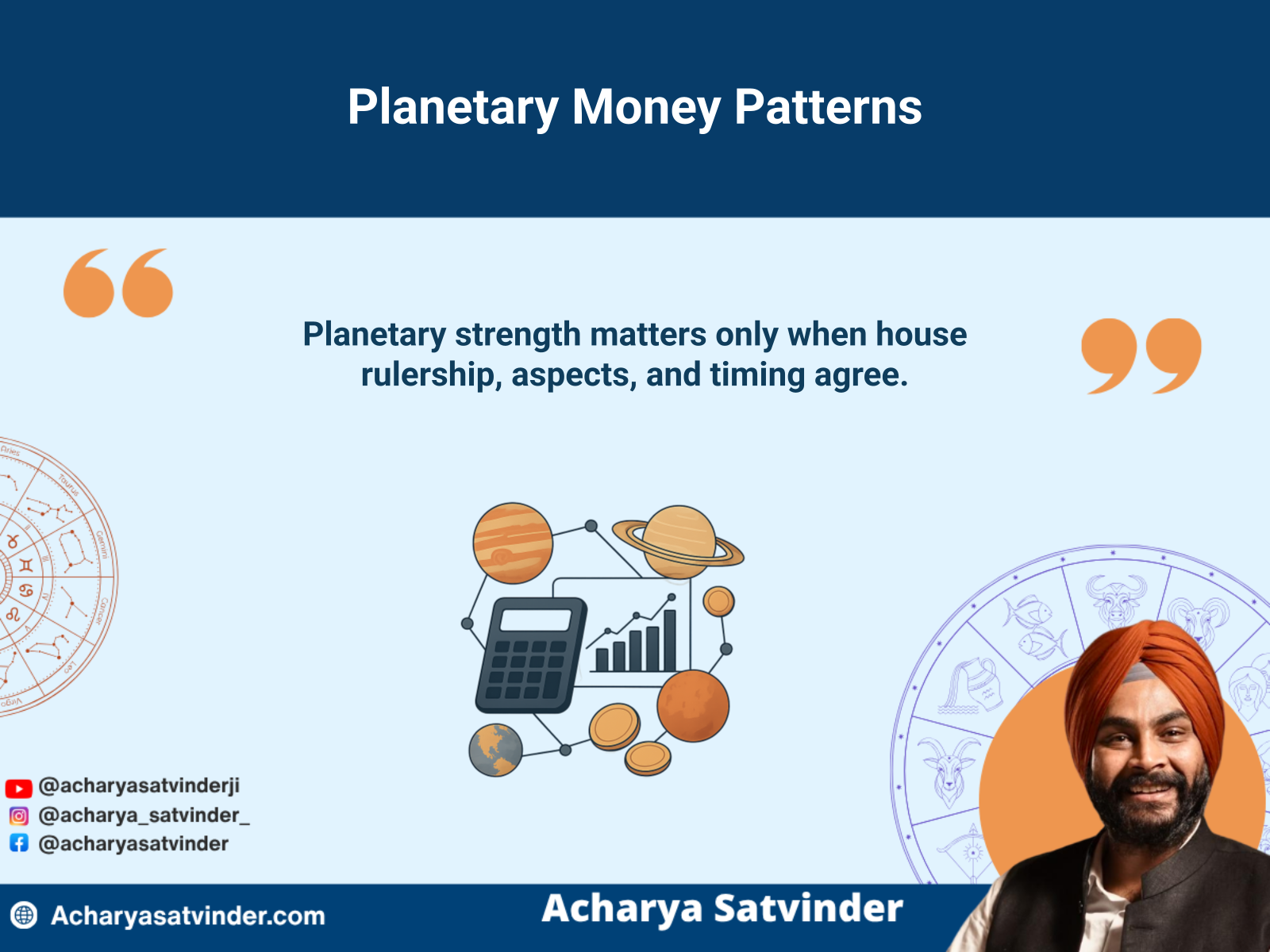
- Jupiter may reflect expansion, judgement, knowledge and the ability to recognise sustainable opportunities.
- Venus relates to value, comforts, agreements and the balance between enjoyment and responsible spending.
- Mercury can describe calculation, trade, communication, analysis and commercial adaptability.
- Saturn is associated with structure, patience, duty and results developed through sustained effort.
- Mars may show initiative, technical action, property matters and willingness to take financial risks.
- The Moon can reflect changing needs, emotional security and everyday responses to financial pressure.
- The Sun may connect finances with authority, leadership, government or independent responsibility.
Saturn is particularly relevant when studying slow accumulation and long-term responsibility. However, understanding Saturn’s disciplined role in astrology requires its lordship, strength, aspects and running period to be considered together.
A planet gives financial results through the houses it governs and activates, not through its name alone.
Dashas, transits and financial timing
A birth chart shows the underlying pattern, while planetary periods reveal when parts of that pattern become active. Transits provide additional context but should not override the natal promise.
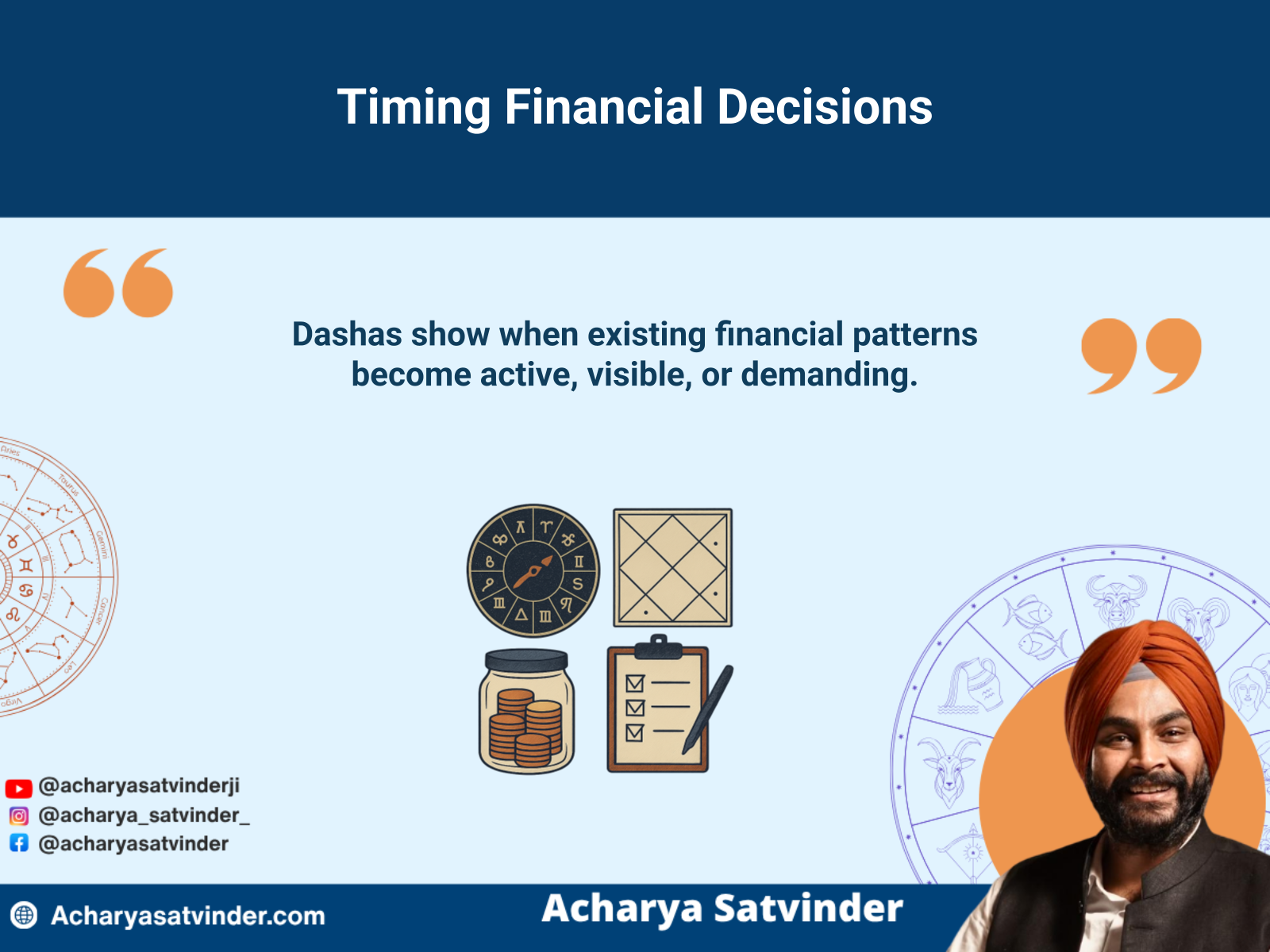
Dashas connected with the second, tenth or eleventh houses may highlight income, professional progress or accumulation. Periods involving the sixth, eighth or twelfth can bring repayments, restructuring, shared obligations or increased expenditure.
Suppose, hypothetically, that a person has supportive income combinations but enters a period strongly connected with expenses. Earnings may continue, yet saving becomes harder because unavoidable responsibilities receive greater attention.
This is why financial stability astrology must distinguish earning phases from accumulation phases. The D2 chart may provide supporting detail, but it should be interpreted with the main birth chart rather than independently.
Timing does not create a financial promise from nothing. It activates patterns already present in the complete chart.
Stability is different from sudden wealth
Occasional gains and lasting financial security are not the same condition. Stability normally requires continuity of income, controlled outflow and the ability to preserve resources through difficult phases.
Dhana Yogas can indicate wealth potential when relevant house lords form supportive relationships. Their results still depend on planetary strength, the ascendant, aspects, divisional support and an appropriate dasha.
For business owners, higher revenue may coexist with irregular cash flow or rising operating costs. Choosing the business direction that suits the complete astrology chart can offer context, but planning and market judgement remain essential.
In this sense, financial stability astrology asks whether gains can be managed consistently. It does not merely search for signs of a large payment or rapid expansion.
When financial instability appears
Financial strain can arise through several chart patterns and life circumstances working together. It should never be blamed on one planet, sign or house.
- Income may fluctuate while fixed responsibilities remain high.
- Savings may repeatedly move toward debt, family needs or emergencies.
- Professional changes may temporarily interrupt predictable cash flow.
- Shared finances may become complicated by incomplete communication.
Major life transitions can also reshape a household budget. When financial pressure accompanies separation concerns, examining relationship challenges and separation timing separately prevents money indicators from being mistaken for a definite marital outcome.
Likewise, sudden marriage timing indicators may matter when shared expenses and responsibilities begin quickly. The relationship chart factors and financial houses must still be interpreted through their own proper principles.
Financial pressure may accompany a life transition without defining its final outcome.
Practical guidance for building stability
Financial stability astrology becomes most useful when awareness leads to measured action. Planetary guidance should support discipline rather than encourage impulsive financial choices.
- Track income and spending: Compare predictable earnings with essential, flexible and avoidable expenses.
- Build an emergency reserve: Keep accessible savings for income interruptions and unexpected household costs.
- Review debt clearly: Understand repayment amounts, interest obligations and the effect of additional borrowing.
- Separate goals: Maintain distinct plans for emergencies, property, education, retirement and business growth.
- Manage investment risk: Seek qualified financial advice and avoid concentrating resources without understanding possible losses.
- Review important timing: Use astrology for perspective while checking contracts, affordability, taxes and legal responsibilities independently.
Naam Simran, Daan, Seva and disciplined living may help a person remain calm, grateful and accountable during demanding periods. These are conscious spiritual responses, not methods for changing the life path.
A consultation should clarify which patterns require patience, preparation or professional attention. It should never create fear or promise a specific financial result.
FAQs
Which house is most important for financial stability?
The second house describes accumulated resources and saving capacity. The eleventh house shows gains and income, so both must be assessed with their lords and supporting factors.
Can one planet guarantee wealth in a birth chart?
No planet can guarantee wealth or permanent financial comfort by itself. House rulership, strength, aspects, combinations, dashas and the complete chart must be studied together.
How do dashas affect financial stability?
Dashas activate the houses and planetary patterns connected with their ruling planets. They can highlight earning, saving, debt, expenses or restructuring according to the complete birth chart.
Can astrology tell me which investment to buy?
Astrology can provide perspective on timing, risk tendencies and decision patterns. It should not replace regulated financial guidance, independent research or an assessment of possible losses.
What details are required for a financial astrology reading?
An accurate birth date, birth time and birthplace are normally required to prepare the chart. Financial stability astrology can then examine relevant houses, planets, dashas and current concerns.
Final Words
Financial security develops when opportunity, timing and disciplined choices work together. A complete chart can clarify recurring patterns, but practical responsibility determines how thoughtfully that knowledge is used.
Used responsibly, financial stability astrology offers direction for understanding income, savings, obligations and changing financial periods. Acharya Satvinder Ji’s approach encourages awareness, realistic planning and steady action without fear or false promises.

Acharya Satvinder is a spiritual guide and life mentor who blends Sikh astrology, philosophy, and coaching to help you find clarity, balance, and purpose. He offers personalized guidance for career, relationships, stress, and spiritual growth — empowering you to unlock your true potential.
With over 20 years of experience, Acharya Satvinder is regarded as one of the most respected and Best astrologers in India for his ethical and disciplined approach. Each year, he guides more than 10,000 individuals through his teachings and consultations, including extensive one-to-one sessions with followers across India, Canada, USA and the global NRI community. His guidance explains discipline, conscious decision-making, seva, and inner clarity as the foundation of meaningful growth.