
Can vedic astrology be wrong? A reading can miss the mark when birth information, calculation choices, interpretation, or the expectation of absolute certainty creates a weak foundation.
Vedic astrology studies planetary direction, timing, and life patterns shown from birth. Its practical purpose is awareness: helping a person plan carefully, act with discipline, and understand recurring themes.
It should not be used to surrender personal judgment or avoid practical responsibility. A thoughtful reading offers a map of tendencies and periods, not a mechanical script for every event.
Why Can vedic astrology be wrong in practice?
Astrological guidance may seem wrong for several different reasons, and they should not be confused. Some concern the chart itself, while others arise from interpretation, timing, language, or unrealistic expectations.
The practical answer to Can vedic astrology be wrong is yes: an astrologer can make an error, a prediction can be too rigid, or the available birth data can be incomplete.
This does not make every traditional principle meaningless, nor does it prove every reading correct. It means the reliability of a conclusion depends on how carefully and responsibly the method is applied.
A chart may contain useful direction, but the astrologer remains responsible for interpreting that direction with humility.
- Rounded or incorrect birth time may alter the ascendant and house structure.
- A general statement may be mistaken for a guaranteed event.
- One planet may be judged without considering its lordship, strength, or aspects.
- Dasha timing may be read without checking supporting transits and chart factors.
- The person may remember one sentence while overlooking the conditions attached to it.
What a wrong reading can mean
Not every apparent failure has the same cause or importance. The event, timing, intensity, and language of a prediction must be examined separately before deciding what went wrong.
Sometimes the predicted event does not occur at all. In other cases, the broader theme appears, but its form, scale, or timing differs from the original statement.
For example, a period described as professional growth might bring greater responsibility without an immediate promotion. The theme may be visible, while an overly specific conclusion remains inaccurate.
A statement can also be so broad that almost any experience seems to confirm it. Responsible astrology should offer meaningful context, practical limits, and a clear explanation of uncertainty.
A prediction should not be rescued by changing its meaning after the outcome is already known.
From a modern research perspective, scientific testing of astrology has not produced broad empirical validation. People may still value it as a traditional or reflective framework, but that is different from laboratory proof.
Where errors usually begin
Most unreliable readings can be traced to a few recurring weaknesses. Reviewing the input, calculation method, interpretive process, and wording often reveals where confidence became greater than the available evidence.
Uncertain birth details
The ascendant and house positions depend heavily on birth time and location. A time recalled approximately by relatives may produce a chart that differs from one based on a reliable record.
If the ascendant is near a boundary, a modest time difference can affect house lordship and divisional analysis. Birth time rectification may be considered, but its assumptions should be explained honestly.
Different calculation settings
Astrological software may use different ayanamsa settings, node calculations, house approaches, or dasha options. These choices can create differences in degrees, nakshatras, house positions, and period dates.
A responsible astrologer should use a consistent method and understand it. Switching systems only because another setting produces a preferred answer weakens the reading.
Incomplete interpretation
A planet cannot be labelled favourable or difficult in isolation. Its sign, house, lordship, dignity, conjunctions, aspects, relevant divisional position, and active planetary periods must be considered together.
Personal bias can also influence interpretation. An astrologer who expects delay, conflict, or success may unintentionally give more weight to chart factors supporting that expectation.
Accuracy begins with honest inputs; interpretation cannot repair a chart built on uncertain information.
Why complete-chart analysis matters
The Jyotisha tradition treats the horoscope as an interconnected structure rather than a collection of isolated placements. Sound analysis compares several layers before reaching a practical conclusion.
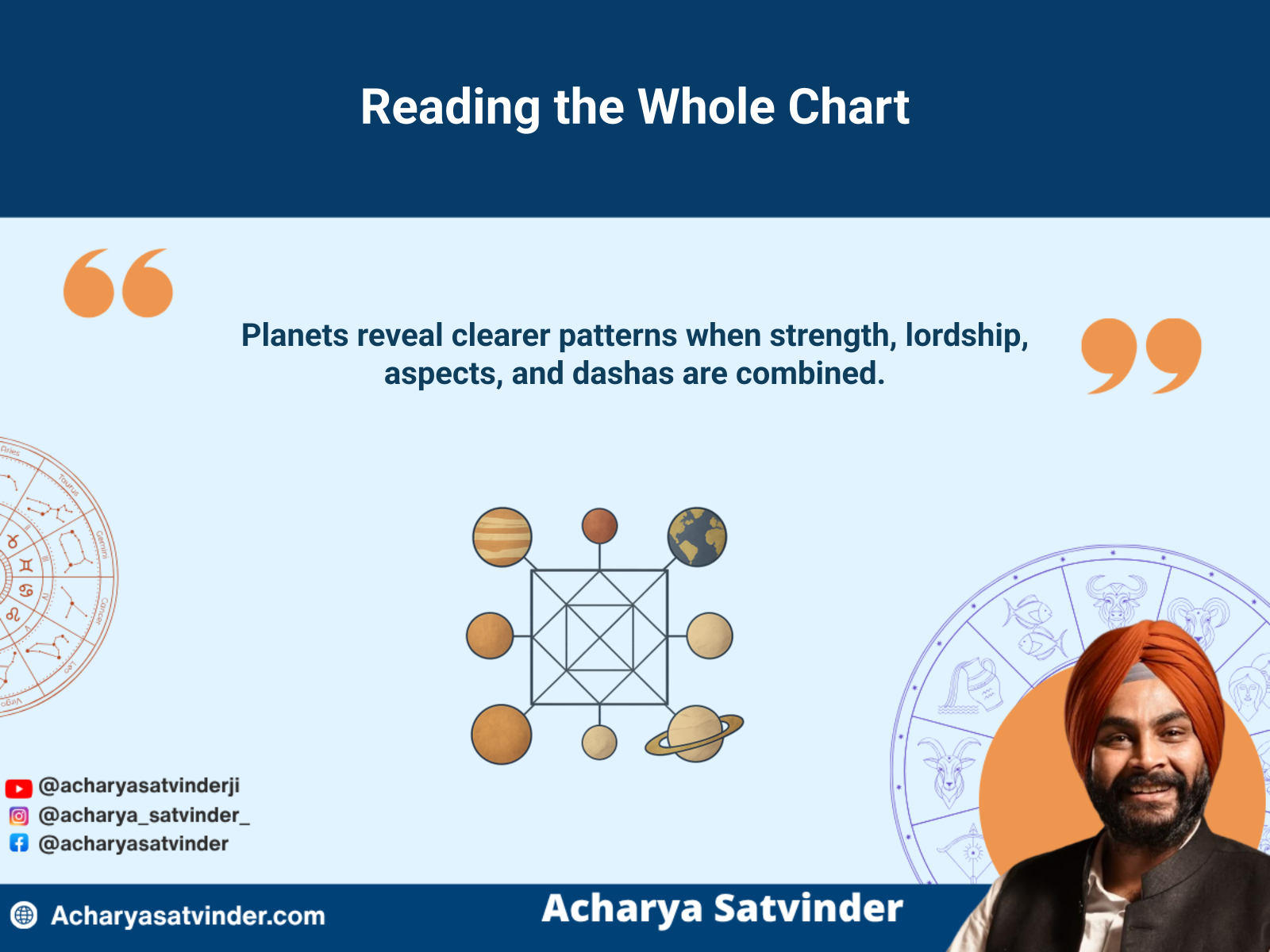
A complete reading normally considers the ascendant, ascendant lord, relevant houses, house lords, planetary strength, aspects, conjunctions, dashas, transits, and appropriate divisional charts.
The repeated pattern matters more than a dramatic placement seen alone. When several independent factors support the same theme, the interpretation has a stronger traditional basis.
- Promise: Does the birth chart contain the relevant life pattern?
- Strength: Can the connected planets express their indicated results?
- Timing: Are the relevant dashas and sub-periods active?
- Support: Do transits and associated houses reinforce the conclusion?
- Context: How do age, circumstances, decisions, and responsibilities shape expression?
Consider a hypothetical career question. The tenth house alone cannot establish promotion timing if its lord, the active dasha, professional significators, and supporting transits point in different directions.
No planet speaks alone; every conclusion belongs to a wider pattern of lordship, strength, aspect, and timing.
Prediction, probability and personal action
Astrological language becomes misleading when possibilities are presented as fixed promises. A careful reading describes stronger periods, likely themes, pressures, and choices without claiming certainty about every detail.
When people ask Can vedic astrology be wrong, they often remember a precise date or event that failed. Such precision may have exceeded what the combined chart factors could reasonably support.
Timing is often better understood as a window rather than one guaranteed day. A favourable professional period, for instance, may support interviews, new duties, training, relocation, or a change in workplace direction.
Personal action also matters within the lived experience of a period. Preparation, communication, skill, health, family obligations, and economic conditions can influence how an opportunity is encountered.
This does not mean disciplined action rewrites the life path. It means awareness helps a person respond more responsibly to the direction and timing indicated by the chart.
How to judge a reading wisely
A trustworthy consultation should make the reasoning understandable without overwhelming the listener. It should also distinguish observation, interpretation, possibility, and firm practical advice instead of blending them together.
Use the following questions to evaluate the quality of an astrology reading:
- Were the exact birth details confirmed before interpretation?
- Did the astrologer consider the complete chart rather than one isolated placement?
- Were dashas, house lords, planetary strength, aspects, and timing connected logically?
- Were uncertainty and alternative expressions acknowledged?
- Did the guidance encourage practical preparation rather than fear?
- Were health, legal, or financial concerns directed toward qualified professionals when necessary?
- Did the consultation leave you clearer rather than dependent?
Acharya Satvinder Ji presents astrology as a guiding science for understanding planetary direction and life patterns. Its value lies in planning with awareness, patience, discipline, and personal responsibility.
An ethical astrologer should be willing to say when the birth time is uncertain or the chart does not support a highly specific answer. Honest limits strengthen guidance rather than weaken it.
A useful reading reduces confusion and fear; it does not create certainty, pressure, or dependence.
What to do after a failed prediction
A failed prediction should lead to calm review rather than panic or complete surrender of judgment. The aim is to identify what can be checked, corrected, or understood more carefully.
- Write down the original prediction without changing its wording afterward.
- Confirm the recorded birth time, birthplace, and time-zone details.
- Ask which houses, lords, dashas, aspects, and transits supported the conclusion.
- Check whether the statement included conditions or alternative expressions.
- Consider a second responsible analysis if the matter is important.
- Continue practical action instead of waiting passively for an event.
Naam Simran, Daan, Seva, and disciplined living may support patience, humility, and inner steadiness. They are conscious spiritual responses, not devices for replacing effort or controlling the life path.
Major medical, legal, financial, relationship, and career decisions require real-world information and appropriate professional support. Astrological guidance can add reflection, but it should not replace evidence, consent, planning, or expert care.
FAQs
Can vedic astrology be wrong even with correct birth details?
Yes, because correct data does not guarantee correct interpretation. The astrologer must still assess the complete chart, planetary strength, aspects, dashas, and timing carefully.
Why do two astrologers give different predictions?
They may use different calculation settings, interpretive techniques, or levels of experience. They may also assign different importance to certain chart factors or timing systems.
Can an incorrect birth time change a Kundli reading?
Yes, birth time affects the ascendant, houses, and time-sensitive chart divisions. Even a modest difference can matter when important positions are close to boundaries.
Should I make major decisions only from astrology?
No, major decisions should include facts, professional advice, personal values, and practical consequences. Astrology may offer reflective guidance, but it should not replace informed judgment.
What makes a Vedic astrology reading more reliable?
Reliable analysis begins with accurate birth data and a consistent calculation method. It then examines the complete chart, house lords, planetary strength, aspects, dashas, transits, and real-life context.
Final Words
The balanced answer is that readings can fail, especially when data, method, or interpretation is weak. Good guidance remains humble, complete, and focused on responsible action.
If you ask Can vedic astrology be wrong, use the answer to seek clarity rather than certainty. Astrology is most constructive when it supports awareness, discipline, and sound decisions.

Acharya Satvinder is a spiritual guide and life mentor who blends Sikh astrology, philosophy, and coaching to help you find clarity, balance, and purpose. He offers personalized guidance for career, relationships, stress, and spiritual growth — empowering you to unlock your true potential.
With over 20 years of experience, Acharya Satvinder is regarded as one of the most respected and Best astrologers in India for his ethical and disciplined approach. Each year, he guides more than 10,000 individuals through his teachings and consultations, including extensive one-to-one sessions with followers across India, Canada, USA and the global NRI community. His guidance explains discipline, conscious decision-making, seva, and inner clarity as the foundation of meaningful growth.