Which kundli chart is best depends on the question you want the chart to answer. The direct answer is the D1 Lagna or Rashi chart for an overall Vedic reading.
The D9 Navamsa provides essential supporting insight, while charts such as D10, D7 and D4 examine particular life areas. None should be interpreted as a complete replacement for D1.
A reliable reading begins with a kundli prepared from the correct birth date and time. Accurate birthplace information is also necessary because the ascendant and house structure depend on location.
Which kundli chart is best for general guidance?
There is no single chart that independently answers every possible question. For broad life guidance, begin with D1 and confirm important findings through relevant supporting charts and timing systems.
For most people asking, “Which kundli chart is best?”, the practical choice is the D1 chart because it establishes the ascendant, houses, planetary signs, house lords and major life patterns.
- D1 Lagna chart: Overall direction, personality, health, relationships, work and major life areas.
- D9 Navamsa: Planetary depth, dharma, maturity and marriage-related assessment.
- Relevant divisional chart: Focused analysis of career, property, children or another specific subject.
The best chart is not the most complicated one. It is the chart suited to the question and read within the complete Kundli.
North Indian, South Indian and East Indian layouts present the same planetary information through different visual arrangements. A familiar layout may be easier to read, but it is not more accurate.
If you are wondering whether kundli really matters in practical life, its value lies in thoughtful guidance rather than fear. It can help identify patterns, timing and areas requiring disciplined attention.
Why the D1 Lagna chart comes first
The D1 chart is the foundation from which the other birth-chart divisions are calculated and understood. It gives the broadest view of the person and the life path.
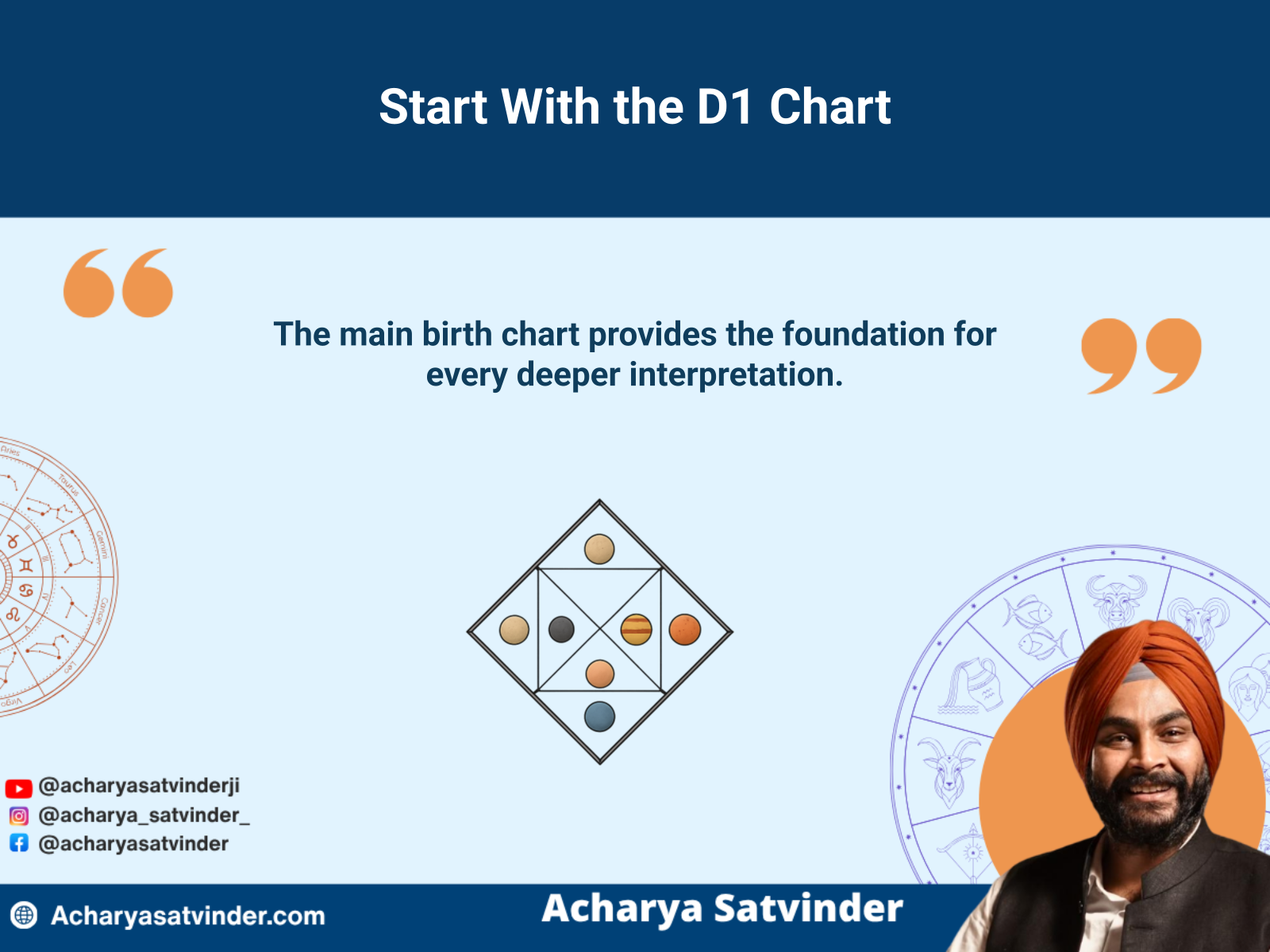
The ascendant establishes the first house, while the remaining houses represent different life areas. Planets, signs, conjunctions, aspects and house lordships must then be studied together.
- The first house describes the self and general direction.
- The seventh house concerns partnerships and marriage.
- The tenth house relates to work, responsibility and public contribution.
- The eleventh house concerns gains, networks and fulfilment of aims.
A Bhava Chalit chart can refine house placement, but it does not replace the Rashi chart. The Chandra Kundli also offers a secondary viewpoint, particularly for emotional experience and selected timing observations.
D1 establishes the main promise of the birth chart. Supporting charts help an astrologer examine its strength, expression and timing.
A sound interpretation also checks planetary degrees, nakshatras, house lords and active dashas. One favourable or difficult placement cannot responsibly decide the entire result.
How D9 and divisional charts add depth
Divisional charts magnify particular dimensions already present within the birth chart. They are most useful when the birth time is reliable and the D1 foundation has been properly assessed.
Navamsa for strength and maturity
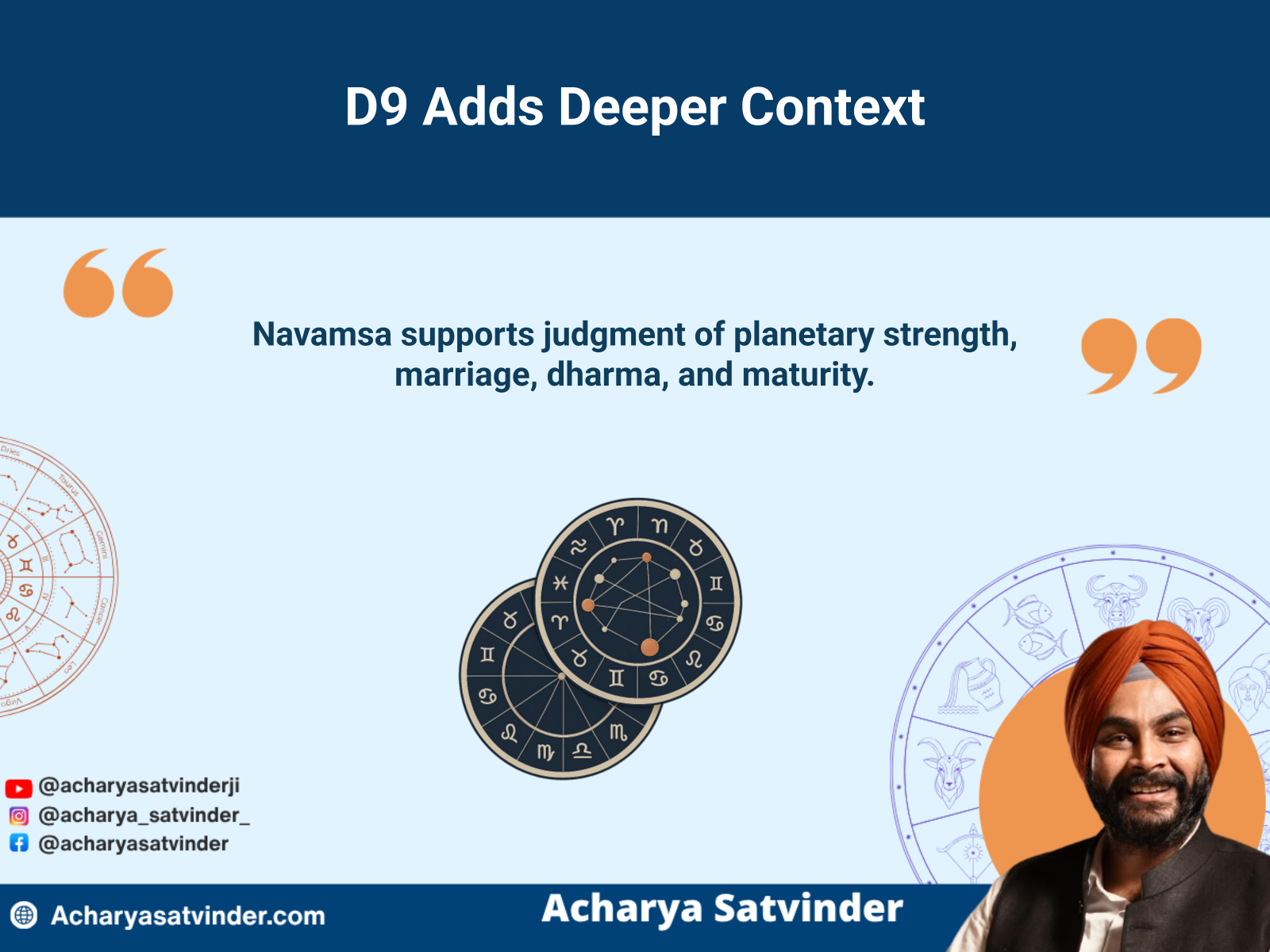
The D9 Navamsa is commonly studied after D1 to assess marriage, dharma and the deeper condition of planets. A placement in D9 must always be connected back to its role in D1.
Other charts for focused questions
- D2 Hora: Resources, financial capacity and the handling of material support.
- D4 Chaturthamsa: Property, residence, stability and fixed assets.
- D7 Saptamsa: Children, parenthood and related responsibilities.
- D10 Dasamsa: Career direction, professional role, authority and contribution.
A divisional chart adds resolution, not a separate life story. Its indications must remain connected to the main birth chart.
Sensitive divisions can change with a small difference in recorded birth time. This is why advanced charts should not be used casually when the birth details are approximate.
Which chart fits a specific life question?
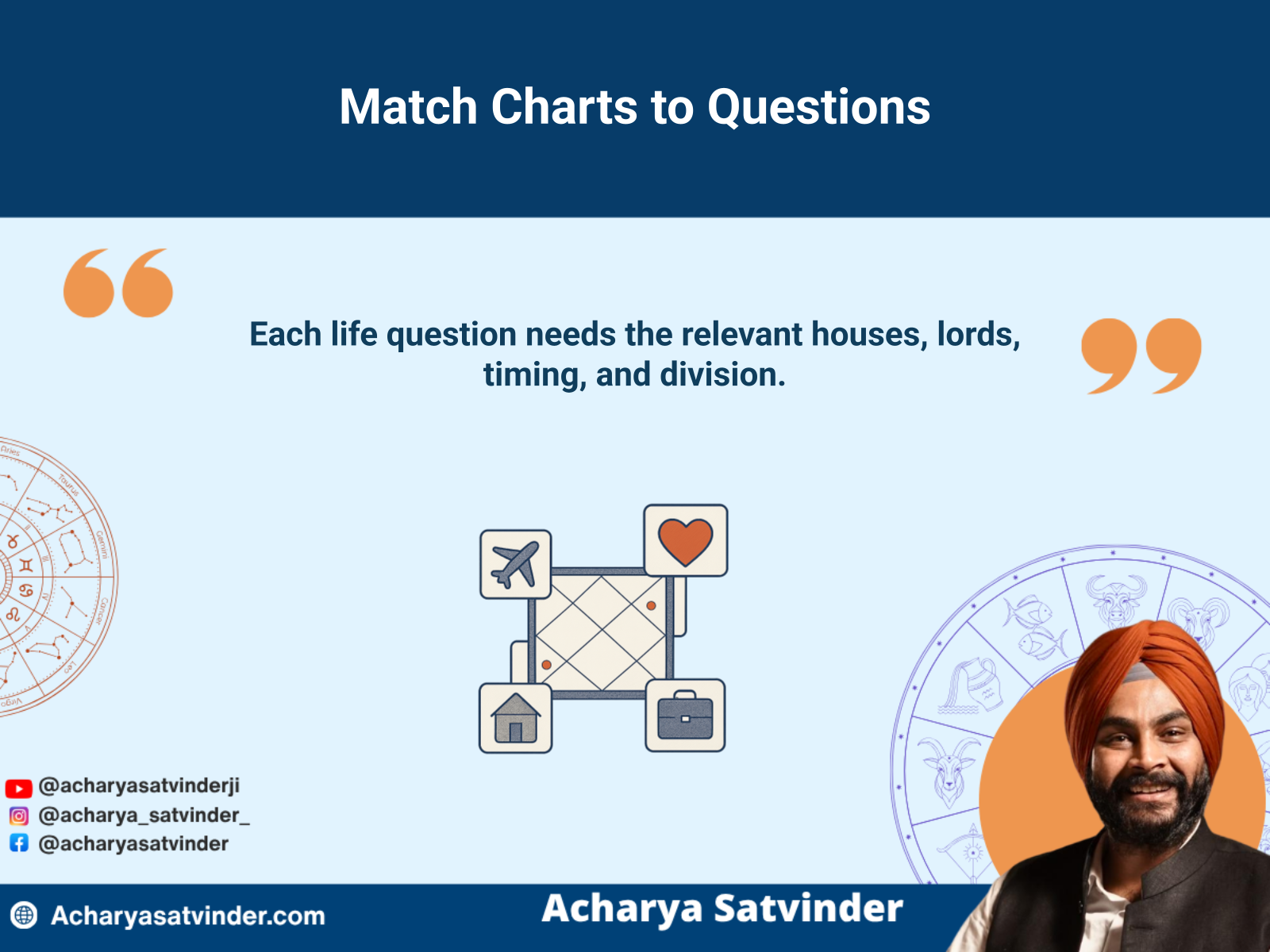
The purpose of the reading determines which supporting chart deserves attention. The relevant D1 houses, their lords, significators, divisional chart and timing must agree before reaching a conclusion.
Marriage and relationships
Which kundli chart is best for marriage? Begin with the D1 seventh house, its lord and relationship significators, then use D9 to assess deeper strength, compatibility themes and maturity.
Career and professional growth
Career analysis starts with the D1 second, sixth, tenth and eleventh houses. D10 adds detail about professional responsibility, work environment and the manner in which ability develops.
Money and property
Financial analysis considers the complete D1 pattern, especially houses of income, resources and gains. D2 can add financial context, while D4 becomes relevant for property and residence.
Travel and settlement abroad
Questions about living overseas require connections among travel, residence and distance-related houses. A careful reading of the houses associated with foreign settlement is more dependable than judging Rahu or the twelfth house alone.
Event timing
Charts describe potential and life areas, while dashas and transits help examine when themes may become active. Learning which Mahadasha is running in your Kundli is therefore central to practical timing.
The chart identifies the subject, but timing systems show when that subject may demand attention, effort or patience.
Birth-time accuracy matters more than chart style
An attractive chart cannot correct inaccurate birth information. Reliable date, time and place details are more valuable than choosing a fashionable layout or generating many advanced divisions.
The ascendant and house structure can be sensitive to time, while divisional charts may be even more sensitive. An uncertain birth time should be disclosed before interpretation begins.
Where the recorded time is doubtful, an astrologer may compare known life events and chart possibilities. The final reading should acknowledge uncertainty rather than present fragile details as certainty.
Precision begins before interpretation. Better birth data creates a stronger foundation for meaningful astrological guidance.
North Indian or South Indian format?
Neither format is inherently better. The North Indian layout keeps houses fixed, while the South Indian layout keeps zodiac signs fixed; both can show the same ascendant and planetary positions.
Choose the style that you or your astrologer can read clearly. Changing the drawing format does not change the underlying Kundli.
How a complete Vedic reading is built
A useful reading follows a sequence rather than jumping between isolated combinations. Each layer should clarify the main chart without creating unnecessary fear or contradiction.
Acharya Satvinder Ji approaches astrology as a guiding science for understanding planetary direction, timing and birth patterns. Its purpose is to help a person plan with awareness, responsibility and discipline.
- Confirm the birth details and ascendant.
- Read the D1 houses, lords and planetary strengths.
- Check relevant aspects, conjunctions and nakshatras.
- Use D9 and the subject-specific divisional chart.
- Examine Mahadasha, Antardasha and major transits.
Naam Simran, Daan, Seva and disciplined living may support a conscious spiritual response to difficult periods. They should not be presented as methods for rewriting the life path shown at birth.
Astrology becomes useful when insight leads to wiser planning, steadier conduct and a more disciplined response to circumstances.
When a professional Kundli reading helps
Software can calculate planetary positions, but interpretation requires context and judgment. Professional guidance is valuable when several charts appear contradictory or a major decision requires clarity.
A guide to choosing the right astrologer for clear Vedic guidance can help you assess the reader’s approach. Look for balanced explanations, complete-chart analysis and respect for personal responsibility.
A consultation with Acharya Satvinder Ji can connect D1, D9, relevant divisional charts and timing into one understandable direction. The aim is informed planning, not fear or absolute predictions.
FAQs
Which kundli chart is best for beginners?
Begin with the D1 Lagna or Rashi chart because it provides the complete foundation. Learn the ascendant, houses, planets and house lords before studying divisional charts.
Is D9 more important than D1?
D9 is highly important, but it does not replace D1. It adds depth concerning planetary strength, marriage, dharma and maturity.
Which Kundli chart is best for career analysis?
Career analysis begins with the D1 chart and its work-related houses. The D10 Dasamsa then provides more focused professional insight.
Does changing the Kundli chart style change the prediction?
No, the visual layout does not change the planetary data. North Indian and South Indian formats simply arrange houses and zodiac signs differently.
Can divisional charts be read with an approximate birth time?
Sensitive divisional charts may change when the recorded time changes slightly. Disclose any uncertainty so the astrologer can keep the interpretation appropriately cautious.
Final Words
The answer to “Which kundli chart is best?” begins with D1, becomes clearer through D9 and gains focus through the relevant divisional chart. A complete reading also requires accurate birth details, house lords, planetary strength, aspects, dashas and timing.

Acharya Satvinder is a spiritual guide and life mentor who blends Sikh astrology, philosophy, and coaching to help you find clarity, balance, and purpose. He offers personalized guidance for career, relationships, stress, and spiritual growth — empowering you to unlock your true potential.
With over 20 years of experience, Acharya Satvinder is regarded as one of the most respected and Best astrologers in India for his ethical and disciplined approach. Each year, he guides more than 10,000 individuals through his teachings and consultations, including extensive one-to-one sessions with followers across India, Canada, USA and the global NRI community. His guidance explains discipline, conscious decision-making, seva, and inner clarity as the foundation of meaningful growth.