How to be a good astrologer begins with disciplined study, patient observation, and respect for the person whose birth chart you are reading. Memorizing planetary meanings is useful, but it is only the beginning.
A capable astrologer connects technical knowledge with timing, practical context, careful listening, and responsible language. The goal is guidance that strengthens awareness rather than fear or dependence.
Acharya Satvinder Ji presents astrology as a guiding science for understanding planetary direction and life patterns shown from birth. Its purpose is thoughtful planning, conscious action, and disciplined living.
How to be a good astrologer through disciplined foundations
Strong practice begins with a dependable understanding of the chart’s basic components. Each concept should be learned separately before several factors are combined into one interpretation.
Learn the vocabulary before prediction
Study the twelve signs, twelve houses, nine grahas, nakshatras, house ownership, aspects, conjunctions, planetary strength, and dispositors. Know what each factor represents and how its meaning changes through context.
The Lagna establishes the chart framework, while its lord helps describe overall direction and capacity. The Moon, Sun, relevant house lords, and active planetary periods add further layers.
- Learn the natural qualities and significations of every graha.
- Understand the life areas represented by all twelve houses.
- Memorize sign lords and identify them quickly in any chart.
- Distinguish a planet’s natural role from its functional role.
- Study aspects, conjunctions, strength, and supporting combinations.
Students seeking neutral background on terminology may consult an overview of Hindu astrology. Traditional terms become useful only when you can apply them coherently to a complete chart.
Knowledge becomes dependable when every conclusion can be traced through connected chart factors.
Read the complete kundli, not fragments
A single placement may offer a clue, but it cannot establish the whole result. Reliable interpretation comes from examining ownership, condition, relationships, supporting factors, and timing together.
Never declare an outcome from one planet, sign, house, or combination. Begin with the Lagna, identify the relevant houses, and examine how their lords connect with the broader chart.
- Which houses does the planet rule?
- Where is it placed, and in which sign?
- What is the condition of its dispositor?
- Which planets join or aspect it?
- Does the relevant house receive additional support or pressure?
- Is the planet connected with the active dasha or sub-period?
Suppose Mars occupies the tenth house in a hypothetical chart. Career success, conflict, leadership, or instability should not be declared until ownership, strength, aspects, dasha involvement, and the remaining professional indicators are considered.
Divisional charts may provide supporting detail when the birth time is dependable. They should clarify the main chart rather than become isolated sources of dramatic conclusions.
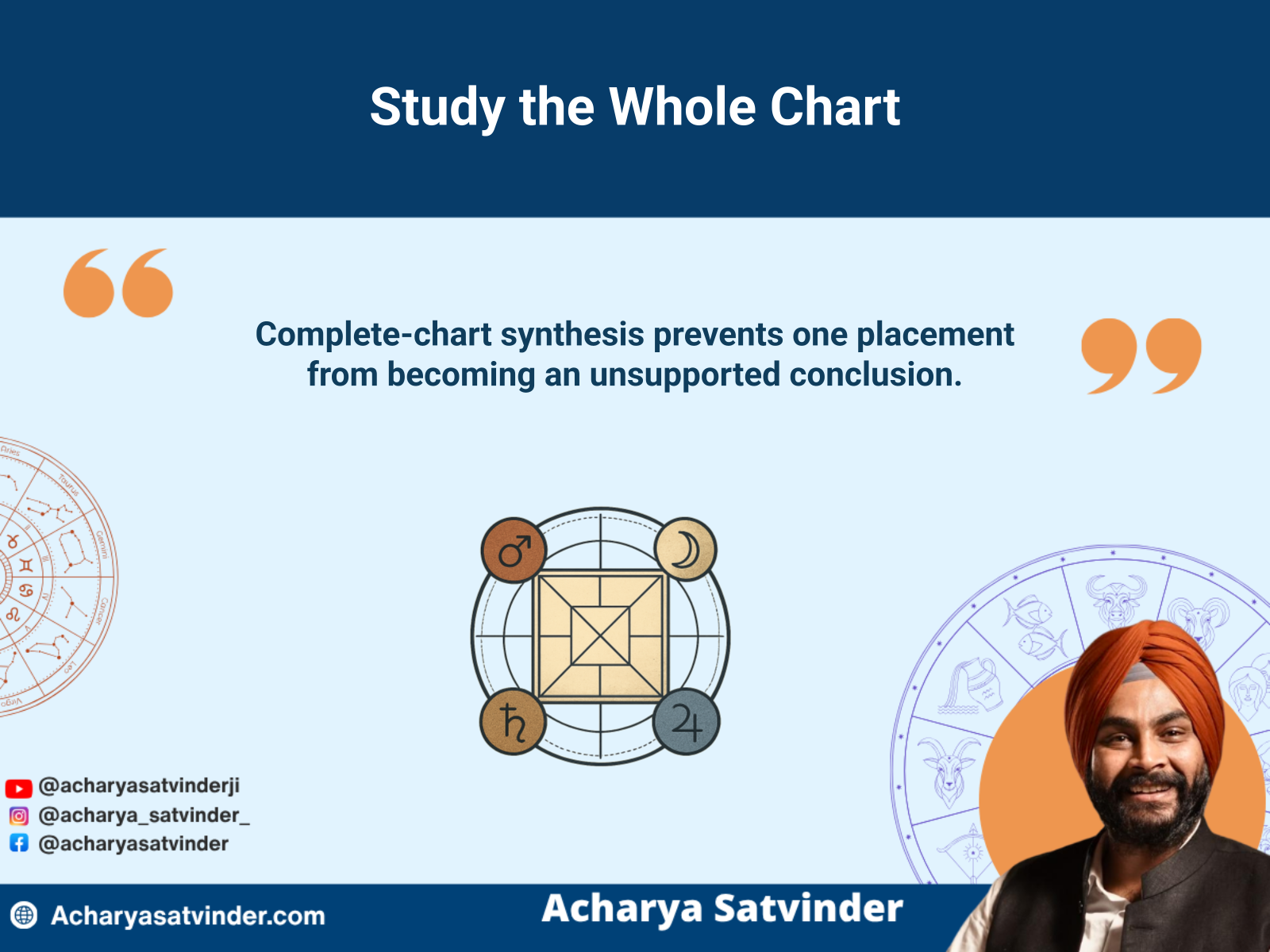
No placement speaks alone; complete-chart synthesis gives each indication its proper weight.
Build a repeatable analysis method
A fixed sequence protects the reader from jumping toward a preferred answer. It also makes interpretation easier to review, explain, and correct as experience develops.
A practical reading sequence
- Confirm birth data: Verify the recorded date, time, birthplace, and reliability of the source.
- Establish the framework: Identify the Lagna, Lagna lord, Moon, Sun, and overall planetary distribution.
- Define the question: Connect the person’s concern with the appropriate houses, significators, and practical circumstances.
- Examine house lords: Study ownership, placement, strength, aspects, conjunctions, and dispositors.
- Look for repetition: Give more weight to themes supported by several independent chart factors.
- Add timing: Review the Mahadasha, Antardasha, and relevant transits after understanding the natal pattern.
- Form practical guidance: Translate the analysis into clear priorities, cautions, and responsible next steps.
Write down the evidence supporting each interpretation. If you cannot explain why a conclusion was reached, return to the chart instead of presenting intuition as certainty.
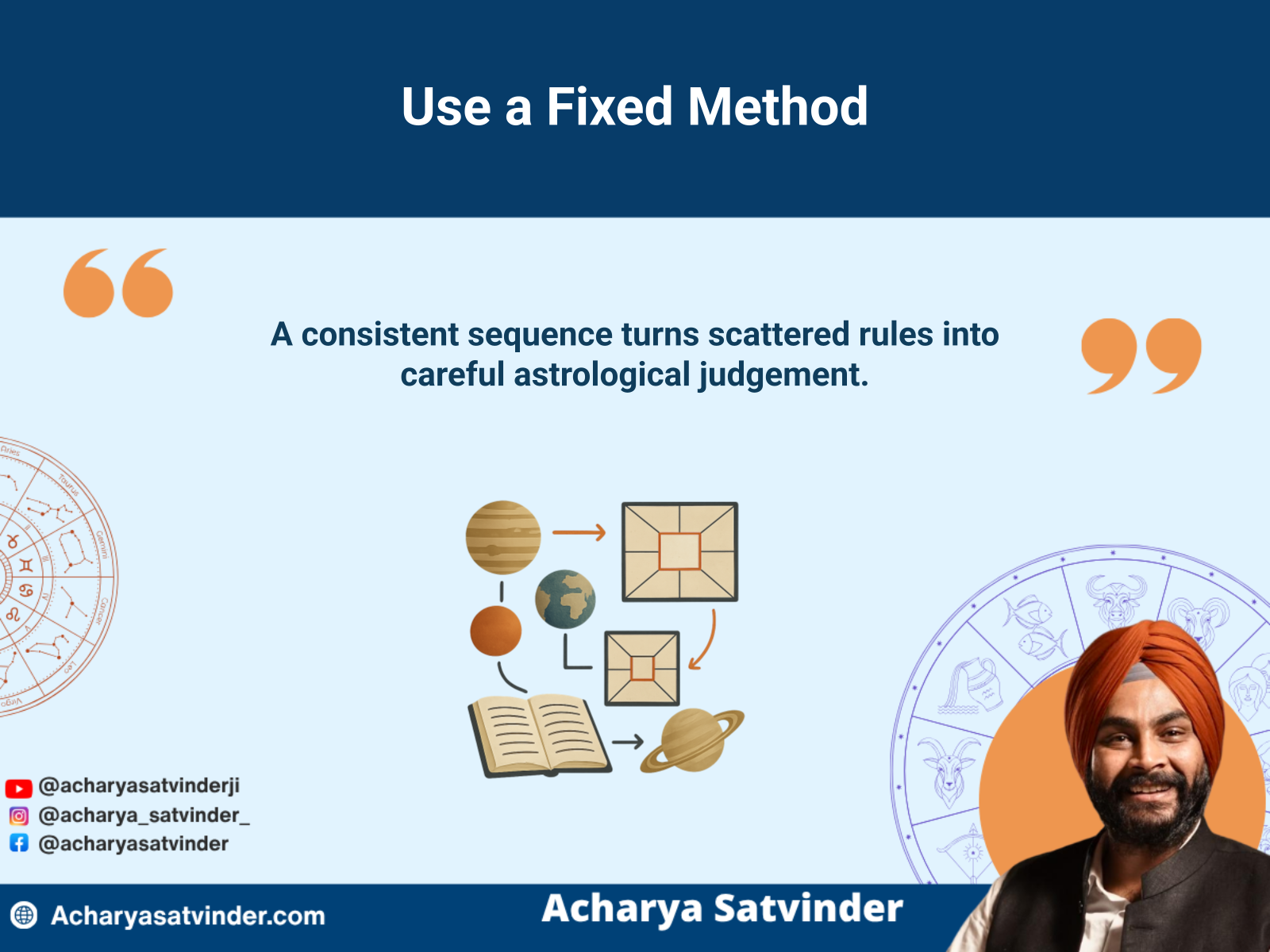
A consistent sequence turns scattered astrological rules into careful professional judgement.
Develop consultation and communication skills
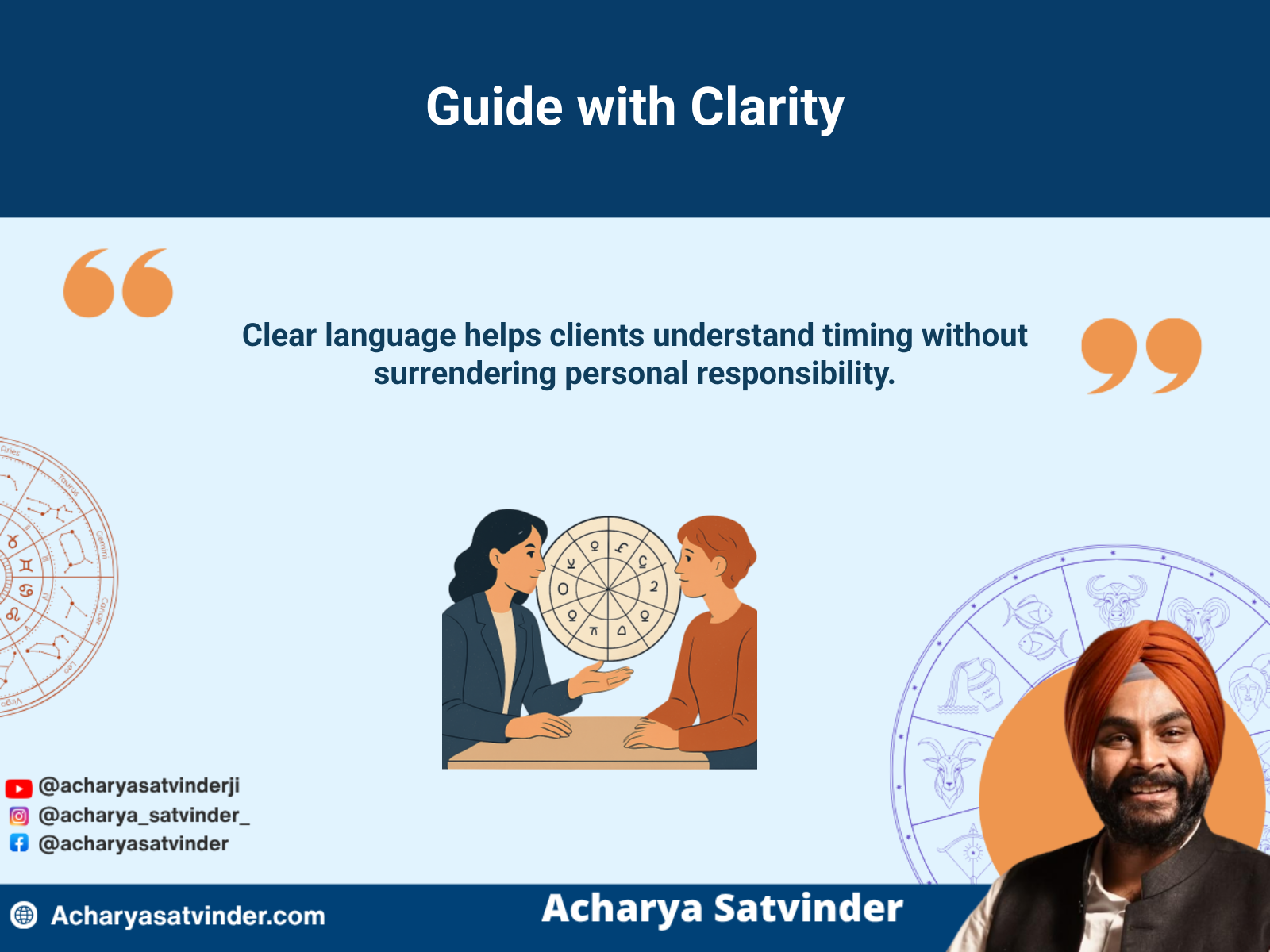
Technical accuracy is only valuable when the listener can understand and apply it. A good consultation requires attentive questions, calm language, useful structure, and respect for personal judgement.
Ask before interpreting
Begin by clarifying the person’s main concern, recent circumstances, deadlines, and responsibilities. This helps you identify the relevant chart areas without turning the session into an unfocused account of everything.
- Ask what the person wants to understand or plan.
- Confirm whether the birth time is recorded or estimated.
- Separate immediate concerns from long-term questions.
- Explain uncertainty when several interpretations remain possible.
- Summarize the main guidance before ending the consultation.
Use ordinary language before technical terminology. When a Vedic term is necessary, explain what it means, why it matters, and which other chart factors support the interpretation.
Studying service information can also reveal how expectations vary by context. Compare how Vedic guidance in Panchkula and online guidance in Patiala explain preparation, access, and consultation scope.
For remote practice, review how online astrology guidance in Manchester and consultation guidance in London present practical details. The lesson is to make your own process transparent, not to copy wording.
Leave space for questions and respectful disagreement. Guidance should help the person think more clearly, not pressure them to accept every interpretation without reflection.
Follow firm ethical boundaries
Trust depends on how you handle private information, uncertainty, and emotionally sensitive concerns. Ethical limits protect the client, the consultation, and the integrity of your practice.

How to be a good astrologer also depends on knowing what astrology should not replace. Medical, legal, psychological, and regulated financial concerns require appropriately qualified professionals.
- Keep birth details, recordings, notes, and personal discussions confidential.
- Explain the consultation method, duration, scope, and fees beforehand.
- Obtain consent before recording or using chart material for teaching.
- Avoid fear-based statements, absolute predictions, and false urgency.
- Do not interpret another living person’s private life without suitable consent.
- Refer concerns beyond your knowledge or professional competence.
Honesty about limits is a strength. Uncertain birth data, conflicting indicators, or insufficient experience should lead to careful qualification rather than exaggerated confidence.
Responsible guidance protects autonomy, confidentiality, and the client’s ability to make independent decisions.
Practise, review, and cultivate discipline
Astrological judgement develops through repeated analysis, written reasoning, correction, and observation over time. Random chart reading without review can reinforce errors instead of improving skill.
Maintain a study journal for every practice chart. Record the question, relevant houses, supporting factors, timing methods, unanswered points, and any conclusions that later require correction.
- Practise one chart-reading sequence until it becomes natural.
- Compare similar placements across different complete charts.
- Revisit earlier interpretations and identify unsupported assumptions.
- Study real timelines without inventing causes after events occur.
- Seek correction when several chart factors appear contradictory.
Personal discipline also affects consultation quality. Regular Naam Simran, Daan, Seva, reflection, and responsible living may support humility and steadiness when approached as conscious spiritual responses, not shortcuts.
Acharya Satvinder Ji’s approach keeps planetary guidance connected with awareness, duty, and practical action. The astrologer’s role is to clarify direction and timing while respecting the life pattern shown from birth.
Skill grows when study, observation, humility, and disciplined conduct develop together.
Know when you are ready to consult
Readiness is not measured by how many rules you can recite. It appears when you can analyse consistently, communicate carefully, and recognize the limits of your knowledge.
A practical answer to How to be a good astrologer includes seeing the consultation from the seeker’s viewpoint. People need clarity about your method, boundaries, preparation requirements, and the kind of guidance you provide.
- You can calculate or verify a chart accurately.
- You follow a stable complete-chart analysis sequence.
- You can explain the reasoning behind major conclusions.
- You qualify uncertainty without becoming vague or evasive.
- You maintain confidentiality and professional boundaries.
- You know when to decline, pause, research, or refer.
Before offering consultations, read this guide to deciding which astrologer is best from the seeker’s perspective. It shows why method, communication, ethics, and realistic expectations matter more than dramatic presentation.
Begin with limited, clearly defined sessions and review your work afterward. Confidence should grow from preparation and reliable reasoning rather than from speaking with unnecessary certainty.
FAQs
How long does it take to become a capable Vedic astrologer?
Foundational knowledge can develop through regular structured study, but dependable synthesis requires sustained practice and correction. Progress should be measured by reasoning quality rather than a fixed timetable.
What should a beginner study first?
Begin with signs, houses, grahas, sign lords, the Lagna, and basic planetary relationships. Add strength, aspects, house ownership, dashas, and transits after those foundations are stable.
Can astrology software make someone a good astrologer?
Software can calculate charts, positions, and planetary periods efficiently. Interpretation still requires contextual knowledge, complete-chart synthesis, communication skill, and responsible judgement.
Why is accurate birth time important?
Birth time helps establish the Lagna, houses, and time-sensitive supporting charts. When the recorded time is uncertain, the astrologer should avoid unsupported precision and explain the limitation.
Should an astrologer make definite predictions?
A responsible astrologer discusses supported patterns, timing, and possible expressions without presenting every outcome as certain. Practical circumstances and personal decisions still require thoughtful judgement.
Final Words
How to be a good astrologer becomes clearer when study, complete-chart synthesis, ethical conduct, and practical communication are treated as one discipline. None of these qualities can fully replace another.
Learn patiently, verify your reasoning, listen carefully, and remain honest about uncertainty. Responsible astrology should provide perspective on direction and timing while encouraging awareness, discipline, and thoughtful personal action.

Acharya Satvinder is a spiritual guide and life mentor who blends Sikh astrology, philosophy, and coaching to help you find clarity, balance, and purpose. He offers personalized guidance for career, relationships, stress, and spiritual growth — empowering you to unlock your true potential.
With over 20 years of experience, Acharya Satvinder is regarded as one of the most respected and Best astrologers in India for his ethical and disciplined approach. Each year, he guides more than 10,000 individuals through his teachings and consultations, including extensive one-to-one sessions with followers across India, Canada, USA and the global NRI community. His guidance explains discipline, conscious decision-making, seva, and inner clarity as the foundation of meaningful growth.