Is kundli reading true is a fair question when predictions sound personal, different readers disagree, or an important life decision is involved. The honest answer depends on what you expect a reading to prove.
Modern scientific testing has not established natal astrology as a consistently accurate predictive method. Within Vedic tradition, however, a kundli remains a structured interpretive system for examining tendencies, timing, strengths, pressures, and recurring patterns.
Acharya Satvinder Ji describes astrology as a guiding science for understanding planetary direction and life patterns shown from birth. Its responsible purpose is greater awareness and disciplined planning, not unquestioning dependence.
Is kundli reading true when judged fairly?
A fair judgment separates chart calculation, traditional interpretation, personal meaning, and scientific proof. These are related questions, but they do not have identical standards or conclusions.
A kundli calculation maps planetary positions for a recorded birth date, local time, and birthplace. A reading then interprets those positions through a particular Vedic method and the reader’s judgment.
Four standards of reliability
Instead of asking whether every statement must come true, examine the foundations of the reading. A responsible assessment considers four practical standards:
- Data accuracy: Were the birth date, exact time, and actual birthplace entered correctly?
- Method: Were relevant houses, lords, aspects, strength, combinations, and dashas considered together?
- Proportion: Were tendencies presented honestly without turning possibilities into certainties?
- Usefulness: Did the guidance support reflection, preparation, and responsible action?
A reading becomes more dependable when its reasoning is visible and its uncertainty is acknowledged.
The question Is kundli reading true becomes clearer when truth is not confused with absolute prediction. The related guide on whether kundli really matters explains why practical value depends on how the chart is used.
What a kundli can actually show
A traditional birth chart organizes several layers of astrological information into one connected framework. Its interpretation concerns patterns and timing rather than a list of isolated planetary labels.
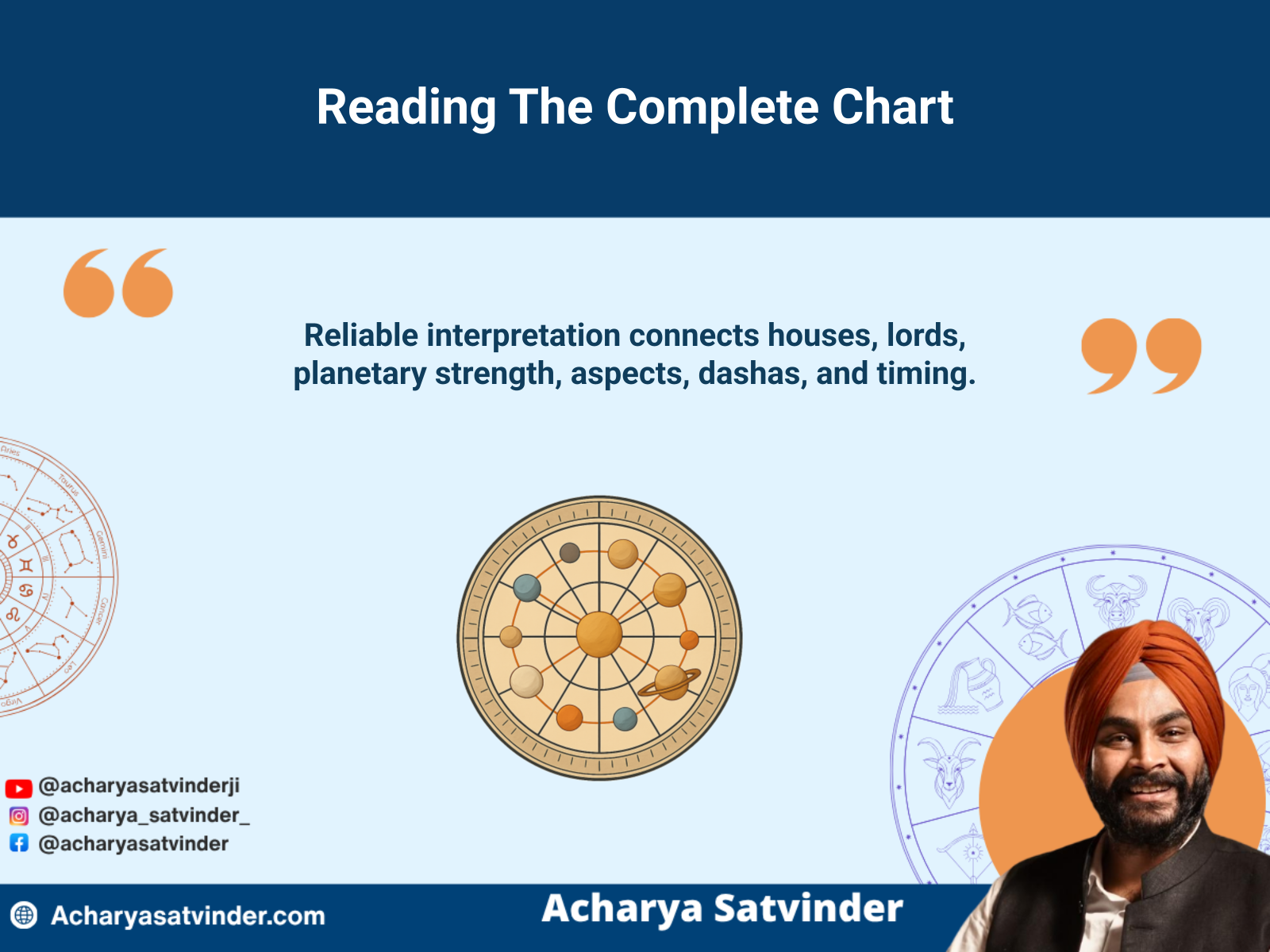
The Lagna establishes the starting point of the houses, while every house represents a broad area of experience. Planets, signs, house lords, aspects, and combinations modify how those areas are interpreted.
- The Lagna, its lord, condition, and supporting influences
- The relevant houses, their lords, occupants, and connections
- Planetary strength, dignity, conjunctions, and aspects
- The Moon and patterns connected with emotional response
- Mahadasha, Antardasha, and significant planetary timing
- Supporting divisional charts suited to the question
Different charts serve different interpretive purposes, but supporting charts should remain connected to the main birth chart. This guide to choosing the right kundli chart explains the distinction more fully.
No planet, sign, yoga, or house should decide a major conclusion by itself.
Potential and timing are different
A chart may traditionally indicate an ability, concern, or repeated tendency, while dashas help examine when that theme may become more active. Even then, circumstances and personal choices remain important.
For example, a hypothetical professional may have supportive career patterns but enter a demanding period requiring patience and stronger preparation. The reading should guide planning rather than announce unavoidable success or failure.
Why some readings feel accurate
A reading may feel accurate because it identifies a recognizable pattern or gives language to an existing concern. Personal relevance alone, however, does not prove that every conclusion is objectively correct.
Specific interpretation can create recognition
When accurate birth information is combined with a focused question, the reading can become more specific. Connections among houses, lords, timing, and present circumstances may reflect experiences the person already recognizes.
A skilled reader also asks for context instead of delivering a fixed speech. Learning how kundli reading is studied step by step can help you distinguish structured interpretation from unsupported statements.
- Correct birth details may produce a more stable chart foundation.
- Several repeating factors may support the same theme.
- A focused question helps keep the interpretation relevant.
- Thoughtful dialogue may reveal details missing from a written report.
- General statements may feel personal even when they fit many people.
Feeling understood is meaningful, but it should not replace careful evaluation of the reasoning.
When people ask, Is kundli reading true, they may really be asking whether a personally accurate statement proves the entire system. One meaningful observation should be considered carefully without automatically validating every prediction.
Why kundli readings can be wrong
Even within Vedic practice, a reading can be incomplete, overstated, or based on unreliable information. Understanding these weaknesses prevents confidence and dramatic language from being mistaken for accuracy.
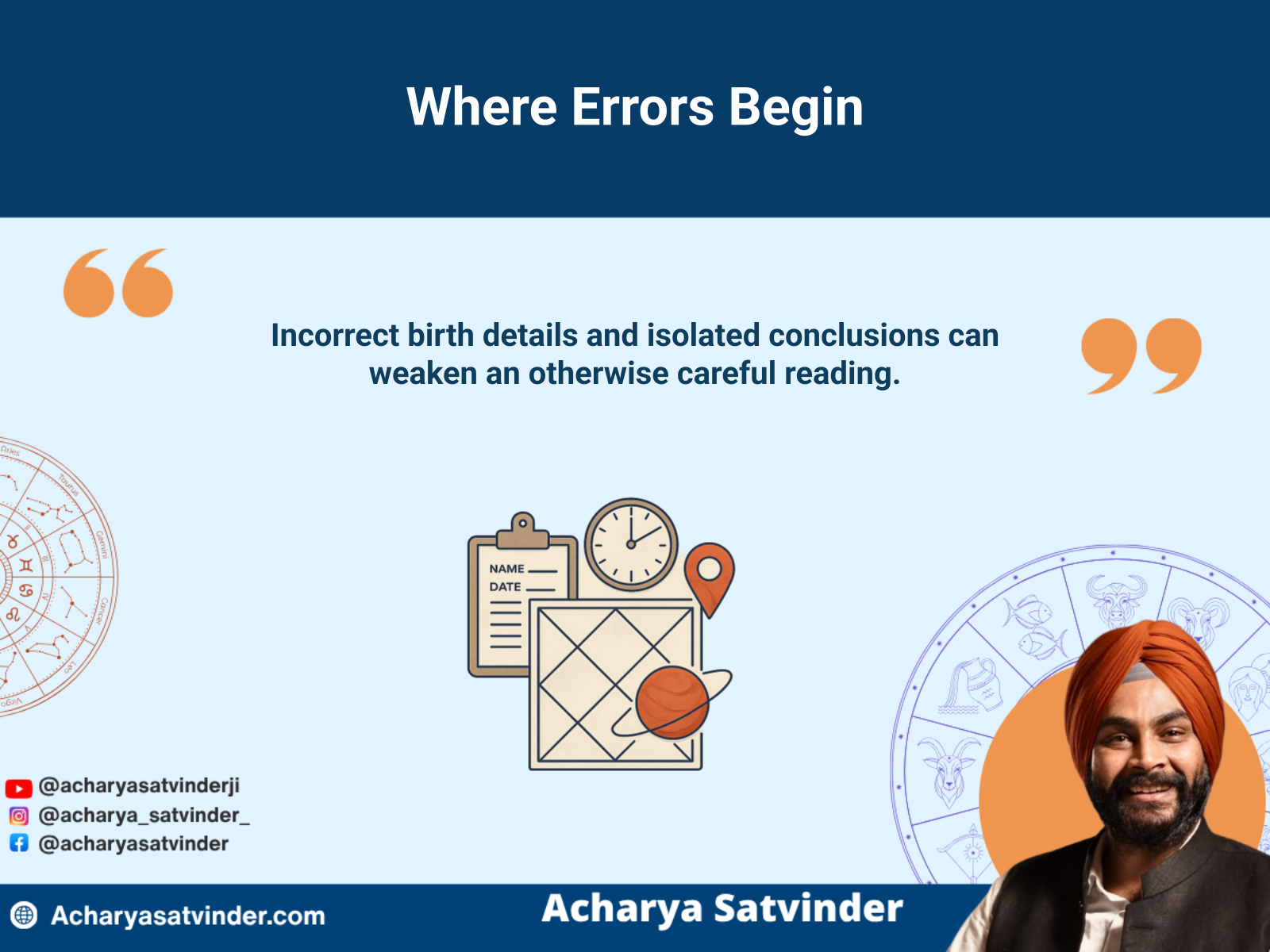
An incorrect or approximate birth time may change the Lagna, house positions, planetary degrees, or sensitive divisional details. The reader should disclose how that uncertainty limits precise interpretation.
- Incorrect birth time, date format, or birthplace
- Judging one planet or house without the complete chart
- Ignoring planetary strength, lordship, aspects, or timing
- Using general statements that cannot be checked
- Presenting one possible outcome as unavoidable
- Overlooking practical context and contradictory chart factors
Automated reports may calculate placements quickly but still produce generic or disconnected conclusions. Before relying on one, review this guide to assessing automated kundli guidance and verify the underlying chart details.
Honest uncertainty is more trustworthy than false precision built on doubtful information.
Scientific limits also matter
Controlled research has not reliably demonstrated that birth-chart interpretation predicts personality or outcomes better than chance. Kundli reading should therefore not be presented as laboratory-proven forecasting.
That limitation does not prevent someone from finding cultural, spiritual, or reflective value in the practice. It does mean personal meaning should be distinguished from repeatable scientific evidence.
How to judge a trustworthy reading
A responsible reading explains how conclusions were reached and where uncertainty remains. It should leave you better informed, not frightened, pressured, or dependent on repeated consultations.
Ask the reader to identify the chart factors supporting an important conclusion. A meaningful answer should connect multiple placements and timing factors rather than repeat a dramatic label.
- Which houses and house lords relate to the question?
- What strengthens, weakens, delays, or modifies the pattern?
- Which dasha or timing factor makes the issue relevant now?
- Are supporting and contradictory indications both discussed?
- How does uncertain birth information affect the conclusion?
- What practical response is sensible regardless of prediction?
When personal interpretation is needed, consider the principles for selecting a careful kundli reader. Clear reasoning, calm language, ethical boundaries, and respect for personal responsibility are more valuable than impressive certainty.
A trustworthy reading offers direction without taking ownership of your decisions.
Warning signs to notice
Be cautious when a reader declares a major outcome from one placement, uses fear to create urgency, or discourages practical advice. Responsible astrology does not demand that evidence, consent, health care, or safety be ignored.
Repeatedly seeking new readings until one confirms a preferred answer can also create confusion. A better approach is to define the question, understand the reasoning, and decide responsibly.
Using kundli without losing judgment
Birth-chart guidance is most constructive when combined with evidence, reflection, and disciplined action. The chart may suggest questions and timing considerations, but you remain responsible for the response.
- Clarify the question. Ask about a defined concern rather than requesting a frightening summary of your future.
- Verify the foundation. Confirm the birth details and disclose when the recorded time is approximate.
- Request complete analysis. Look for connected reasoning involving houses, lords, strength, aspects, dashas, and timing.
- Separate tendency from certainty. An astrological indication should not be treated as an unavoidable event.
- Convert insight into action. Improve preparation, communication, skills, routines, and conduct where greater awareness is needed.
Major health, legal, financial, relationship, or career decisions still require suitable professional advice and practical verification. Astrology can support reflection, but it should not replace qualified expertise or informed consent.
Acharya Satvinder Ji presents Naam Simran, Daan, Seva, and disciplined living as conscious spiritual responses. They support steadiness, humility, and responsible conduct rather than offering a shortcut around the life path.
The value of guidance is measured by clearer conduct, not passive dependence on prediction.
The most responsible answer to Is kundli reading true accepts both its traditional framework and its evidential limits. Use the chart as guidance for awareness while keeping judgment, effort, and accountability firmly in your hands.
FAQs
Is a kundli calculation the same as a kundli reading?
No, a calculation maps planetary positions from verified birth details. A reading interprets the relationships, strength, houses, and timing shown within that chart.
Can an incorrect birth time affect the reading?
Yes, the birth time can affect the Lagna, houses, degrees, and sensitive chart divisions. Any uncertainty should be disclosed before precise conclusions are offered.
Can one planet prove that an event will happen?
No, one planet cannot responsibly establish a major outcome. House lords, strength, aspects, dashas, supporting combinations, and timing must be studied together.
Should I base a major decision only on kundli guidance?
Kundli guidance may add perspective, but it should not become the only basis for a major decision. Practical evidence, consequences, consent, and suitable professional advice remain essential.
Why do two kundli readers give different answers?
Readers may use different methods, priorities, timing systems, or levels of detail. Ask each reader to explain the chart factors and uncertainty supporting the conclusion.
Final Words
Ultimately, Is kundli reading true has no honest one-word answer. A calculated chart can be exact, while its interpretation remains dependent on method, complete-chart analysis, context, and the reader’s judgment.
Kundli guidance is most useful when it helps you recognize patterns, prepare for demanding periods, and act with greater discipline. Approach it thoughtfully, question absolute claims, and never surrender responsibility for your decisions.

Acharya Satvinder is a spiritual guide and life mentor who blends Sikh astrology, philosophy, and coaching to help you find clarity, balance, and purpose. He offers personalized guidance for career, relationships, stress, and spiritual growth — empowering you to unlock your true potential.
With over 20 years of experience, Acharya Satvinder is regarded as one of the most respected and Best astrologers in India for his ethical and disciplined approach. Each year, he guides more than 10,000 individuals through his teachings and consultations, including extensive one-to-one sessions with followers across India, Canada, USA and the global NRI community. His guidance explains discipline, conscious decision-making, seva, and inner clarity as the foundation of meaningful growth.