
Job change astrology can help you understand whether professional restlessness reflects a passing difficulty, a genuine transition period or the need for better preparation.
Acharya Satvinder Ji describes astrology as a guiding science for understanding planetary direction, timing and life patterns shown from birth. It supports aware planning without removing personal responsibility.
A reliable assessment combines the complete kundli with qualifications, finances, family duties and actual opportunities. One planet or transit cannot decide whether you should resign.
How Job change astrology reads a career shift
A career transition is studied as a connected event rather than an isolated prediction. The astrologer first identifies what is changing, why it is changing and whether the timing supports movement.
In Job change astrology, dissatisfaction alone does not confirm that a switch is wise. Pressure may indicate a temporary workplace phase, an unsuitable role, limited growth or a deeper change in professional direction.
If you want to check career by astrology, begin with a specific question. Compare staying, changing employers, accepting an offer, retraining or moving toward independent work.
Restlessness becomes useful information only when its source and timing are understood together.
Consider a hypothetical professional who receives a better title but faces uncertain income and heavy travel. The chart may show movement, yet practical conditions determine whether that particular offer is suitable.
Houses linked with job movement
Several houses describe profession, employment, income, effort and transition. Their lords, occupants, aspects and strength must form a meaningful pattern before a career conclusion is drawn.
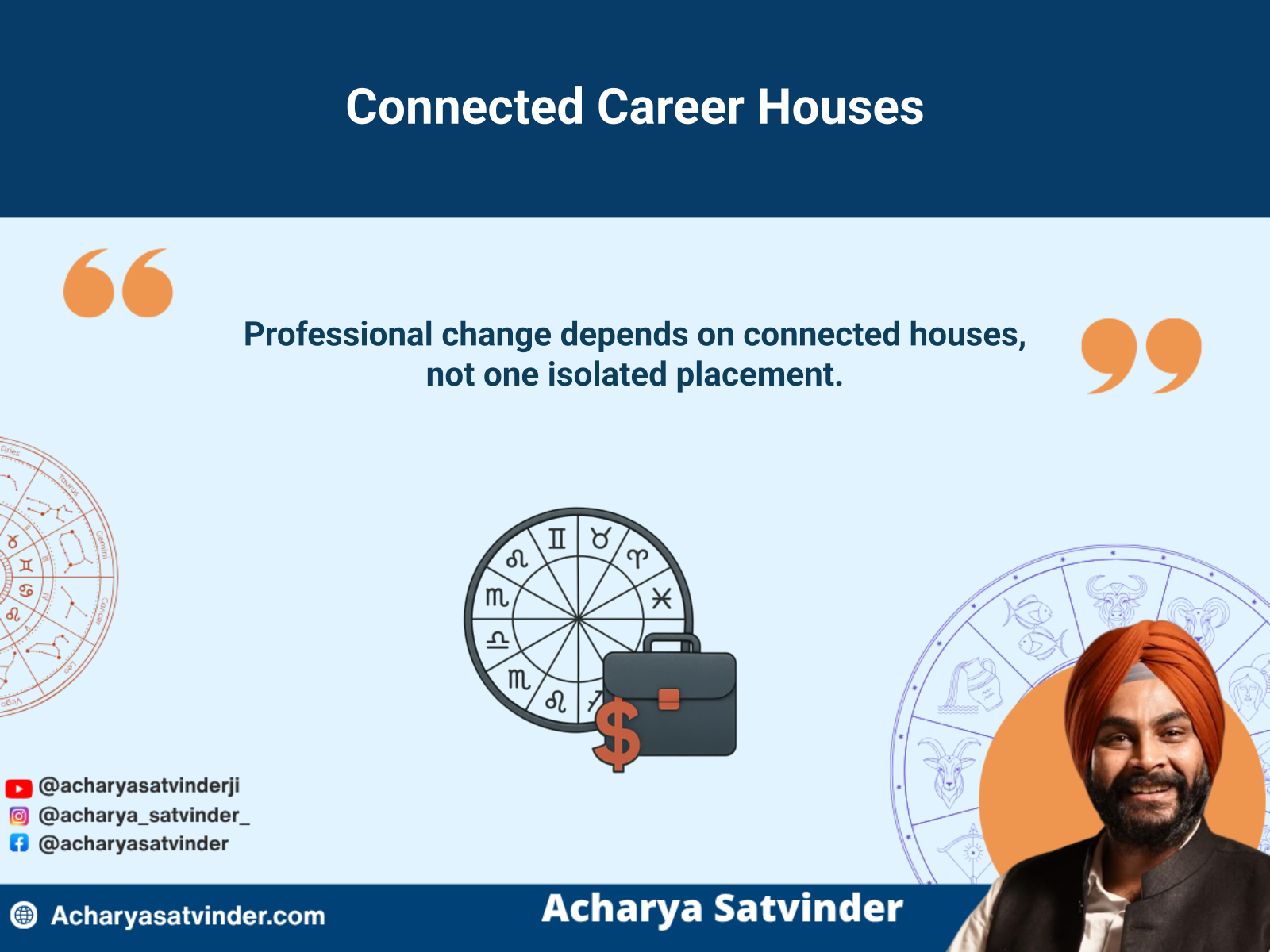
The tenth house, traditionally associated with Karmasthana, begins the discussion of responsibility, professional contribution and public standing. The sixth house adds employment, routine, competition and workplace obligations.
What the connected houses reveal
- Second house: Earnings, accumulated resources, speech and the ability to sustain a livelihood.
- Third house: Initiative, courage, communication, applications and short professional movements.
- Sixth house: Service, employment, colleagues, competition, routine and daily responsibilities.
- Eighth house: Disruption, uncertainty, confidential work, restructuring and major adjustment.
- Tenth house: Profession, authority, responsibility, reputation and visible contribution.
- Eleventh house: Gains, professional networks, recognition and fulfilment of career aims.
- Twelfth house: Separation, distant settings, institutional work and withdrawal from an existing structure.
A responsible Job change astrology reading studies how these houses interact. A sixth-tenth connection may activate employment matters, while support from income and gains houses can describe financial continuity.
The tenth house identifies professional action, but connected houses reveal its practical consequences.
The career divisional chart
The Dashamsha can refine professional themes, authority patterns and the quality of career development. It should confirm the main birth chart rather than replace it.
Accurate birth time is especially important because divisional placements can change quickly. Uncertain data should be acknowledged instead of producing false precision.
Dashas, transits and timing
The birth chart describes underlying potential, while dashas show which planetary themes are active. Transits provide supporting context for pressure, opportunity, delay, movement or consolidation.

Job change astrology becomes more dependable when active periods connect with the relevant career houses and their lords. Repeated support across the birth chart, Dashamsha and transits carries greater weight.
Dasha and sub-period activation
Vedic planetary periods are assessed through the condition, ownership, placement and associations of their ruling planets. No Mahadasha or Antardasha produces identical career results for everyone.
How transits add context
Saturn may bring responsibility, restructuring or sustained effort, while Jupiter may expand learning, visibility or opportunity. Rahu and Ketu can coincide with unfamiliar directions, ambition, detachment or sudden reorientation.
For wider context about active professional concerns, career astrology today can help separate general planetary discussion from a personal chart-based decision.
Timing reveals when preparation matters most; it never replaces preparation itself.
Planets that may shape a transition
Planets describe different professional energies, but none should be treated as a universal job-change signal. House ownership, strength, aspects, associations and active timing modify every result.
- Sun: Authority, leadership, administration and the desire for meaningful responsibility.
- Moon: Adaptation, public contact, movement and changing emotional engagement with work.
- Mars: Initiative, technical action, competition and impatience with restricted progress.
- Mercury: Interviews, communication, contracts, analysis, commerce and professional negotiation.
- Jupiter: Knowledge, counsel, development, institutional roles and broader responsibility.
- Saturn: Structure, duty, endurance, delay, regulation and gradual professional maturity.
- Rahu and Ketu: Unconventional paths, specialised work, unfamiliar settings and detachment from established roles.
The same planet may support promotion in one chart, restructuring in another and a demanding learning phase elsewhere. The complete chart determines how its energy is expressed.
A planet activates its chart relationships; it does not issue a standalone career verdict.
Job change or career change?
Changing employers is different from changing professions, relocating, accepting an internal transfer or becoming self-employed. Each decision activates a different combination of responsibilities, risks and house connections.
- Employer switch: Similar skills and industry, but a different organisation or contract.
- Internal movement: A new team, location, manager or responsibility within the same organisation.
- Professional change: New training, identity, work environment or long-term direction.
- Independent work: Greater attention to clients, capital, partnerships, risk and financial continuity.
- Distant opportunity: Relocation, travel demands, cultural adjustment and family considerations.
Define the actual transition before asking about timing. A period supporting movement may not automatically support every company, salary package, business proposal or location.
How to decide before resigning
A chart reading should organise the decision without creating dependence. Practical readiness remains essential even when several astrological factors suggest professional movement.
Use Job change astrology as one layer of informed planning, supported by practical career advice through astrology, factual research and honest assessment of your present responsibilities.
- Identify whether you are escaping pressure or moving toward a stronger direction.
- Review savings, debt, dependants, notice periods and contractual obligations.
- Confirm the role, salary, location, reporting structure and expected responsibilities.
- Assess whether your skills match the opportunity or require further training.
- Compare long-term development rather than focusing only on immediate relief.
- Keep written evidence of the offer before making an irreversible decision.
Suppose a hypothetical employee feels overlooked and receives an attractive offer from an unstable organisation. A supportive period may favour movement, but careful verification can prevent an impulsive decision.
The right period cannot make an unsuitable offer suitable without practical evidence.
Spiritual discipline during uncertainty
Career uncertainty can disturb concentration, sleep and confidence. Spiritual discipline may help you respond calmly while continuing applications, skill development and responsible financial planning.
Naam Simran can steady attention, while Daan and Seva can encourage humility and social responsibility. Disciplined living supports clearer choices but does not purchase a preferred outcome.
Maintain regular sleep, respectful communication, honest work and a realistic routine. These actions strengthen your response to the life pattern already unfolding.
When a personal reading helps
General principles cannot account for individual house ownership, planetary strength or birth-time sensitivity. Personal guidance becomes useful when several realistic options must be compared carefully.
A focused career astrology consultation can examine your decision and timing, while a structured career astrology reading can provide broader professional direction.
Prepare your accurate birth date, birth time and birth place, along with your current role and proposed options. Focused information allows the discussion to remain practical and relevant.
FAQs
Which house shows a job change in astrology?
The tenth house begins the career analysis, while the sixth house describes employment and daily service. A reliable judgement also checks income, effort, transition and gains houses with their lords and timing.
Can astrology provide an exact resignation date?
Job change astrology can identify a supportive period, but an exact date should not be chosen from one transit. Notice periods, contracts, finances and a confirmed offer must remain part of the decision.
Which dasha is best for changing jobs?
No dasha is favourable for every person because each planet owns and occupies different houses. Its strength, associations, sub-period and support from the complete chart must be assessed.
Does Saturn always delay a career change?
Saturn may bring delay, responsibility, restructuring or gradual progress depending on the individual chart. A strong Saturn period can also support stable work built through patience and sustained effort.
Is an exact birth time necessary for career timing?
An accurate birth time improves house, ascendant and Dashamsha analysis. If the recorded time is uncertain, the reading should avoid narrow timing claims and acknowledge that limitation.
Final Words
Job change astrology is most valuable when the complete chart, active timing and real-world readiness are considered together. It can clarify a transition, but disciplined preparation must carry the decision forward.

Acharya Satvinder is a spiritual guide and life mentor who blends Sikh astrology, philosophy, and coaching to help you find clarity, balance, and purpose. He offers personalized guidance for career, relationships, stress, and spiritual growth — empowering you to unlock your true potential.
With over 20 years of experience, Acharya Satvinder is regarded as one of the most respected and Best astrologers in India for his ethical and disciplined approach. Each year, he guides more than 10,000 individuals through his teachings and consultations, including extensive one-to-one sessions with followers across India, Canada, USA and the global NRI community. His guidance explains discipline, conscious decision-making, seva, and inner clarity as the foundation of meaningful growth.