What is my career path astrology? This question often arises when your abilities, responsibilities and opportunities seem to point in different professional directions.
Vedic astrology can organise that uncertainty by examining the planetary patterns shown from birth. Acharya Satvinder Ji approaches it as a guiding science for awareness, planning and disciplined effort.
The purpose is not to assign a rigid job title or replace practical judgment. A responsible reading identifies professional themes, suitable environments and periods requiring preparation or patience.
What is my career path astrology? Understanding the real question
A career path includes more than the profession printed on a business card. It also concerns your working style, responsibilities, motivation, growth pattern and relationship with authority.
When someone searches What is my career path astrology, they are usually asking several connected questions about ability, stability, purpose, income and timing.
- Which abilities deserve further development?
- Do structured roles or independent decisions suit me better?
- Why do certain professional difficulties keep repeating?
- Is dissatisfaction temporary or part of a deeper transition?
- When should I prepare for movement rather than act impulsively?
A birth chart can describe professional patterns, but it should not reduce your potential to one compulsory occupation.
A complete career astrology reading compares these questions with the whole kundli, current circumstances and realistic options. Education, experience, health, finances and family duties still matter.
How a Vedic career chart is read
Career analysis begins with the main birth chart but does not stop at one placement. House lords, planetary strength, aspects, combinations and timing must support the interpretation together.
The ascendant and its lord help describe temperament, initiative and the way a person approaches responsibility. The Moon adds emotional needs, while the Sun contributes confidence, direction and comfort with visibility.
The Karma Bhava, or tenth house, is central to profession, public responsibility and reputation. Its lord, occupants and aspects show how career themes connect with other areas of life.
The D10 divisional chart refines professional analysis. It can help assess responsibility, authority, development and the way broader birth-chart promises may operate through work.
The main chart shows the foundation; the D10 adds professional detail and confirmation.
You can check career by astrology through a structured process, but conclusions should be compared across charts rather than taken from an isolated placement.
Houses that shape professional direction
The tenth house receives the most attention, yet several houses contribute essential context. Their lords, connections and strength help distinguish profession, income, service, enterprise and gains.
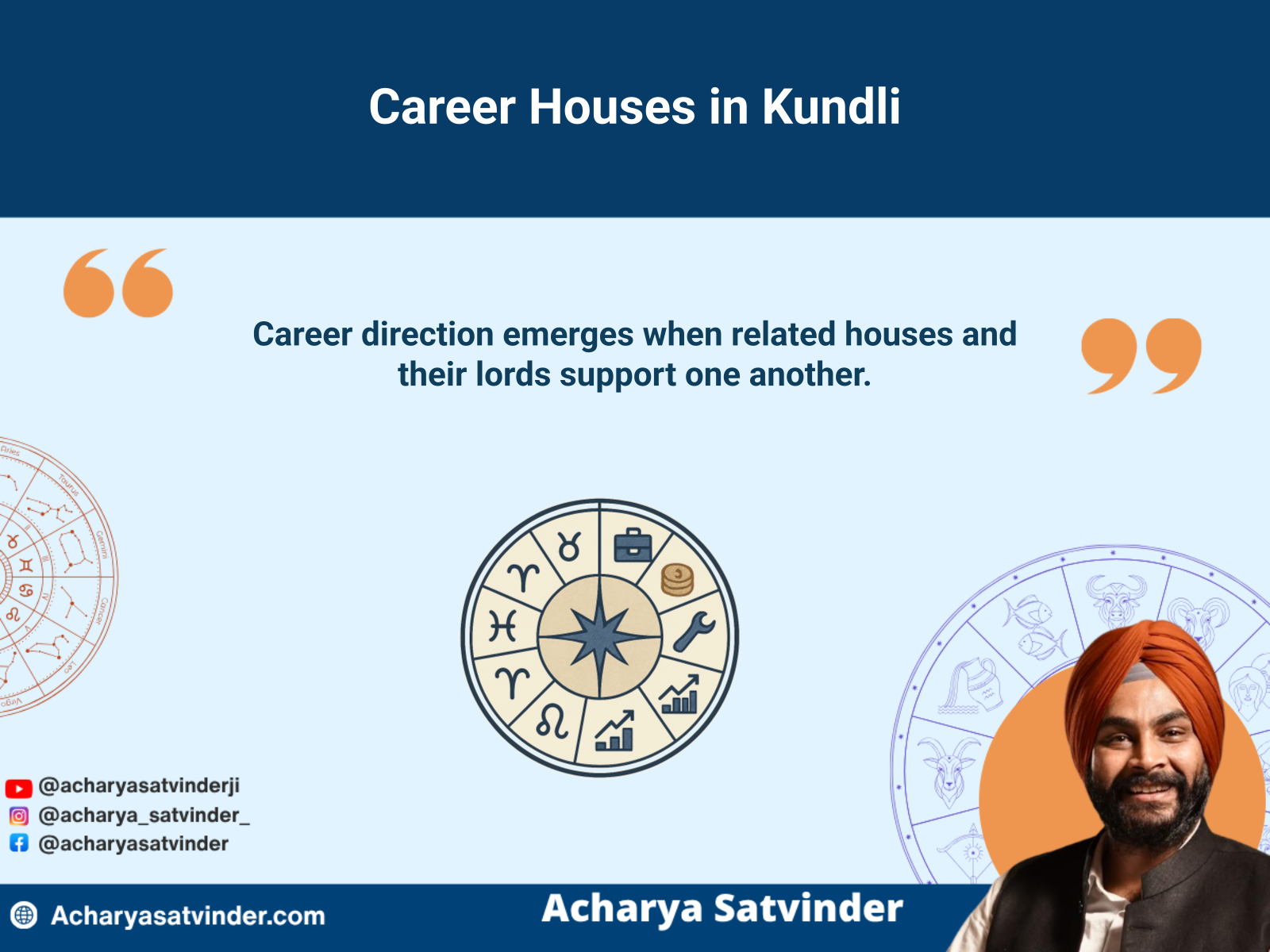
- Second house: earned resources, speech, knowledge and financial continuity.
- Sixth house: employment, routines, competition, service and problem-solving.
- Seventh house: trade, clients, partnerships and public dealings.
- Ninth house: higher learning, mentors, principles and long-range direction.
- Tenth house: profession, duty, authority and public contribution.
- Eleventh house: gains, networks, recognition and fulfilment of professional aims.
For example, a hypothetical chart may show strong communication and client interaction but limited comfort with repetitive routines. That pattern could support several fields, not one predetermined role.
Career direction becomes clearer when profession, income, daily work and gains tell a connected story.
Planets describe your working style
Planets contribute qualities, motivations and methods rather than automatic job titles. Their house ownership, dignity, aspects, combinations and divisional strength determine how those qualities may operate.
- Sun: leadership, administration, visibility and responsibility.
- Moon: public connection, care, adaptability and changing environments.
- Mars: action, engineering, competition, courage and technical execution.
- Mercury: analysis, communication, commerce, calculation and technology.
- Jupiter: teaching, counsel, law, ethics, finance and expansive judgment.
- Venus: design, negotiation, relationships, comfort and refined presentation.
- Saturn: discipline, systems, labour, endurance and long-term responsibility.
Rahu and Ketu can add unconventional ambition, specialised interests, detachment or sudden changes when supported by the wider chart. Their results require particularly careful assessment.
No planet works alone; professional meaning comes from relationships across the complete chart.
Timing a career decision with dashas
Potential and timing answer different questions within a career reading. A chart may support a direction, while the current period shows whether development, consolidation or transition deserves attention.
Dasha planetary periods indicate which natal factors are active. Antardashas add detail, while transits can describe the immediate pressures or opportunities surrounding those periods.
Timing analysis may help organise questions such as when to build skills, seek promotion, explore another field or compare employment with enterprise. It does not remove uncertainty or guarantee an outcome.
Good timing strengthens preparation; it never replaces competence, evidence or responsible judgment.
People seeking career astrology for present decisions should compare planetary timing with contracts, workplace conditions, savings and available opportunities before making a major move.
Turning chart insight into practical choices
The question What is my career path astrology becomes useful only when insight leads to a workable decision process. Astrology should narrow priorities without taking ownership of your choices.

- Write down the two or three options you are genuinely considering.
- Compare the skills, risks and daily responsibilities of each option.
- Identify repeating chart themes instead of chasing one attractive prediction.
- Review the running dasha and the preparation each period requires.
- Choose a practical next step with a clear review point.
A hypothetical professional choosing between management and specialist work could compare authority, technical depth, communication demands and timing. The chart may clarify tendencies, while workplace evidence completes the decision.
Naam Simran, Daan, Seva and disciplined living may support patience, humility and steadiness. They are conscious spiritual responses, not ways to rewrite the life path.
Astrological clarity has value when it produces better questions, steadier preparation and accountable action.
For a broader decision framework, career advice through astrology can help connect chart observations with research, training and realistic professional priorities.
When a personalised reading is useful
General explanations cannot account for every house lord, aspect, strength or planetary period in an individual chart. Personal guidance becomes useful when the decision is specific and consequential.
Consider a reading when you are comparing two realistic paths, facing repeated delays, returning after a break or deciding whether present dissatisfaction justifies a change.
Bring an accurate birth date, birth time and birth place, along with focused questions. A personalised career astrology consultation should explain the reasoning clearly rather than offer vague declarations.
Acharya Satvinder Ji also discusses connected career indicators in his verified video on career and government-job indications.
FAQs
Can astrology identify my exact future job?
Astrology can describe suitable professional themes, abilities and working environments. It should not declare one compulsory job without considering your education, experience and opportunities.
Which house is most important for career?
The tenth house is central to profession, responsibility and public standing. The second, sixth, seventh, ninth and eleventh houses also add important context.
Is an accurate birth time necessary for career analysis?
An accurate birth time supports reliable houses, divisional charts and timing calculations. If the recorded time is uncertain, that limitation should be discussed before interpretation.
Can a kundli compare employment and business?
A complete kundli can compare patterns connected with service, independence, clients, partnerships and risk. Financial readiness and professional experience must remain part of the decision.
Can astrology help during a career change?
Astrology may clarify whether dissatisfaction reflects a temporary phase or a broader professional pattern. It can also identify periods better suited to preparation, evaluation or movement.
Final Words
Career astrology is most helpful when it connects self-understanding, planetary timing and practical preparation. It can reveal patterns of work, responsibility and growth without dictating one unavoidable profession.
A responsible answer to What is my career path astrology gives you a clearer framework for choosing, preparing and reviewing your direction. Use that insight with discipline, real-world research and ownership of every decision.

Acharya Satvinder is a spiritual guide and life mentor who blends Sikh astrology, philosophy, and coaching to help you find clarity, balance, and purpose. He offers personalized guidance for career, relationships, stress, and spiritual growth — empowering you to unlock your true potential.
With over 20 years of experience, Acharya Satvinder is regarded as one of the most respected and Best astrologers in India for his ethical and disciplined approach. Each year, he guides more than 10,000 individuals through his teachings and consultations, including extensive one-to-one sessions with followers across India, Canada, USA and the global NRI community. His guidance explains discipline, conscious decision-making, seva, and inner clarity as the foundation of meaningful growth.