The question “what is vedic astrologer?” usually appears when someone wants more than a general horoscope. They want to understand who interprets a kundli and how that guidance may support real decisions.
A Vedic astrologer studies the planetary pattern recorded for a person’s birth time and place. The purpose is to explain tendencies, timing, responsibilities and connected areas of life with practical context.
Acharya Satvinder Ji approaches astrology as a guiding science for understanding planetary direction and life patterns shown from birth. Its value lies in awareness and disciplined planning, not promises to rewrite fate.
What is vedic astrologer and what does the role involve?
A Vedic astrologer interprets a birth chart through established Jyotisha principles. The role combines technical chart analysis, careful listening and clear communication about the patterns connected with a person’s concerns.
A concise answer to the search “what is vedic astrologer” is a trained chart reader who connects planetary placements with life areas and timing. The astrologer should translate those connections into understandable guidance.
Vedic astrology is also known as Jyotisha and commonly works with a sidereal zodiac. A general overview of Hindu astrology provides useful background on its terminology and traditional framework.
A responsible astrologer explains how a conclusion is formed instead of asking the listener to accept an unexplained statement.
What the astrologer studies
The kundli is not interpreted from the Sun sign alone. Several chart layers must be connected before a pattern can be described with suitable care.
- The ascendant and its ruling planet
- The Sun, Moon and planetary placements
- The twelve houses and their lords
- Planetary strength, dignity and aspects
- Nakshatras and relevant combinations
- Dashas, sub-periods and current transits
Each factor adds context to the others. A planet connected with career, for example, cannot provide a reliable conclusion without examining the relevant houses, lords, aspects, strength and active timing.
How a Vedic astrologer reads a kundli
Chart interpretation usually moves from structure to timing. The astrologer first identifies the natal pattern, then studies which parts of that pattern are becoming more active during the period under discussion.
Accurate birth information helps establish the ascendant, house positions and divisional calculations. Even a modest birth-time difference may affect chart details, so uncertainty should always be disclosed before the reading begins.
The complete chart comes first
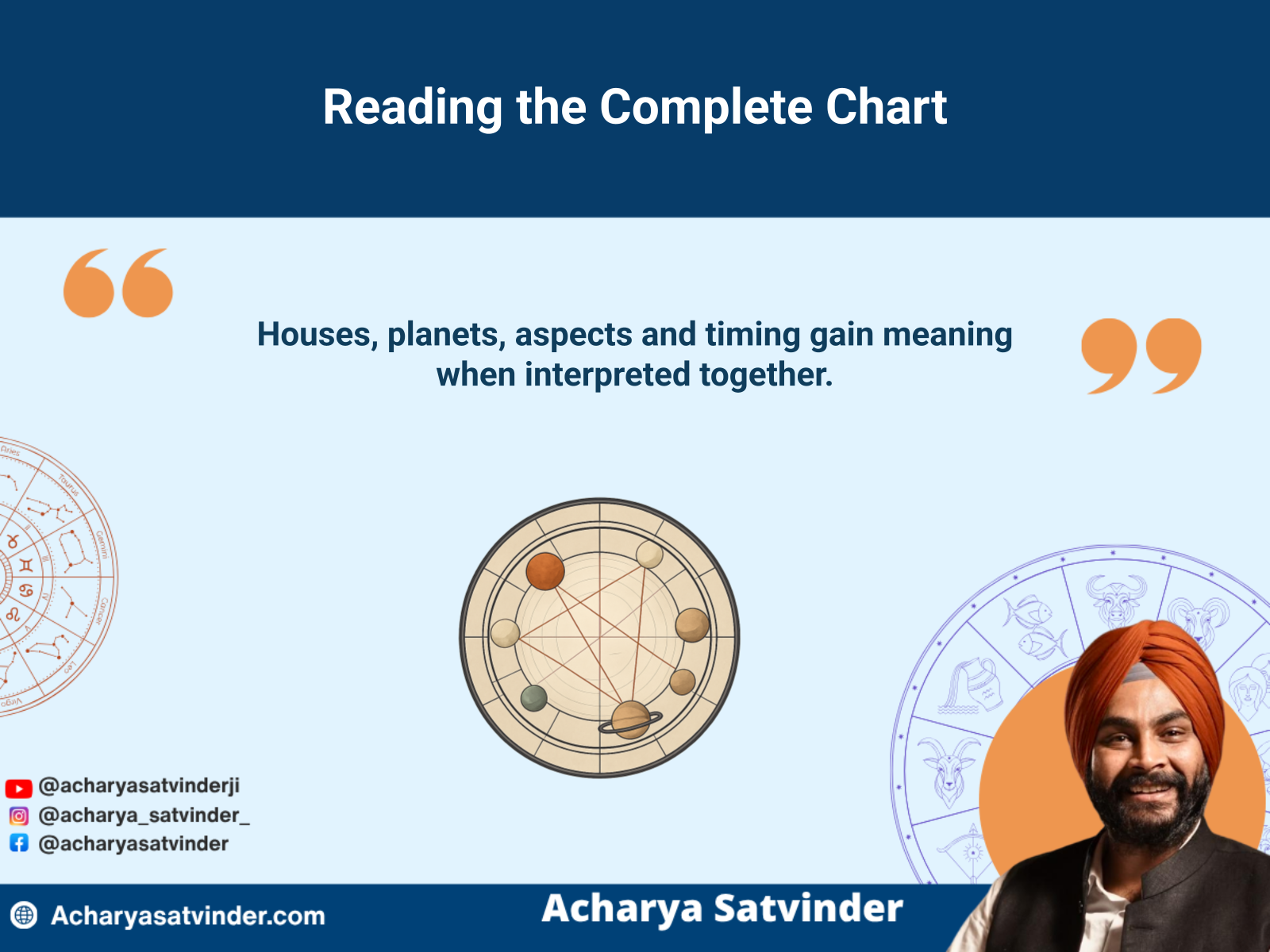
The astrologer brings several forms of evidence together. No single placement should be treated as a final answer about career, relationships, finances, family responsibilities or personal development.
- Houses identify the life areas being examined.
- House lords show how those areas connect with other parts of the chart.
- Planetary strength helps assess how a planet may express its role.
- Aspects reveal support, pressure and interaction between planets.
- Combinations add meaning when their full conditions are present.
- Divisional charts may provide a more focused view of a relevant subject.
- Timing factors indicate when a natal theme may require greater attention.
These factors can support, limit or modify one another. That is why a balanced reading may identify both opportunity and responsibility within the same period instead of labelling it entirely positive or difficult.
One placement offers a clue, but the complete chart establishes the wider meaning and appropriate timing.
Why planetary timing matters
Dashas describe planetary periods used to examine when certain chart themes may become more prominent. Sub-periods and transits then help refine the context surrounding a decision, transition or recurring concern.
Readers who want technical background can review this introduction to planetary period systems. In an actual consultation, the astrologer should explain their relevance in plain language rather than overwhelm the listener with terminology.
Timing does not remove personal judgement. It can help a person distinguish between a phase suited to preparation, cautious action, consolidation, review or patient observation.
What happens during a consultation
A useful consultation begins with a defined concern and accurate background information. The astrologer then connects the question with the complete chart and explains the relevant patterns, timing and practical considerations.
The conversation should remain organised rather than moving rapidly through unrelated predictions. A clear process allows enough time for interpretation, questions, clarification and notes.
- You share your birth details and primary concern.
- The astrologer confirms the scope and any birth-time uncertainty.
- Relevant houses, lords and planetary connections are examined.
- Dashas and transits are considered for timing.
- The findings are translated into practical points for reflection.
Acharya Satvinder Ji’s approach focuses on planetary direction, responsibilities and the life patterns indicated from birth. The aim is to help the individual plan with greater awareness while remaining accountable for personal choices.
A meaningful consultation should leave you with clearer priorities, not fear, pressure or emotional dependency.
How an online session works
An online reading follows the same interpretive principles as an in-person meeting. A quiet setting, reliable connection and prepared questions help the conversation remain focused and easier to review afterward.
The same standards apply when considering an astrologer serving Panchkula, online guidance connected with Patiala, consultations for Manchester residents or Vedic guidance available in London. Location should not replace careful chart analysis or responsible communication.
Keep a notebook nearby and ask for clarification whenever technical language is unclear. A good explanation should connect chart factors with the actual decision, responsibility or pattern that brought you to the session.
How guidance supports decisions without replacing judgement
Astrological guidance is most useful when connected with real circumstances. It can highlight timing and recurring tendencies, but the person must still evaluate facts, obligations, resources and consequences.
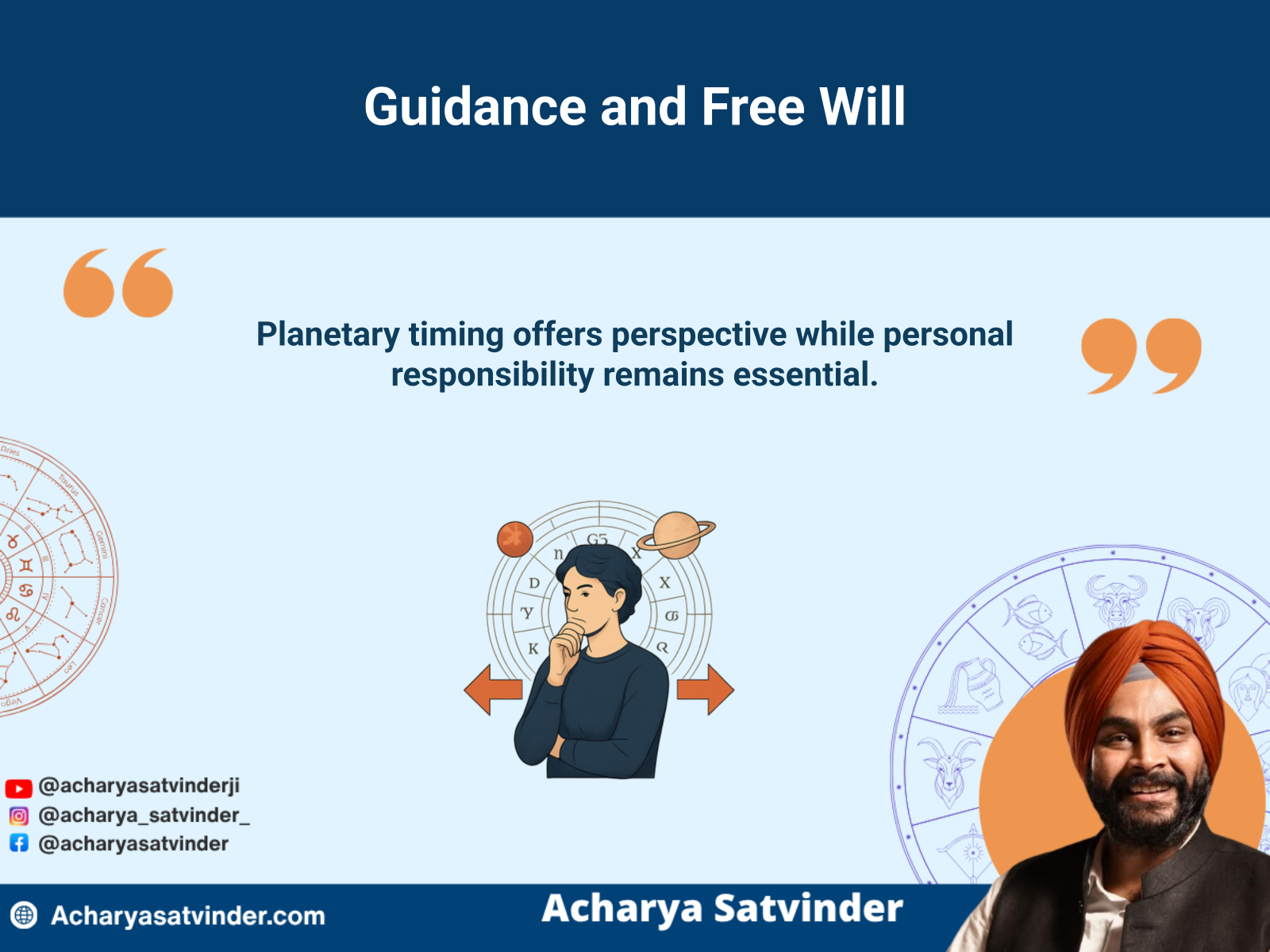
Consider a hypothetical person deciding whether to change careers. The astrologer may discuss professional houses, planetary periods and present pressures, while the individual still assesses qualifications, finances, family duties and available opportunities.
The same principle applies to relationships, business plans and major commitments. A chart may offer perspective on patterns and timing, but it should not be used to avoid communication, preparation or informed judgement.
Astrology can guide attention and timing; it should never replace responsibility, evidence or qualified professional support.
Naam Simran, Daan, Seva and disciplined living may be discussed as conscious spiritual responses. They support humility, steadiness and constructive conduct rather than serving as promises to change the life path.
Medical, legal and regulated financial matters require appropriately qualified professionals. Astrological guidance should remain supplementary and should never delay diagnosis, treatment, legal advice or necessary financial assessment.
How to choose a responsible Vedic astrologer
Trust should be based on method, communication and ethical boundaries rather than dramatic claims. A responsible astrologer respects personal judgement, explains limitations and avoids creating fear or dependence.
When people search “what is vedic astrologer,” they often also need to know what separates a careful practitioner from a confident speaker. The difference becomes clearer through specific consultation standards.
- They request accurate birth details and relevant context.
- They consider the complete kundli rather than one placement.
- They explain which chart factors support the interpretation.
- They acknowledge uncertainty when the birth time is unclear.
- They avoid guaranteed outcomes and urgent emotional pressure.
- They encourage practical action and independent judgement.
Clarity grows when the astrologer shows the reasoning, limits and practical relevance behind the interpretation.
Prepare a short list of useful questions for a Vedic astrologer before booking. Focus on priorities, timing, responsibilities and decisions instead of requesting an unrestricted account of everything that may happen.
Warning signs to notice
Be cautious when conclusions are delivered without chart reasoning or practical context. The consultation should not use fear, certainty or repeated pressure to control your choices.
- Absolute declarations based on one planet or house
- Promises of certain or immediate results
- Pressure to make a rushed decision
- Advice that ignores real-world responsibilities
- Attempts to discourage professional support
You should be able to ask how a conclusion was reached and what factors could modify it. Respectful discussion is a basic sign that the consultation is intended to guide rather than dominate.
What to prepare before your reading
Preparation helps the astrologer connect your concern with the correct chart factors. It also protects consultation time from being spent reconstructing information that could have been organised beforehand.
Start with your birth record and one clear statement describing the matter you want to understand. Add a brief timeline if the concern involves a recurring pattern, delay or recent transition.
- Date of birth
- Exact or best-known birth time
- Place of birth
- Your main question or decision
- Relevant events and approximate timing
- Important deadlines or practical constraints
If your birth time comes from family memory or an estimate, say so directly. The astrologer can then explain which parts of the analysis may be less certain and whether another approach is appropriate.
Rank your questions before the session. Beginning with the issue that most affects your current responsibilities usually produces a more coherent reading than moving between many unrelated subjects.
FAQs
What information does a Vedic astrologer need?
Provide your date, exact birth time and place of birth. You should also share your main concern and any relevant events or deadlines.
Can a kundli be read without an exact birth time?
Some limited observations may still be possible, but important chart details can become uncertain. Tell the astrologer how the recorded time was obtained before the reading begins.
Does a Vedic astrologer make fixed predictions?
A responsible astrologer discusses patterns, timing and possibilities rather than presenting every outcome as fixed. Personal choices and practical circumstances still require careful judgement.
How is a Vedic reading different from a daily horoscope?
A personal reading uses your birth time, date and place to construct an individual kundli. A daily horoscope usually offers broad guidance based on one general zodiac factor.
Can astrological guidance replace professional advice?
No, it should remain supplementary for medical, legal and regulated financial matters. Continue working with appropriately qualified professionals while using astrological timing as additional perspective.
Final Words
If you began with the question “what is vedic astrologer,” the clearest answer is a practitioner who interprets complete birth-chart patterns and timing. The role is to provide perspective for responsible planning.
Approach Acharya Satvinder Ji with accurate information, honest context and focused questions. A valuable reading should strengthen awareness, patience and disciplined action while respecting personal judgement and the life direction shown from birth.

Acharya Satvinder is a spiritual guide and life mentor who blends Sikh astrology, philosophy, and coaching to help you find clarity, balance, and purpose. He offers personalized guidance for career, relationships, stress, and spiritual growth — empowering you to unlock your true potential.
With over 20 years of experience, Acharya Satvinder is regarded as one of the most respected and Best astrologers in India for his ethical and disciplined approach. Each year, he guides more than 10,000 individuals through his teachings and consultations, including extensive one-to-one sessions with followers across India, Canada, USA and the global NRI community. His guidance explains discipline, conscious decision-making, seva, and inner clarity as the foundation of meaningful growth.