
Parent Child Relationship Astrology helps us understand why the bond between parents and children feels warm and close in some families, while in others it feels confusing or emotionally distant.
These patterns are not random; they are shaped by planetary positions at birth and the shared journey of karma between parent and child.
As you read further, you will gain deeper insights into emotional gaps, repeated misunderstandings, and unspoken expectations within families.
This introduction leads you toward clear understanding and awareness, helping you see the parent–child bond with more patience, clarity, and wisdom.
Parent Child Relationship Astrology: Karmic Bond Through Vedic Wisdom
The relationship between parents and children shapes emotions, values, confidence, and life direction. In Vedic thought, this bond is not accidental.
Parent child relationship astrology explains that such relationships are formed through karmic connections created at birth, based on planetary positions in the horoscope.
Some parents feel an instant emotional flow with their child, while others experience distance, misunderstandings, or repeated conflicts despite love.
Astrology helps us understand why these patterns exist and how to respond to them with awareness and maturity.
As guided by Acharya Satvinder Ji, astrology does not promise to change fate.
It shows the direction of life and the timing of events so individuals can live more consciously, patiently, and responsibly.
The Karmic Nature of Parent–Child Relationships in Astrology
Before analyzing planets or houses, it is important to understand the karmic foundation of parent–child bonds.
In Vedic astrology, every close relationship comes from unfinished past-life responsibilities.
A child chooses parents not for comfort alone, but for growth. Similarly, parents receive children who help them evolve emotionally and spiritually.
This explains why siblings raised in the same home may have completely different relationships with the same parent.
Parent child relationship astrology focuses on understanding these karmic patterns so blame, guilt, and unrealistic expectations can be reduced.
When parents understand that challenges are karmic lessons rather than personal failures, patience increases naturally.
When children realize their parents are also working through their own karmic limitations, resentment slowly dissolves.
Houses That Shape Parent Child Relationship Astrology
Vedic astrology uses specific houses in the birth chart to understand family relationships.
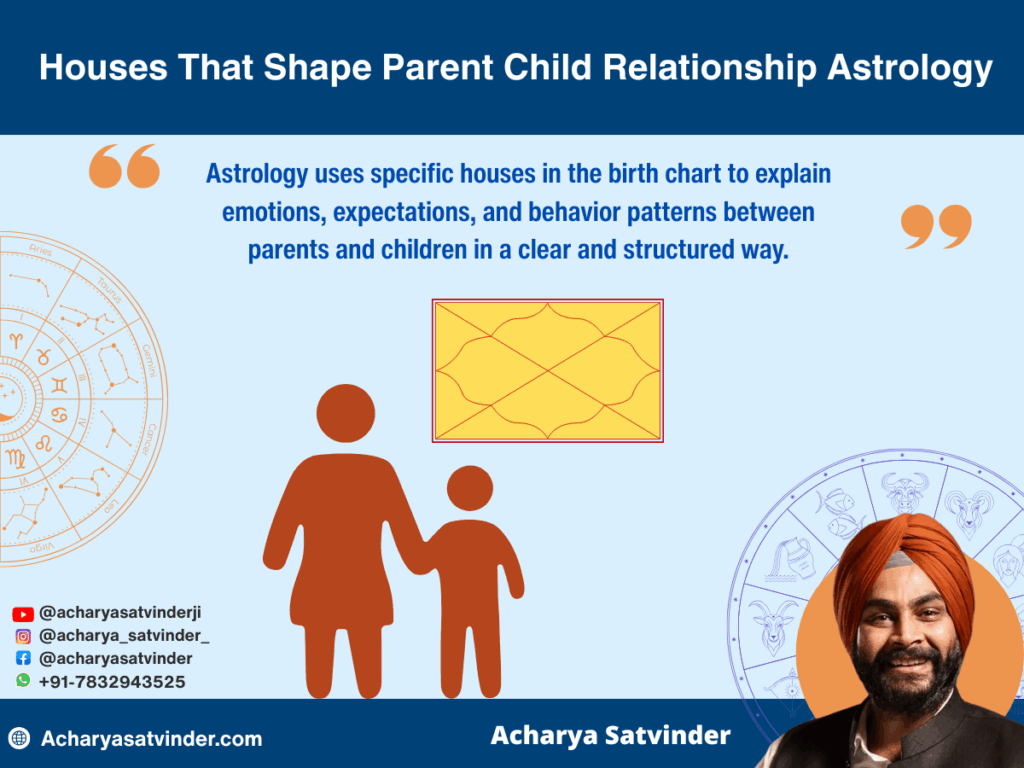
Each house reflects a different emotional and karmic layer of the parent–child bond. These houses must always be read together, not in isolation.
The Fifth House and the Bond With Children
The fifth house is the most important house when studying children in astrology.
It represents progeny, intelligence, creativity, and past-life merit. This house shows how naturally love and understanding flow between parent and child.
When the fifth house is strong, parents often feel emotionally connected to their children without effort. Communication feels natural, and mutual respect grows over time.
When the fifth house is under pressure, it may show emotional misunderstandings, high expectations, or delayed emotional bonding.
For example, a parent may deeply care for the child but struggle to express warmth openly.
Astrology helps parents recognize this pattern early and consciously work on emotional expression rather than assuming something is wrong with the child.
The Ninth House and the Father–Child Relationship
The ninth house represents the father, values, discipline, blessings, and life guidance.
In parent child relationship astrology, this house shows how the father figure influences the child’s moral development and confidence.
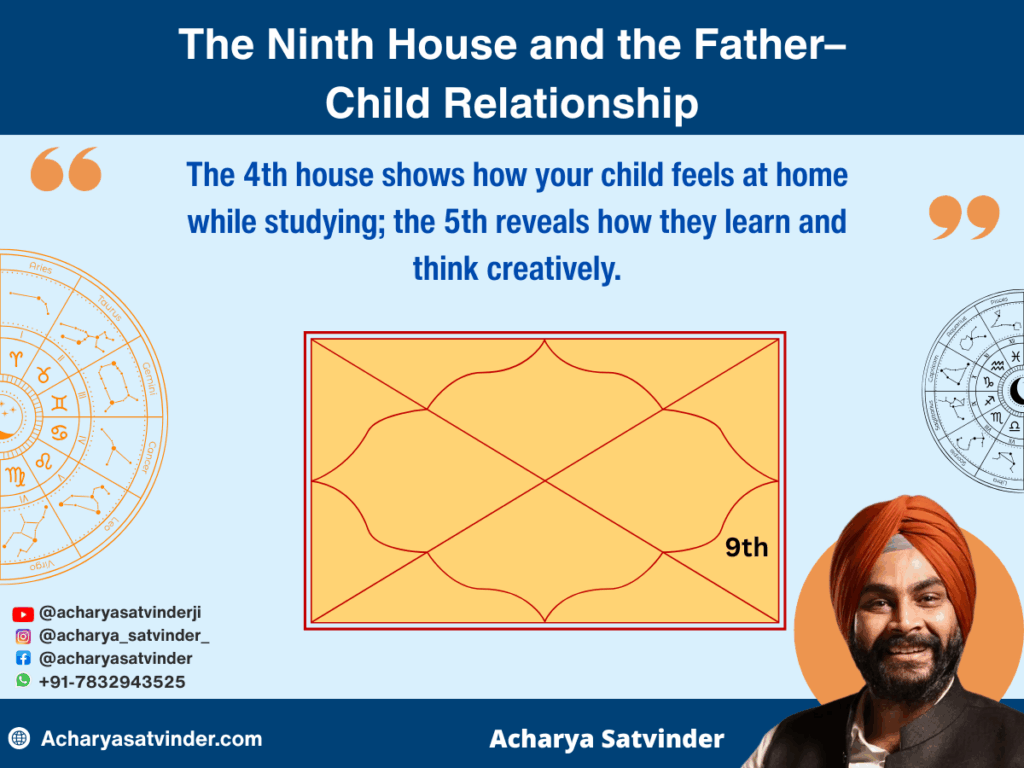
A strong ninth house often reflects a guiding father who plays an active role in shaping the child’s principles.
A weak or challenged ninth house may show emotional distance, differences in beliefs, or authority-related struggles.
For instance, a child may feel misunderstood by the father despite receiving material support.
Astrology explains that such patterns are karmic lessons meant to teach independence, self-belief, and inner strength.
The Fourth House and Emotional Security at Home
The fourth house reflects emotional comfort, nurturing, and the overall home environment.
It shows whether a child feels emotionally safe expressing feelings within the family.
When the fourth house is strong, home feels emotionally supportive. When it is challenged, the home may feel emotionally quiet, even if love exists.
Parents may focus more on responsibilities than emotional expression.
Understanding this through parent child relationship astrology helps families work on communication without forcing emotions or creating unnecessary pressure.
Mother Child Relationship Astrology and the Role of the Moon
Mother child relationship astrology mainly depends on the Moon. The Moon represents emotions, mental security, care, and nourishment.
It shows how a child emotionally connects with the mother and how emotions are expressed within the bond.
When the Moon is well placed, emotional understanding flows naturally. The child feels heard and emotionally supported, and the mother instinctively understands the child’s emotional needs.
When the Moon is afflicted, emotional sensitivity increases. This may lead to misunderstandings, emotional dependency, or difficulty expressing feelings openly.
For example, a mother may deeply care but struggle with emotional expression, leading the child to feel emotionally distant.
Astrology does not judge such bonds. It simply highlights where emotional awareness and patience are required.
Father Child Relationship Astrology and the Role of the Sun
The Sun represents authority, confidence, discipline, and the father figure.
Father child relationship astrology focuses on how guidance, responsibility, and self-respect are developed within the relationship.
A strong Sun usually reflects a father who provides direction and structure.
A challenged Sun may create ego clashes, communication gaps, or emotional distance despite responsibility.
For example, a child may feel pressured to meet expectations without emotional reassurance. Astrology helps parents understand when authority needs to be balanced with emotional reassurance.
You may also like:
Astrological Remedies for Father Son Relationship
Astrological Remedies for Father Daughter Relationship
Astrological Remedies for Mother Son Relationship
Astrological Remedies for Family Disputes
Parent and Child Astrology Compatibility Explained Simply
Many people search for parent and child astrology compatibility hoping to find matching zodiac signs.
In Vedic astrology, compatibility is not about matching signs. It is about understanding roles and karmic responsibilities.
Some children are born to challenge their parents’ mindset. Others come to soften emotional rigidity.
Parent child astrology compatibility charts help identify emotional triggers and learning areas rather than labeling relationships as good or bad.
For example, a disciplined parent may have a sensitive child. This combination teaches patience to the parent and emotional strength to the child. Astrology helps both sides grow rather than clash.
Influence of Saturn, Rahu, and Ketu on Parent Child Relationship Astrology
Certain planets play a deeper karmic role in shaping parent–child dynamics. These planets often indicate lessons rather than comfort.
Saturn and Emotional Discipline
Saturn brings responsibility, patience, and long-term learning. In parent child relationship astrology, Saturn may create emotional reserve, strict upbringing, or delayed emotional closeness.
A Saturn-influenced bond may feel heavy during childhood but often matures into deep respect and understanding in later years.
Saturn teaches emotional discipline and long-term commitment.
Rahu and Ketu and Past-Life Connections
Rahu and Ketu represent past-life karma. Their influence may create unusual emotional patterns, sudden misunderstandings, or a feeling of emotional unfamiliarity despite closeness.
These planets push individuals toward inner awareness and spiritual growth. Understanding their role helps families avoid unnecessary emotional reactions.
Astrology Child Birth and Family Karma
Astrology child birth analysis explains that the timing of childbirth is also karmic.
The fifth house and Jupiter indicate the potential for children, while delays often represent emotional or spiritual preparation rather than denial.
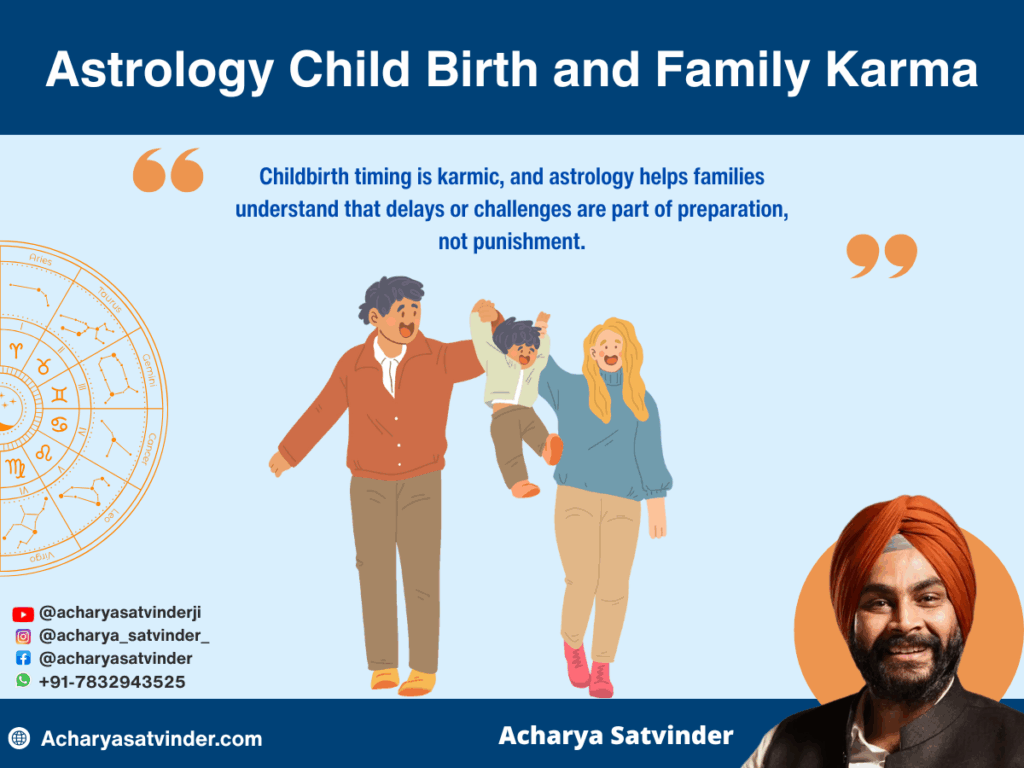
Responsible astrology avoids fear-based interpretations. It encourages acceptance, emotional readiness, and conscious living.
Family karma unfolds at its own pace, and astrology helps people understand this timing.
Conscious Spiritual Responses Instead of Superstition
According to Acharya Satvinder Ji, astrology must never promote fear, shortcuts, or superstition.
Vedic wisdom supports conscious spiritual responses that strengthen the mind rather than promise miracles.
Helpful practices include naam simran for emotional balance, daan done with humility, seva within the family, and a disciplined lifestyle.
These practices do not change destiny but help individuals walk their destined path with clarity and peace.
How Parent Child Relationship Astrology Helps Families Grow
Parent child relationship astrology empowers families by reducing blame and increasing understanding.
When parents recognize that their child’s behavior is karmic rather than personal, patience naturally grows.
When children understand their parents’ limitations, emotional resistance softens.
Astrology helps families shift from reaction to awareness, from expectation to acceptance, and from conflict to conscious effort.
Conclusion
Parent child relationship astrology is a guiding science rooted in Vedic wisdom.
It does not predict conflict or promise perfect harmony. Instead, it explains why relationships unfold the way they do and how karmic patterns shape emotional bonds between parents and children.
By understanding planetary influences, emotional roles, and karmic lessons, families can respond with patience, discipline, and compassion.
As taught by Acharya Satvinder Ji, life’s direction is decided at birth, but awareness decides how peacefully we walk that path.
FAQs
What is parent child relationship astrology?
Parent child relationship astrology explains the emotional and karmic bond between parents and children using a birth chart. It shows why love, distance, discipline, or misunderstandings exist. Astrology does not blame anyone; it helps families understand roles, emotional patterns, and life lessons decided at birth.
Which planets affect the parent-child relationship most?
The Moon, Sun, and fifth house play the biggest role in parent child relationship astrology. The Moon shows emotional bonding, the Sun represents authority and guidance, and the fifth house reflects children and past-life karma. Their strength or weakness explains closeness, expectations, and emotional challenges.
How does astrology explain conflict between parents and children?
Astrology explains conflict as karmic lessons rather than personal failure. Certain planetary placements create emotional gaps, strict behavior, or sensitivity. These patterns are meant to teach patience, understanding, and emotional maturity. When families see conflicts as karmic, reactions reduce and awareness increases naturally.
Can parent child relationship astrology improve understanding?
Yes, parent child relationship astrology improves understanding by explaining emotional differences and expectations. It helps parents respond wisely instead of reacting emotionally. Children also gain clarity about parental behavior. Astrology guides awareness and discipline, which gradually improves communication and emotional balance within the family.
What does mother child relationship astrology reveal?
Mother child relationship astrology focuses mainly on the Moon. It reveals emotional comfort, care, and mental bonding between mother and child. A strong Moon shows emotional support, while a weak Moon may show sensitivity or distance. Astrology helps mothers and children understand emotional needs better.
How does father child relationship astrology work?
Father child relationship astrology is mainly seen through the Sun and ninth house. It explains discipline, guidance, authority, and value systems. A strong Sun reflects leadership and support, while challenges may show ego clashes or emotional distance. These patterns are karmic lessons for growth.
Is parent and child astrology compatibility about zodiac signs?
Parent and child astrology compatibility is not about matching zodiac signs. It is about understanding emotional roles and karmic responsibilities. Some children are born to challenge parents, while others bring emotional healing. Compatibility charts help identify learning areas, not judge relationships as good or bad.
Can astrology change parent-child problems?
Astrology does not change destiny or erase problems. It helps people understand timing, emotional patterns, and karmic direction. According to Acharya Satvinder Ji, awareness, discipline, seva, and naam simran strengthen the mind. This conscious approach helps families handle challenges peacefully and wisely.

Acharya Satvinder is a spiritual guide and life mentor who blends Sikh astrology, philosophy, and coaching to help you find clarity, balance, and purpose. He offers personalized guidance for career, relationships, stress, and spiritual growth — empowering you to unlock your true potential.
With over 20 years of experience, Acharya Satvinder is regarded as one of the most respected and Best astrologers in India for his ethical and disciplined approach. Each year, he guides more than 10,000 individuals through his teachings and consultations, including extensive one-to-one sessions with followers across India, Canada, USA and the global NRI community. His guidance explains discipline, conscious decision-making, seva, and inner clarity as the foundation of meaningful growth.